
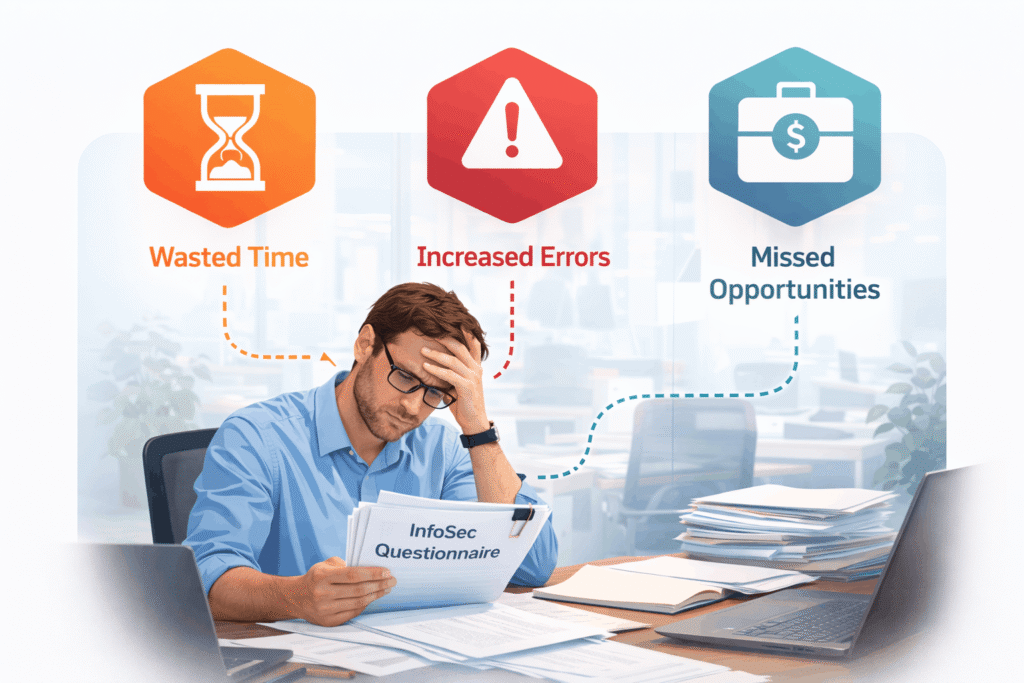

The cost of security questionnaires is often underestimated. Most organisations view them as a routine part of vendor assessments, customer due diligence, and security reviews. But what appears to be a simple questionnaire can quickly become a significant operational burden for security, compliance, sales, and engineering teams.
Every questionnaire requires gathering information, validating responses, coordinating with subject matter experts, reviewing security controls, and ensuring consistency across answers. As organisations grow, the volume of incoming questionnaires increases, turning what was once a manageable task into a recurring drain on resources.
The challenge isn’t just the hours spent filling out forms. The true cost of security questionnaires includes delayed sales cycles, interrupted engineering work, compliance bottlenecks, inconsistent responses, and missed business opportunities. When teams rely on manual processes, these hidden costs accumulate quickly and can impact both revenue and productivity.
For organisations receiving dozens, or even hundreds, of security questionnaires each year, the financial impact can be substantial. Understanding these costs is the first step toward improving efficiency and building a more scalable approach to security reviews.
In this article, we’ll break down the hidden cost of security questionnaires, explore where these expenses originate, and discuss strategies organisations can use to reduce them.
What Is the Actual Cost of Security Questionnaires?
Many organisations assume the cost of security questionnaires is limited to the time required to fill out forms. In reality, the cost extends far beyond the security team’s effort. Each questionnaire requires collaboration across multiple departments, including security, compliance, legal, IT, engineering, and sales. As questionnaire volumes increase, these costs compound rapidly.
The challenge is that most organisations do not track the true cost of responding to security questionnaires. While a single questionnaire may seem manageable, handling dozens or hundreds each year can consume hundreds of hours of valuable employee time and create bottlenecks that delay customer onboarding and revenue generation.
The table below illustrates the typical costs associated with manually responding to a single security questionnaire:
| Cost Component | Typical Time Required | Potential Business Impact |
|---|---|---|
| Security Team Review | 4–8 hours | Diverts security staff from strategic initiatives and risk management activities |
| Engineering Input | 1–4 hours | Interrupts development work and creates costly context switching |
| Compliance & Legal Review | 1–3 hours | Delays approvals and increases administrative overhead |
| Sales Team Coordination | 1–2 hours | Slows deal progression and customer communication |
| Follow-Up Questions | 1–3 hours | Extends review cycles and increases workload |
| Response Validation & Updates | 1–2 hours | Requires ongoing effort to ensure accuracy and consistency |
| Opportunity Cost | Difficult to quantify | Delayed projects, slower innovation, and reduced productivity |
For example, if an organisation receives 15 security questionnaires per month and spends an average of 10 hours on each questionnaire, that’s 150 hours every month, or 1,800 hours annually. Assuming an average blended employee cost of $75 per hour, the direct labour expense alone exceeds $135,000 per year.
And that’s before accounting for hidden costs such as delayed sales cycles, lost opportunities, employee burnout, and the disruption caused when subject matter experts are repeatedly pulled away from high-value work.
The actual cost of security questionnaires is not measured solely in labour hours. It is the cumulative impact on productivity, revenue, customer experience, and organisational efficiency. Understanding these costs is essential for organisations looking to scale their security review processes without overwhelming internal teams.
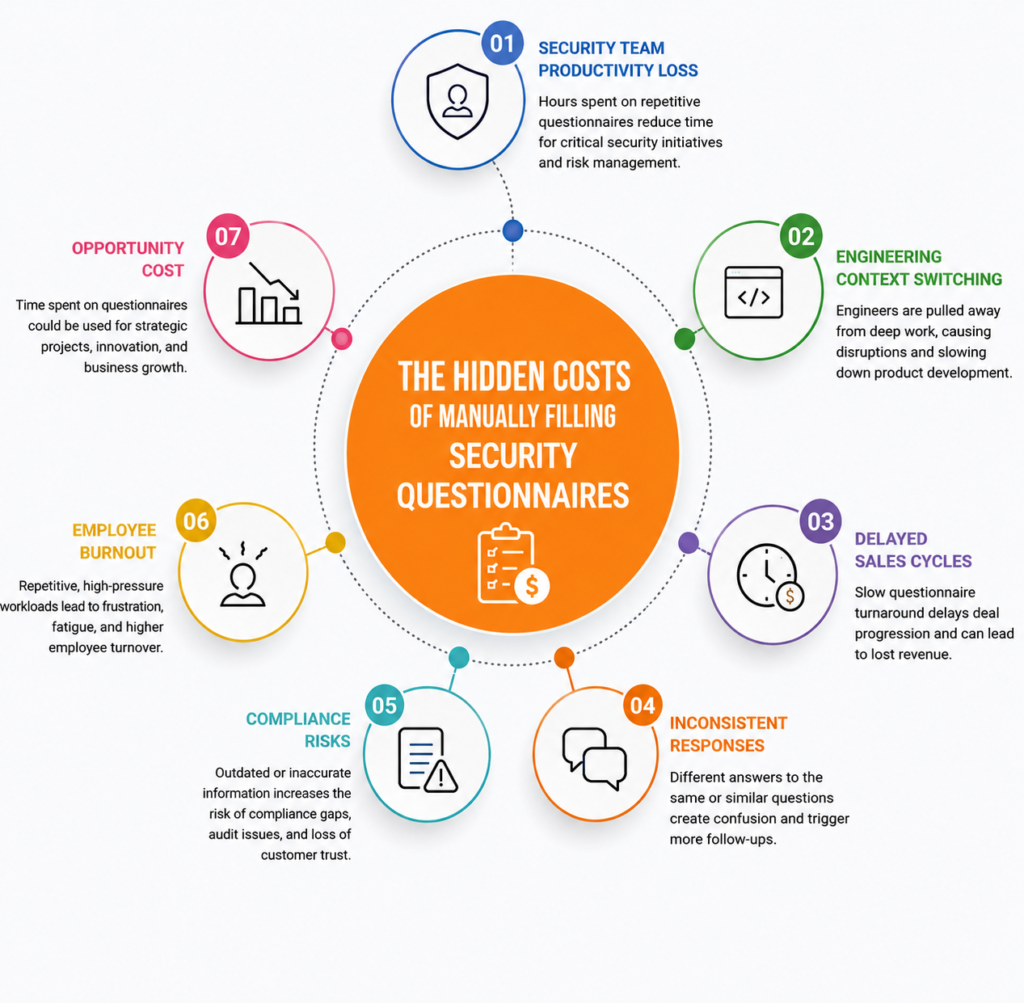
The 7 Hidden Costs of Security Questionnaires
Security questionnaires are often viewed as a routine part of vendor assessments and procurement reviews. However, the true cost of security questionnaires extends far beyond the time spent answering questions. Every questionnaire requires coordination, validation, and follow-up from multiple teams, creating hidden expenses that can impact productivity, revenue, and business growth.
Let’s explore the seven hidden costs organisations often overlook.
1. Security Team Productivity Loss
Security teams are responsible for protecting the organisation, managing risks, improving security posture, and supporting compliance initiatives. When security professionals spend hours repeatedly answering similar questionnaire questions, they have less time to focus on strategic priorities.
Many questionnaires contain hundreds of questions covering topics such as access controls, encryption, incident response, compliance certifications, and data protection practices. While the questions may be similar from one customer to another, teams often find themselves manually searching for information and rewriting responses.
Over time, this administrative burden reduces the capacity of security teams to work on higher-value activities such as security improvements, threat detection, risk assessments, and compliance programmes.
2. Hidden Engineering Costs
Security questionnaires rarely involve the security team alone. Complex or highly technical questions frequently require input from engineering, infrastructure, DevOps, product, and IT teams.
Every time an engineer is pulled into a questionnaire review, they must pause their current work, gather the requested information, and then return to their original task. This process, known as context switching, can significantly reduce productivity.
Research consistently shows that regaining focus after an interruption can take substantial time. Even if an engineer spends only 15 minutes answering a questionnaire-related question, the overall productivity impact is often much greater.
For organisations handling multiple questionnaires each month, these interruptions can slow product development, delay feature releases, and reduce engineering efficiency.
3. Delayed Sales Cycles
Security reviews have become a standard part of B2B buying decisions, particularly for enterprise customers. Before signing a contract, many prospects require vendors to complete detailed security questionnaires.
When responses take days or weeks to prepare, deals can stall.
Sales teams are often forced to wait for questionnaire completion before moving opportunities forward. Prospects may delay purchasing decisions, procurement processes may slow down, and competing vendors may gain an advantage by responding more quickly.
In some cases, lengthy questionnaire turnaround times can result in lost revenue altogether. A delayed security review can become a delayed deal.
For companies with enterprise-focused sales strategies, slow questionnaire responses directly impact pipeline velocity and revenue growth.
4. Inconsistent Responses
When questionnaire responses are created manually, consistency becomes difficult to maintain.
Different team members may answer the same question differently depending on their interpretation, available information, or level of expertise. Over time, organisations may accumulate multiple versions of responses to identical security questions.
These inconsistencies can create confusion for customers and raise concerns during vendor assessments. In some cases, conflicting answers may trigger additional follow-up questions, extending the review process even further.
Maintaining a centralised and approved repository of security responses is critical for ensuring accuracy and consistency across all questionnaires.
5. Compliance Risks
Security questionnaires often include questions related to regulatory compliance, industry standards, and internal security controls.
Providing outdated, incomplete, or inaccurate information can introduce compliance risks. For example, a response that references an old security policy, expired certification, or outdated control may create discrepancies between documented practices and actual operations.
As organisations scale, keeping questionnaire responses aligned with evolving security programmes becomes increasingly challenging.
The more questionnaires a company handles manually, the greater the likelihood of errors that could impact audits, customer trust, or compliance obligations.
6. Employee Burnout
Security questionnaire management is often repetitive, time-consuming, and difficult to scale.
Security teams frequently face pressure from customers, sales teams, compliance teams, and leadership to complete questionnaires quickly. When questionnaire volume increases, workloads can become overwhelming.
Employees may spend hours responding to repetitive questions that provide little strategic value. Over time, this can contribute to frustration, reduced job satisfaction, and burnout.
Burnout not only affects employee well-being but can also lead to reduced productivity, higher turnover, and increased recruitment costs.
Organisations that automate repetitive questionnaire tasks can help reduce administrative burdens and allow employees to focus on more meaningful work.
7. Opportunity Cost
Perhaps the most significant hidden cost of security questionnaires is opportunity cost.
Every hour spent manually responding to questionnaires is an hour that cannot be invested elsewhere.
Security leaders could be strengthening security controls. Engineers could be building new features. Compliance teams could be preparing for audits. Sales teams could be engaging with prospects.
While the direct labour costs of questionnaire completion are easy to measure, the value of the work that doesn’t get done is often much larger.
For growing organisations, opportunity cost can become one of the biggest barriers to scaling security operations efficiently. As questionnaire volumes increase, organisations must decide whether to continue dedicating valuable resources to repetitive administrative work or invest in processes and technologies that reduce the burden.
How AI Helps Reduce the Cost of Security Questionnaires
As security questionnaires become longer and more frequent, many organizations are finding that traditional, manual processes simply don’t scale. Security teams are forced to answer the same questions repeatedly, engineers are pulled into reviews, and sales cycles slow down while responses are being prepared.
This is where AI can make a significant difference.
Modern AI-powered security questionnaire solutions help organizations reduce the cost of security questionnaires by automating repetitive tasks, improving response accuracy, and enabling teams to complete reviews faster without sacrificing quality.
1. Answer Reuse Across Questionnaires
One of the biggest challenges in managing security questionnaires is the repetitive nature of the questions. While the wording may vary between customers, many questions ultimately seek the same information about security controls, compliance certifications, access management, data protection, and incident response procedures.
Instead of creating responses from scratch every time, AI can identify similar questions and automatically suggest approved answers from previous questionnaires.
This significantly reduces the time spent searching through documents, spreadsheets, and past responses, allowing teams to complete questionnaires much faster.
2. Building a Centralized Security Knowledge Base
Many organisations store security information across multiple locations, including policy documents, compliance reports, spreadsheets, internal wikis, and previous questionnaires.
AI-powered platforms can consolidate this information into a centralised knowledge base that serves as a single source of truth.
When a new questionnaire arrives, the system can automatically reference relevant documentation and approved responses, ensuring that teams have access to the most current information.
This not only saves time but also reduces the risk of outdated or conflicting responses.
3. Faster Response Generation
Manually completing a security questionnaire can take hours, or even days, depending on its complexity.
AI can accelerate this process by analyzing incoming questions and generating draft responses based on existing security documentation and previously approved answers.
Rather than spending time writing responses from scratch, security teams can focus on reviewing and validating AI-generated suggestions.
This dramatically reduces turnaround times and enables organisations to respond to customer security reviews more efficiently.
4. Reduced Dependence on Subject Matter Experts
Security questionnaires often require input from multiple stakeholders, including security leaders, engineers, compliance professionals, legal teams, and IT administrators.
As questionnaire volume grows, these subject matter experts (SMEs) can become overwhelmed by repeated requests for information.
AI helps reduce this burden by capturing institutional knowledge and making it readily accessible when needed. Instead of repeatedly consulting the same experts, organisations can leverage previously approved responses and documented expertise.
This allows SMEs to spend more time on strategic initiatives rather than repetitive administrative tasks.
5. Improved Response Consistency
Consistency is critical when responding to security questionnaires. Conflicting answers can create confusion, trigger additional follow-up questions, and potentially undermine customer trust.
AI-powered solutions help maintain consistency by drawing responses from a centralised repository of approved content. Teams can ensure that similar questions receive similar answers, regardless of who is completing the questionnaire.
This not only improves accuracy but also strengthens credibility during customer security reviews and vendor assessments.
6. Lower Costs, Faster Reviews, Better Outcomes
The true value of AI is not simply that it helps organisations answer questionnaires faster. It reduces the operational costs associated with security reviews, minimises disruptions across teams, and creates a more scalable process for managing growing questionnaire volumes.
By enabling answer reuse, building centralised knowledge bases, accelerating response generation, reducing SME involvement, and improving consistency, AI helps organisations transform security questionnaires from a resource-intensive burden into a streamlined and efficient workflow.
As security reviews continue to play an important role in enterprise buying decisions, organisations that leverage AI will be better positioned to reduce the cost of security questionnaires while improving both customer experience and operational efficiency.
Manual vs Automated Security Questionnaire Costs
As the volume and complexity of security questionnaires continue to grow, organisations are increasingly evaluating whether manual processes can keep up. While many teams still rely on spreadsheets, shared documents, and email-based collaboration, these methods become difficult to scale as questionnaire requests increase.
At first glance, manual processes may appear cost-effective because they do not require additional software investments. However, when organisations account for employee time, delayed sales cycles, repeated work, and operational inefficiencies, the actual cost of manual security questionnaire management can be substantial.
Automation changes this equation by reducing repetitive work, improving response accuracy, and enabling teams to complete questionnaires faster and with fewer resources.
The table below highlights some of the key differences between manual and automated approaches.
| Metric | Manual Process | Automated Process |
|---|---|---|
| Average Time per Questionnaire | 8+ hours | 30 minutes or less |
| Response Consistency | Medium | High |
| Other Department Involvement | Frequent | Minimal |
| Scalability | Poor | High |
| Answer Reuse | Limited | Extensive |
| Turnaround Time | Days or weeks | Hours or days |
| Risk of Errors | Medium | Lower |
| Employee Workload | High | Minimal |
| Sales Cycle Impact | Often delayed | Faster customer reviews |
| Operational Cost | Increases with volume | Decreases over time |
Why Manual Processes Become Expensive
Manual questionnaire management requires security teams to repeatedly search for answers, validate information, coordinate with stakeholders, and update responses. Even when similar questions have been answered before, teams often spend time locating previous responses and ensuring they are still accurate.
As questionnaire volume increases, costs rise almost linearly. More questionnaires require more hours, more stakeholder involvement, and more administrative effort.
For example, if a company receives 20 questionnaires per month and spends an average of 8 hours completing each one, that’s 160 hours of work every month. Across a year, this translates into nearly 2,000 hours dedicated to questionnaire management alone.
How Automation Changes the Economics
Automation fundamentally changes the cost structure of security questionnaire management.
Instead of creating answers from scratch, automated platforms leverage centralised knowledge bases, previously approved responses, and AI-assisted answer generation to complete much of the work automatically.
The result is a significant reduction in the time and effort required for each questionnaire.
Rather than involving multiple subject matter experts in every review, teams can focus on validating responses and addressing only genuinely new or unique questions.
This allows organisations to handle larger questionnaire volumes without increasing headcount or overwhelming internal teams.
Measuring the Return on Investment
One of the biggest advantages of automation is that its value can be quantified. Organisations can compare the hours spent manually responding to questionnaires against the time required with automation and calculate the resulting savings.
Factors to consider include:
Hours saved per questionnaire
Reduction in SME involvement
Faster sales cycles
Lower operational costs
Increased team productivity
Ability to handle more questionnaires without additional hires
To estimate the potential savings for your organisation, try Narad’s ROI Calculator and see how much time and money security questionnaire automation could save your team.
Frequently Asked Questions About the Cost of Security Questionnaires
1. What is the most effective way to reduce the cost of security questionnaires?
The most effective approach is to combine standardised security documentation, a centralised knowledge repository, and automation. AI-powered solutions can automatically suggest responses, reduce repetitive work, and minimise the need for repeated involvement from subject matter experts.
2. Can AI tools like Claude automate security questionnaires?
General-purpose AI tools such as Claude can help draft responses and summarise information, but they are not purpose-built for managing security questionnaires at scale. They typically lack features such as approved answer repositories, response governance, workflow management, version control, auditability, and questionnaire-specific automation.
Organizations evaluating AI-assisted security questionnaire workflows should understand the differences between general AI assistants and dedicated automation platforms. Learn more in our guide on Automation Tools vs. Claude for Security Questionnaires.
3. What are the best tools for automating security questionnaires?
The best solution depends on your organisation’s size, questionnaire volume, and security requirements. Dedicated security questionnaire automation platforms typically provide centralised answer libraries, AI-assisted response generation, workflow management, collaboration features, and reporting capabilities.
If you’re evaluating available solutions, explore our guide to the Best Tools to Automate Security Questionnaires to compare leading options and identify the right fit for your team.
4. Is security questionnaire automation worth the investment?
For organisations that regularly respond to customer security reviews, automation often delivers significant ROI through faster response times, improved consistency, reduced manual effort, and accelerated sales cycles. The larger the questionnaire volume, the greater the potential return.
Conclusion
The cost of security questionnaires extends far beyond the hours spent answering questions. What appears to be a routine security review often creates hidden costs across the organisation, including reduced productivity, engineering disruptions, compliance overhead, delayed revenue, and missed opportunities to focus on strategic initiatives.
As customer security requirements continue to grow, manual processes become increasingly difficult to sustain. Teams find themselves answering the same questions repeatedly, searching for information across multiple systems, and pulling subject matter experts away from higher-value work.
Organisations that adopt automation can significantly reduce these costs by centralising security knowledge, reusing approved responses, improving consistency, and accelerating questionnaire completion.
Whether you’re handling a handful of questionnaires each month or managing hundreds of customer security reviews annually, understanding the true cost of security questionnaires is the first step toward building a more efficient and scalable process.
Narad helps organisations automate security questionnaire responses, eliminate repetitive work, and accelerate customer security reviews using AI-powered automation.
Book a personalised demo today to see how Narad can help your team save time, reduce operational costs, and respond to security questionnaires faster and more accurately.