
4 Pillars for a Robust Fintech Compliance Program

Manoj Adwani
Founder, Narad

Fintech is a highly regulated industry where a solid compliance program is not just a regulatory requirement, but, it’s the foundation of long-term success. Fintech companies, by nature, deal with sensitive financial data, complex transactions, and a diverse range of clients and stakeholders. This environment makes fintech compliance both challenging and crucial.
As financial organisations become increasingly dependent on external technology and service providers, regulators are placing greater emphasis on third-party risk management. The Basel Committee has established principles for managing third-party risk, covering areas such as governance, due diligence, ongoing monitoring, concentration risk, and exit strategies.
Narad often deals with Fintech companies, and based on our extensive experience, we have identified four core pillars that form the foundation of a successful compliance program: Regulatory Compliance, Operational Compliance, Technology Compliance, and Reporting & Documentation Compliance.
Below, we’ll break down each pillar, explaining its importance, challenges, and best practices, and provide real-world examples to illustrate how these pillars work together to protect your business and build customer trust.
What Does a Strong Fintech Compliance Program Actually Look Like?
A strong fintech compliance program is more than a collection of policies, annual audits, and regulatory checklists. It is a structured, ongoing system for identifying risks, applying the right controls, monitoring compliance, and maintaining evidence that those controls are working.
As fintech companies grow, this becomes increasingly complex. More customers, employees, technology systems, and third-party vendors mean more risks to assess and more compliance requirements to manage. A process that worked with spreadsheets and shared folders at an early stage can quickly become difficult to scale.
An effective fintech compliance program should help an organisation:
Understand the regulations and compliance requirements that apply to the business.
Build clear policies, controls, and accountability into day-to-day operations.
Assess and manage risks introduced by vendors and other third parties.
Protect sensitive customer and financial data through strong security controls.
Maintain accurate, accessible evidence for audits and regulatory reviews.
Monitor risks and compliance continuously rather than only at audit time.
The strongest compliance programs connect these activities instead of managing them in isolation. Regulatory requirements inform internal controls. Controls guide risk assessments. Assessments generate evidence. And ongoing monitoring helps teams identify gaps before they become larger compliance or security issues.
For fintech companies, this connected approach is particularly important. The goal is not simply to pass the next audit, but to build a compliance program that can keep pace with the business as it grows.
The following four pillars provide the foundation for building that kind of robust, scalable fintech compliance program.
4 Pillars of a Fintech Compliance Program
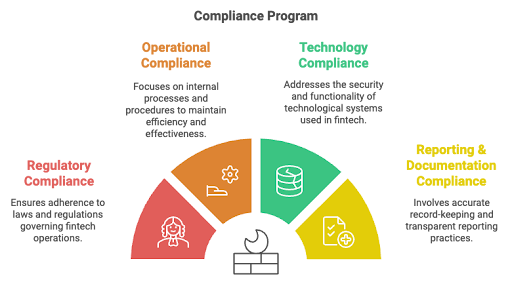
1. Regulatory Compliance
Why Regulatory Compliance Matters
Fintech firms operate under a complex web of financial regulations that vary by country, jurisdiction, and the services they offer. Regulatory compliance is about ensuring that the company’s practices, policies, and procedures align with these legal standards. Failure to comply with regulations can lead to hefty fines, reputational damage, and, in extreme cases, the shutdown of business operations.
Key Areas of Regulatory Compliance
- Anti-Money Laundering (AML) and Know Your Customer (KYC): Fintech companies are required to implement rigorous KYC checks to prevent fraudulent activity and money laundering. These include verifying customer identities and monitoring transactions for suspicious activity.
- Data Protection and Privacy: Compliance with GDPR, CCPA, and other privacy regulations is essential for fintech companies to ensure data security and customer privacy.
To understand an example, read our story of Singhealth data breach, and lessons learnt.
- Payment Card Industry Data Security Standards (PCI DSS): For companies handling credit card information, PCI DSS compliance is necessary to protect customer payment data.
Best Practices for Regulatory Compliance
- Regular Training: Keep your team updated on the latest regulations with frequent compliance training.
- Automated Alerts: Set up alerts for regulatory changes relevant to your industry and region.
- Thorough Documentation: Record all compliance activities, from KYC checks to data privacy protocols, to ensure a comprehensive compliance trail.
2. Operational Compliance
What Operational Compliance Involves
Operational compliance is the implementation of compliance policies in day-to-day operations. It ensures that every function within the company, from customer service to finance to human resources, adheres to the company’s regulatory standards.
Areas Covered by Operational Compliance
- Employee Conduct and Training: Every employee needs to understand their role in maintaining compliance. This includes following procedures, adhering to ethical guidelines, and reporting violations.
- Transaction Monitoring: Monitoring customer transactions helps detect suspicious or illegal activities. Fintech companies often use transaction monitoring systems to identify unusual patterns or large, unexpected transactions.
- Third-Party Vendor Management: Operational compliance extends to vendors and service providers. Fintech companies must assess the compliance practices of their vendors, especially those handling sensitive data or financial services on behalf of the company.
Third-Party Risk Is Now a Core Fintech Compliance Challenge
Fintech companies rarely operate alone. They rely on cloud providers, payment processors, SaaS platforms, data providers, KYC vendors, cybersecurity tools, and other third parties to run critical parts of their business. Every new vendor can also introduce new risks.
A third party may process sensitive customer data, access critical systems, or support an essential business function. A security incident, compliance failure, or operational disruption at that vendor can quickly become your problem too. This is why third-party risk management (TPRM) has become an important part of a modern fintech compliance program.
Effective TPRM goes beyond collecting a security questionnaire during vendor onboarding. Fintech organisations need a structured process to:
Maintain a central inventory of third-party vendors.
Classify and tier vendors based on their access, criticality, and potential risk.
Conduct vendor risk assessments and due diligence before onboarding.
Collect and review relevant security and compliance evidence.
Identify risks and track remediation actions.
Monitor critical vendors throughout the relationship.
The challenge is that these processes are often managed through spreadsheets, emails, shared folders, and repeated follow-ups. As the vendor ecosystem grows, this approach becomes difficult to manage and leaves compliance teams with limited visibility into their overall third-party risk exposure.
This is where dedicated Third-Party Risk Management (TPRM) software can help. A platform like narad centralises vendor information, standardises risk assessments, and gives security and compliance teams greater visibility across the vendor lifecycle. By reducing manual tracking and repetitive administrative work, teams can spend more time evaluating actual risk rather than managing the process around it.
For fintech companies, third-party risk management should, therefore, be treated as an ongoing compliance discipline, not a one-time vendor onboarding exercise.
Best Practices for Operational Compliance
- Clear Communication: Make sure all employees understand compliance policies and their role in upholding them.
- Automated Tracking: Use technology to monitor transactions and flag potential violations.
- Vendor Audits: Conduct regular assessments of vendors to ensure they meet your compliance standards.
3. Technology Compliance
Why Technology Compliance Is Critical in Fintech
Key Aspects of Technology Compliance
- Cybersecurity: Fintech companies must implement security measures to protect against unauthorized access and data breaches. This includes encryption, firewalls, and regular security audits.
- Data Protection: Protecting sensitive customer information is paramount. Technology compliance includes data encryption, data masking, and secure data storage practices.
- Software Validation and Testing: Ensuring that all technology systems function as intended, especially after updates or modifications, is vital to avoid security risks.
Best Practices for Technology Compliance
- Regular Security Audits: Perform audits to identify and address any vulnerabilities in your technology infrastructure.
- Data Encryption: Encrypt all sensitive information to protect it from unauthorized access.
- Access Controls: Limit access to sensitive information to only those employees who need it, reducing the risk of data leaks.
4. Reporting and Documentation Compliance
The Importance of Reporting and Documentation
Core Areas of Reporting and Documentation Compliance
- Incident Reporting: Timely reporting of incidents like data breaches or suspicious activities is crucial to demonstrate compliance with legal requirements.
- Audit Trails: Comprehensive documentation of all compliance activities, from employee training to transaction monitoring, provides a complete audit trail in case of an investigation.
- Performance Metrics: Tracking compliance performance metrics allows fintech companies to assess the effectiveness of their compliance program and make improvements as needed.
Best Practices for Reporting and Documentation Compliance
- Automate Reporting: Use compliance software to automate the generation and distribution of compliance reports.
- Automated Questionnaire Tools: The whole compliance industry uses ‘questionnaires’ to evaluate the other party’s security. Filling these questionnaires manually can be very time consuming, and boring in the long term. It’s best to use Security Questionnaire Automation tools to respond to the tedious questionnaires, while the compliance team can focus on more strategic tasks.
- Maintain Detailed Audit Logs: Keep detailed records of all compliance-related activities to demonstrate due diligence in case of an audit.
- Monitor Performance: Track and evaluate compliance metrics regularly to ensure your program’s effectiveness.
Fintech Compliance Checklist: Is Your Program Built to Scale?
A strong fintech compliance program needs to work beyond audit season. Use this checklist to identify gaps in your current processes and determine whether your compliance program can keep pace as your business, regulatory obligations, and third-party ecosystem grow.
| Compliance Area | What to Check | Key Question to Ask |
|---|---|---|
| Regulatory Requirements | Applicable laws, regulations, licences, and reporting obligations are identified and regularly reviewed. | Do we have a clear view of every regulatory requirement that applies to our business? |
| Policies & Controls | Policies and internal controls are documented, assigned to owners, and reviewed regularly. | Are our policies and controls actively maintained, or only updated before an audit? |
| Third-Party Risk Management | Vendors are inventoried, tiered by risk, assessed before onboarding, and monitored throughout the relationship. | Do we know which third parties pose the greatest risk to our organisation? |
| Vendor Due Diligence | Security questionnaires, due diligence questionnaires (DDQs), evidence, and certifications are reviewed before critical vendors are approved. | Can we consistently assess a vendor’s security and compliance posture before onboarding? |
| Data Security & Privacy | Sensitive customer and financial data is protected through appropriate access, security, and privacy controls. | Do we know who can access sensitive data and how it is protected? |
| Compliance Evidence | Policies, certifications, audit reports, and supporting evidence are centralised and kept up to date. | Can we quickly find the evidence needed for an audit or security review? |
| Security Questionnaires | Responses to customer security questionnaires, VRAs, DDQs, and RFPs are accurate, consistent, and based on approved information. | Are our teams repeatedly answering the same security and compliance questions manually? |
| Risk Remediation | Identified risks have clear owners, priorities, deadlines, and documented remediation actions. | Can we see which risks remain unresolved and who is responsible for addressing them? |
| Audit Trails & Approvals | Key assessments, decisions, changes, and approvals are documented and traceable. | Can we demonstrate who reviewed and approved a compliance decision—and when? |
| Continuous Monitoring | Compliance status, control effectiveness, and critical third-party risks are reviewed beyond initial assessments and annual audits. | Are we identifying emerging risks throughout the year, or only during periodic reviews? |
A fintech compliance program does not need to become more complicated as the business grows. The goal is to create repeatable processes, clear accountability, and continuous visibility into risk and compliance.
If several of these activities still depend heavily on spreadsheets, emails, manual follow-ups, or disconnected systems, it may be time to consider how automation and modern GRC software can help your compliance program scale more efficiently.
How narad Supports a Modern Fintech Compliance Program
As fintech companies grow, managing compliance through spreadsheets, emails, shared folders, and disconnected tools becomes increasingly difficult. narad brings critical GRC workflows together in one AI-powered platform, helping security and compliance teams reduce manual work and manage risk more efficiently.
At the core of the platform is Third-Party Risk Management (TPRM). narad helps fintech organisations centralise vendor information, streamline vendor onboarding and risk assessments, track remediation, and maintain greater visibility across their third-party ecosystem.
narad also uses AI to automate repetitive security and compliance reviews. Teams can complete security questionnaires, Vendor Risk Assessments (VRAs), Due Diligence Questionnaires (DDQs), and RFP responses up to 90% faster, using accurate, reference-backed answers generated from approved policies and compliance documents.
With the narad Trust Center, organisations can centralise policies, certifications, audit reports, and other compliance evidence in one place, making it easier to securely share approved information with customers, vendors, auditors, and other stakeholders.
Together, these capabilities help fintech teams simplify third-party risk management, accelerate security reviews, and maintain organised, audit-ready compliance processes as the business scales.
Conclusion
Building a strong fintech compliance program requires more than responding to regulatory requirements as they arise. It requires a connected approach to regulatory compliance, operational compliance, technology compliance, and reporting and documentation, supported by processes that can scale with the business.
As fintech organisations grow, so do their vendor ecosystems, security reviews, regulatory obligations, and evidence requirements. Manual processes that once worked can quickly become a source of delays, limited visibility, and unnecessary risk.
The strongest compliance programs combine clear governance with the right technology. By strengthening third-party risk management, automating repetitive security and compliance workflows, and keeping evidence organised and accessible, fintech companies can reduce administrative burden while maintaining greater control over risk.
Compliance should not simply help a fintech company pass its next audit. Done well, it becomes part of the infrastructure that enables the business to grow securely, build customer trust, and operate with confidence.
Conclusion
Compliance is a multi-faceted challenge in the fintech industry, but it’s also an opportunity to build trust and foster innovation. By focusing on the four pillars—Regulatory Compliance, Operational Compliance, Technology Compliance, and Reporting & Documentation Compliance—fintech companies can create a compliance framework that’s resilient, adaptable, and scalable. With tools like Narad, achieving comprehensive compliance becomes less of a burden and more of a competitive advantage.
By prioritizing these pillars and leveraging the right technology, fintech companies can stay ahead of regulatory changes, protect sensitive data, and demonstrate their commitment to ethical practices. Compliance doesn’t have to be a roadblock to growth; with the right approach, it can be a foundation for success.