
Fourth-Party Risk Management: Manage Indirect Vendor Risks
Key Takeaways
- Fourth-party risk management focuses on the risks introduced by the vendors and subcontractors your third-party suppliers depend on.
- Even without a direct contract, a fourth party’s security incident or service disruption can significantly impact your organisation.
- Understanding your vendors’ critical dependencies helps reduce supply chain, cybersecurity, and operational risks.
- Assessing high-risk vendors, monitoring subcontractors, and maintaining continuous visibility are key to managing fourth-party risk effectively.
- Modern TPRM platforms like Narad help organisations identify indirect vendor dependencies and monitor emerging risks across their extended supply chain.
Introduction
Modern businesses rarely rely on a single vendor to deliver a service. Your cloud provider may depend on another cloud infrastructure company, your payment processor may rely on a fraud detection platform, and your SaaS vendor may use several subcontractors behind the scenes. While you may never interact with these companies directly, their security, availability, and compliance can still have a significant impact on your business.
This hidden layer of dependencies is becoming increasingly important. According to the World Economic Forum’s Global Cybersecurity Outlook 2025, 54% of large organisations identify supply chain challenges as the biggest barrier to achieving cyber resilience, highlighting the growing risks posed by complex vendor ecosystems. As organisations become more interconnected, understanding risks beyond direct vendors is essential.
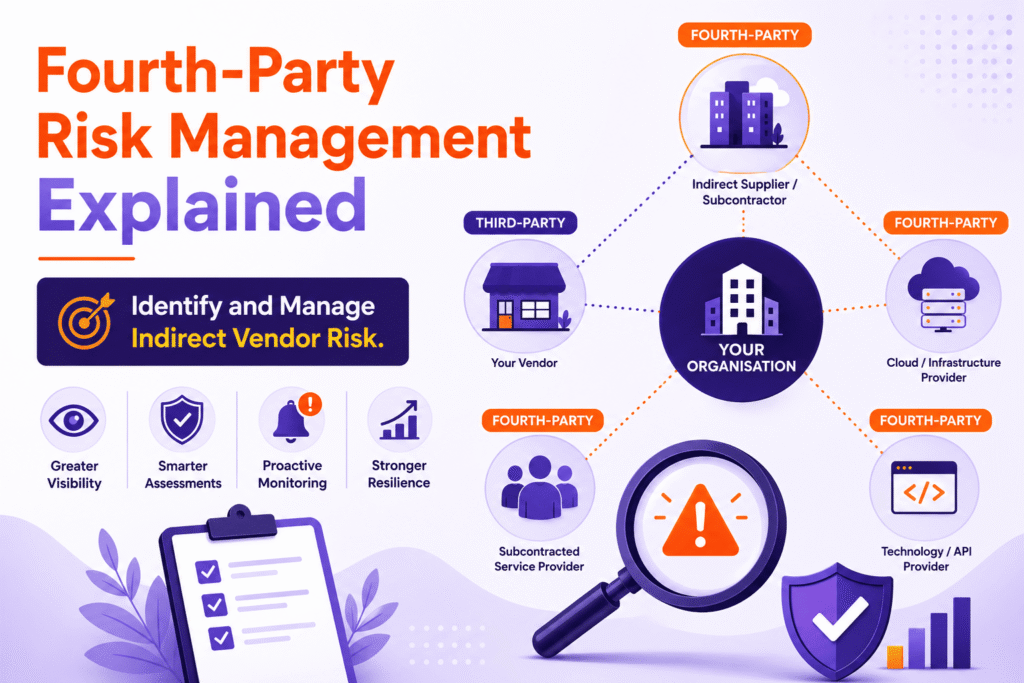
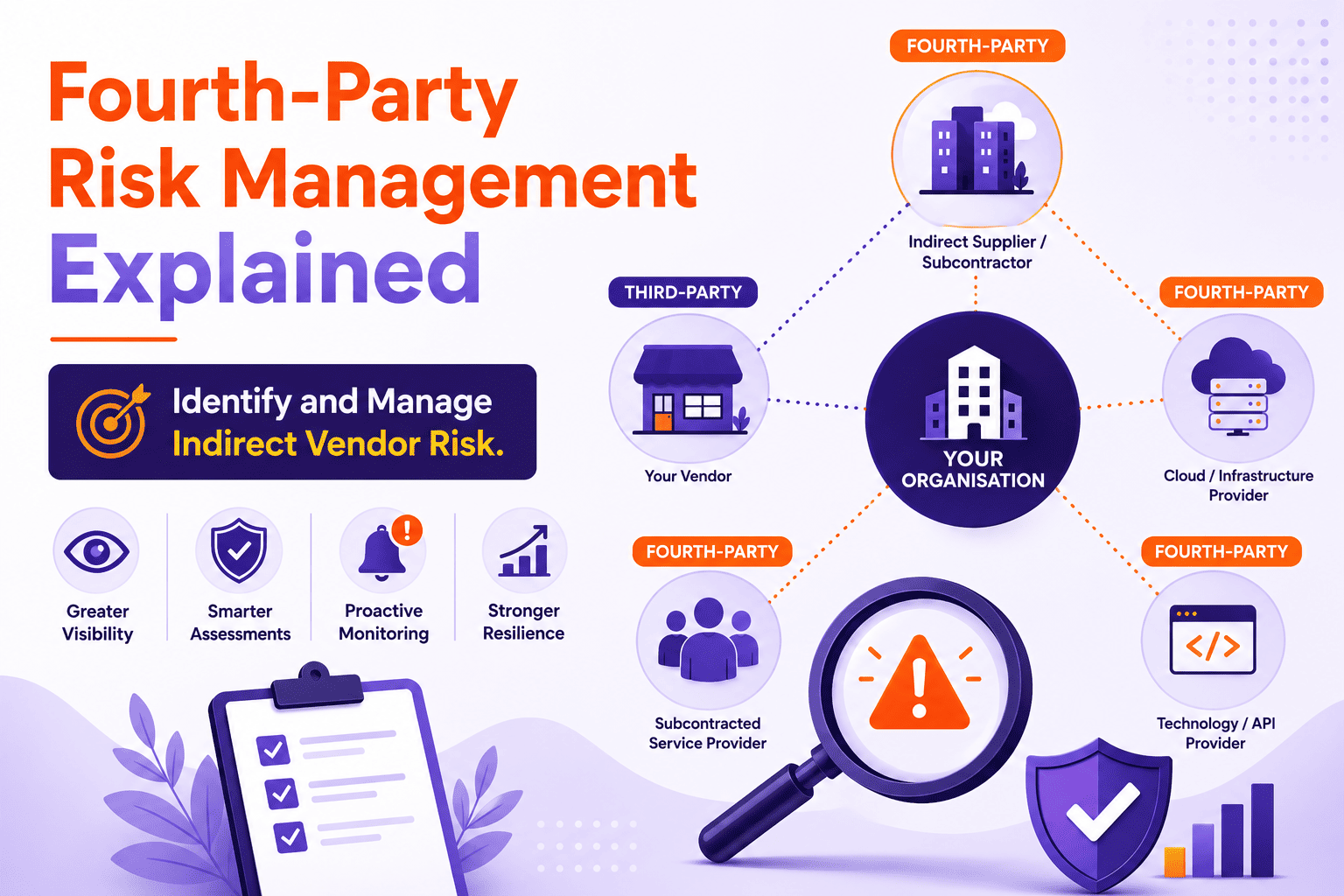
This is where fourth-party risk management comes in. It extends traditional third-party risk management by looking beyond your direct vendors to the subcontractors and service providers they rely on. Although you may not have a contract with these fourth parties, a security breach, system outage, or compliance failure affecting them can still disrupt your operations.
In this guide, we’ll explain what fourth-party risk is, how it differs from third-party risk management, why it matters, and the practical steps organisations can take to improve visibility across their extended supply chain.
Third-Party vs Fourth-Party Risk
Although the terms are closely related, third-party risk and fourth-party risk describe two different levels of your vendor ecosystem.
A third party is a company that your organisation works with directly. You have a contract, negotiate service agreements, and can perform security assessments before onboarding and throughout the relationship. Examples include cloud providers, payroll companies, managed service providers, software vendors, and payment gateways.
To better understand third-party risk management, read our article on why third-party risk management is important.
A fourth party, on the other hand, is a vendor that your third-party vendor depends on. You don’t have a direct contract with these organisations, which means you usually cannot assess them yourself or require them to complete security questionnaires. Despite this, any security incident, operational failure, or compliance issue affecting a fourth party can still impact your organisation through your third-party vendor.
The biggest difference between the two is visibility and control. Organisations have direct oversight of third parties but must rely on their vendors to manage and monitor fourth parties appropriately. This makes fourth-party risks more challenging to identify and often more difficult to respond to.
| Third-Party Risk | Fourth-Party Risk |
|---|---|
| Comes from vendors your organisation contracts with directly. | Comes from the vendors and subcontractors your third-party vendors rely on. |
| You can assess the vendor directly through questionnaires, audits, and reviews. | Assessment is usually indirect through vendor disclosures and ongoing monitoring. |
| Greater visibility into security, compliance, and operations. | Limited visibility and little direct control over security practices. |
| Managed through your TPRM program. | Managed by extending TPRM processes to understand critical vendor dependencies. |
Understanding this distinction helps organisations build a more resilient supply chain. While you may never manage every fourth party directly, identifying your vendors’ most critical dependencies allows you to prioritise risks, strengthen oversight, and reduce the impact of unexpected disruptions.
Examples of Fourth-Party Risks
Fourth-party risk exists in almost every vendor relationship, even if you don’t realise it. Your direct vendors often depend on multiple suppliers, cloud providers, subcontractors, and technology partners to deliver their services. If one of these underlying providers experiences an issue, your organisation can feel the impact despite having no direct relationship with them.
Here are a few common examples:
Fintech and Digital Banking
A fintech company uses a Know Your Customer (KYC) verification provider to onboard new customers. The KYC provider relies on a government identity verification API to validate official documents.
If that API becomes unavailable or experiences a prolonged outage, the KYC provider cannot complete identity checks. As a result, the fintech company is unable to onboard new customers, even though its own systems are functioning normally.
In this case, the government identity verification API is a fourth party.
Banking
A bank purchases core banking software from a trusted technology vendor. Behind the scenes, the software vendor hosts its application on a third-party cloud platform.
If the cloud provider experiences a security breach, configuration error, or regional outage, the banking platform may become unavailable, affecting customers and business operations.
Although the bank has no contract with the cloud provider, it still experiences the consequences of the disruption.
Insurance
An insurance company outsources claims processing to a specialist service provider. To manage large claim volumes, the provider subcontracts part of the data entry work to another company.
If the subcontractor accidentally exposes customer information through poor security practices, sensitive insurance data could be compromised.
Even though the insurer never hired the subcontractor directly, customers will still hold the insurer responsible for the data breach.
SaaS Software
A business uses a project management platform for day-to-day collaboration. The platform depends on a third-party email delivery service to send notifications and password reset emails.
If the email provider suffers an outage, users may stop receiving important alerts or be unable to reset their passwords, disrupting normal business operations.
Again, the organisation has no direct relationship with the email provider, but it still experiences the impact.
These examples demonstrate an important point: fourth-party risks can affect your business just as much as third-party risks. The difference is that organisations often have little visibility into these indirect relationships until something goes wrong.
Why Companies Overlook Fourth-Party Risk Management
Managing direct vendors is already challenging. Extending that visibility to your vendors’ suppliers and subcontractors is even more difficult. As a result, many organisations overlook fourth-party risk management until an incident exposes a hidden dependency.
Some of the most common reasons include:
Limited visibility into the supply chain
Most organisations know who they do business with, but they don’t always know who their vendors rely on. Without visibility into these downstream relationships, identifying fourth-party risks becomes extremely difficult.
Complex vendor ecosystems
Modern vendors often depend on multiple cloud providers, software vendors, subcontractors, and service partners. Mapping these relationships manually across hundreds of vendors is time-consuming and rarely practical.
Overreliance on vendor certifications
Many organisations assume that because a vendor is SOC 2 certified or ISO 27001 compliant, every subcontractor it works with follows the same security standards. In reality, a vendor’s suppliers may have very different security and risk management practices.
Limited contractual control
Unlike third-party vendors, organisations usually have no direct contract with fourth parties. This means they cannot send security questionnaires, request evidence, or enforce remediation activities directly.
Focus on vendor onboarding
Many TPRM programs prioritise assessing vendors before signing a contract but pay less attention to changes that happen afterwards. Vendors frequently introduce new subcontractors, migrate to different cloud providers, or change their infrastructure, creating new fourth-party risks over time.
Check out Narad’s automated TPRM Tool.
Manual processes don’t scale
Tracking vendor dependencies using spreadsheets and emails quickly becomes unmanageable as the number of vendors grows. Without automation, maintaining an accurate view of fourth-party relationships is nearly impossible.
How to Monitor Fourth-Party Risk Effectively
Unlike third-party vendors, you usually can’t assess fourth parties directly because you don’t have a contractual relationship with them. That doesn’t mean you should ignore them. Instead, organisations should build visibility into their extended supply chain by strengthening vendor due diligence, asking the right questions, and continuously monitoring critical dependencies.
Here are some practical ways to monitor fourth-party risk.
1. Identify Your Critical Vendors First
Not every vendor requires the same level of attention.
Start by identifying the vendors that have the biggest impact on your business. These are vendors that:
- Process sensitive customer or employee data
- Have access to critical systems
- Support essential business operations
- Provide infrastructure your organisation depends on
Once you’ve identified these high-risk vendors, focus your fourth-party risk management efforts on them first. Understanding the suppliers and subcontractors they rely on will deliver far more value than trying to map every dependency across your entire vendor ecosystem.
2. Ask Vendors to Disclose Their Critical Subcontractors
One of the simplest ways to improve visibility is to ask vendors about their own supplier network during onboarding and periodic reassessments.
Your vendor questionnaire should include questions such as:
- Which cloud providers host your services?
- Do you use subcontractors to deliver any part of the service?
- Which vendors process customer or sensitive data?
- Have you outsourced any critical business functions?
This information helps build a clearer picture of your extended supply chain and identifies where hidden dependencies may exist.
3. Assess How Vendors Manage Their Own Suppliers
Knowing who your vendor works with is only part of the process.
You should also understand how they manage those relationships.
Ask whether your vendors:
- Perform security assessments on subcontractors
- Require suppliers to meet recognised security standards
- Review subcontractors regularly
- Monitor security incidents affecting their supplier network
- Have a documented supplier risk management process
A vendor with a mature fourth-party risk management program is generally better prepared to identify and respond to emerging risks within its own supply chain.
4. Monitor Security Incidents and Public Advisories
Many fourth-party incidents become public before your direct vendor informs you.
Cybersecurity researchers, government agencies, and software vendors frequently publish breach notifications, vulnerability alerts, and security advisories that may affect organisations worldwide.
Keeping track of these announcements helps organisations identify whether any critical vendors (or their suppliers) have been impacted.
Continuous monitoring is especially valuable because vendor environments constantly change. New vulnerabilities, ransomware attacks, and supply chain compromises can occur at any time, not just during annual vendor reviews.
5. Review Vendor Dependencies Regularly
Vendor ecosystems are constantly evolving.
A software provider may:
- Change its cloud hosting provider
- Introduce new subcontractors
- Acquire another company
- Replace existing technology partners
- Expand operations into new regions
Each of these changes can introduce new fourth-party risks.
Reviewing vendor dependencies during annual assessments or whenever a significant business change occurs helps ensure your organisation maintains an accurate understanding of its extended supply chain.
6. Use Automation for Continuous Monitoring
Manually tracking fourth-party relationships quickly becomes impractical as your vendor ecosystem grows.
An organisation managing hundreds of vendors could potentially be exposed to thousands of indirect supplier relationships. Monitoring these dependencies through spreadsheets and email simply doesn’t scale.
Modern TPRM platforms automate much of this work by:
- Maintaining a centralised vendor inventory
- Recording critical supplier dependencies
- Automating vendor questionnaires
- Tracking security certifications and supporting evidence
- Alerting teams to new risks or changes within the vendor ecosystem
- Supporting continuous vendor reassessments
Automation doesn’t eliminate the need for human oversight, but it allows security and compliance teams to focus on analysing and mitigating risks instead of spending time collecting information manually.
FAQ
1. What is the difference between third-party and fourth-party risk?
Third-party risk comes from vendors you have a direct contract with, while fourth-party risk comes from the vendors those vendors rely on.
2. Do all organisations need fourth-party risk management?
Not necessarily. For many organisations, it isn’t practical to monitor every fourth party. A better approach is to focus on critical vendors that support essential business operations, handle sensitive data, or have access to important systems. Understanding the key suppliers these vendors depend on often provides the greatest value.
3. How can organisations identify fourth-party risks?
Start by asking critical vendors to disclose their major subcontractors, cloud providers, and infrastructure partners during vendor onboarding and periodic reviews. Reviewing how vendors manage their own suppliers and monitoring security advisories can also help identify emerging fourth-party risks.
4. Can you assess a fourth party directly?
In most cases, no. Since there is usually no direct contractual relationship, organisations cannot require fourth parties to complete security questionnaires or provide evidence. Instead, fourth-party risk is managed indirectly through vendor disclosures, supplier oversight, and continuous monitoring.
5. How is fourth-party risk managed in a TPRM program?
A mature TPRM program extends beyond direct vendor assessments by asking critical vendors about their supplier network, reviewing their subcontractor management practices, and monitoring significant changes or security incidents that could affect the wider supply chain.
Conclusion
As businesses become more connected, the risks they face extend beyond the vendors they work with directly. A disruption, security incident, or compliance failure affecting a vendor’s supplier can still impact your organisation, even without a direct contractual relationship.
That said, fourth-party risk management isn’t something every organisation needs to implement comprehensively from day one. For many businesses, understanding every downstream supplier across the entire vendor ecosystem isn’t practical or necessary.
A sensible approach is to start with your most critical vendors. The ones who handle sensitive data, support essential business operations, or provide core technology and infrastructure. Understanding the key suppliers these vendors depend on can provide valuable visibility into potential risks without creating unnecessary complexity.
As your third-party risk management (TPRM) program matures, you can gradually expand fourth-party oversight where it delivers the greatest value. The goal isn’t to map every supplier in your extended supply chain but to gain enough visibility into critical dependencies to make better-informed risk decisions and improve business resilience.