
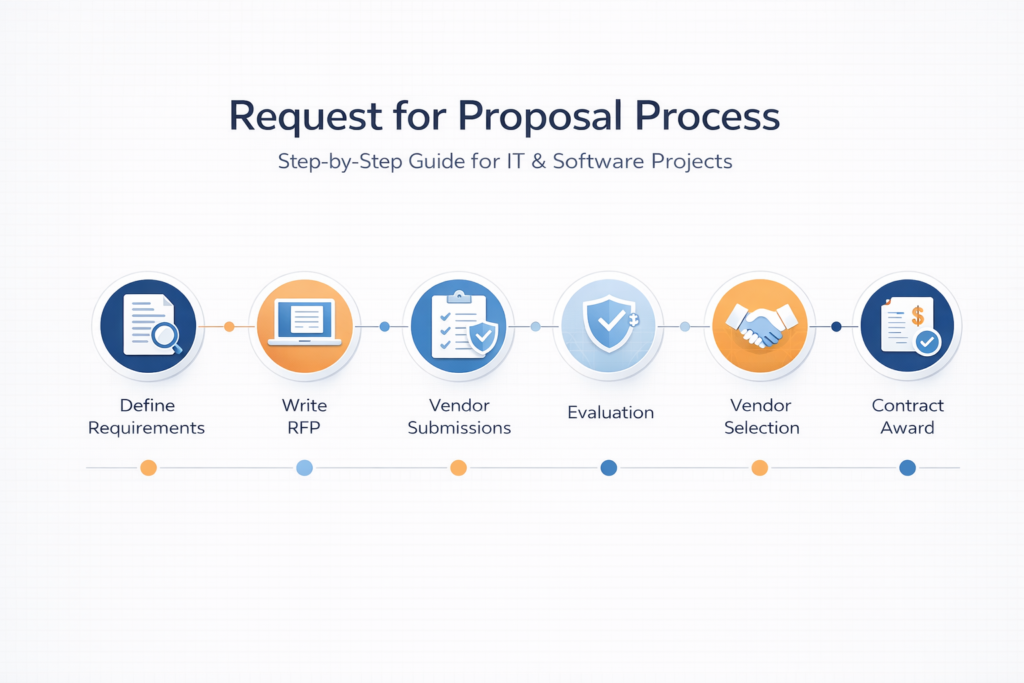
Request for Proposal Process: Step-by-Step Guide for IT & Software Projects
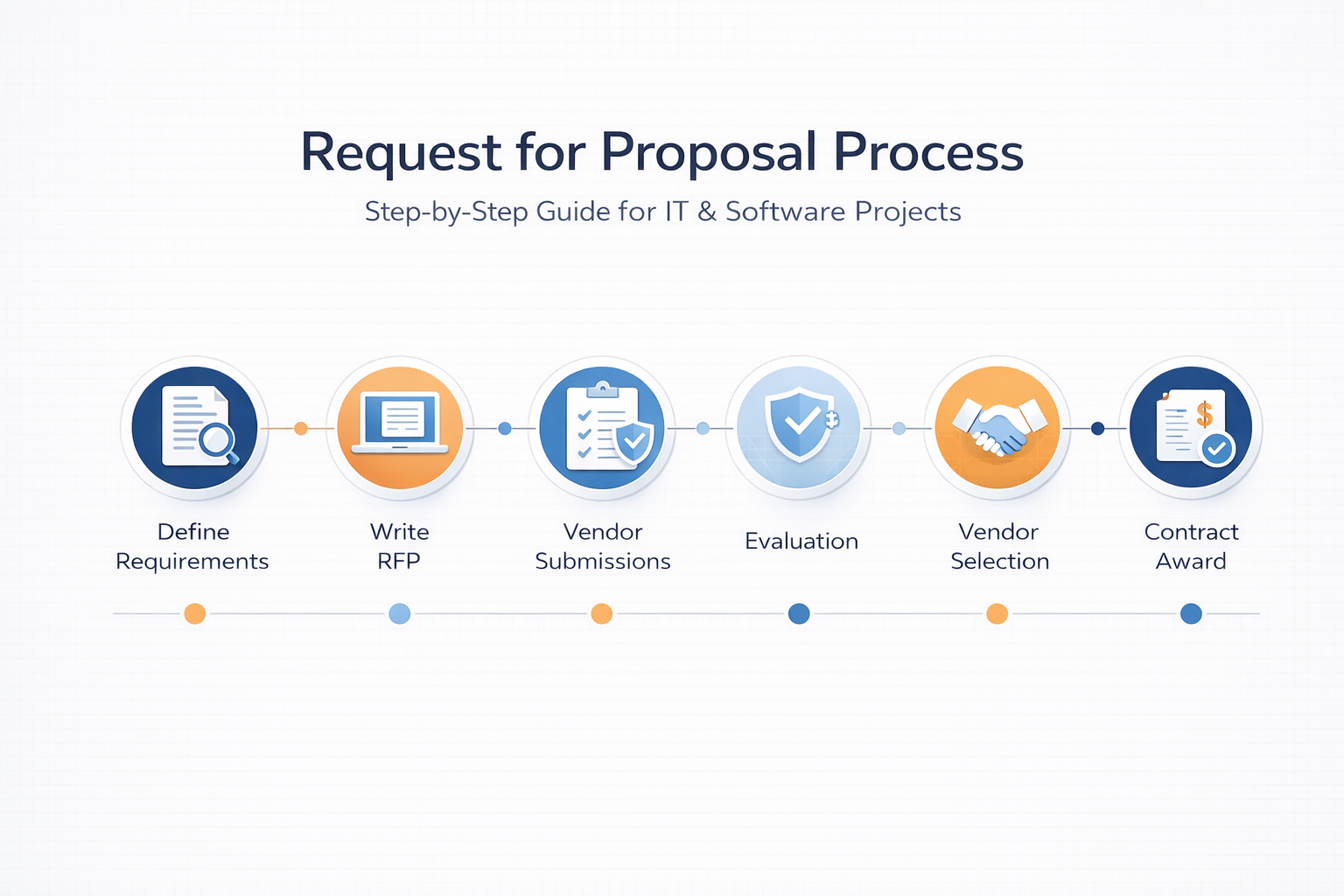
When your organization needs to hire an external vendor for an IT or software project, the request for proposal process is your most powerful tool for making the right choice. Whether you’re building a custom application, migrating to the cloud, or overhauling your cybersecurity infrastructure, a structured request for proposal process ensures you attract qualified vendors, compare them on equal terms, and ultimately select a partner who delivers real value.
In this guide, we walk you through every phase of the request for proposal process, from laying the groundwork to signing a contract, so your IT team can approach procurement with clarity and confidence.
What Is the Request for Proposal Process?
The request for proposal process (commonly referred to as the RFP process) is a formal procurement method organizations use to solicit detailed bids from multiple vendors for a specific project or service. Unlike a simple price quote, an RFP invites vendors to describe how they would approach your project, what technologies they would use, their team’s qualifications, timelines, and costs.
For IT and software projects, the request for proposal process is especially valuable because technology solutions are rarely one-size-fits-all. An RFP gives you a structured framework to objectively evaluate vendors based on their technical expertise, cultural fit, and long-term support capabilities and not just price.
Step 1: Define Your Project Needs & Goals
Every successful request for proposal process starts with internal clarity. Before you write a single word of your RFP document, your team needs to align on the core questions that will shape the entire procurement effort. You should be able to clearly articulate what problem you are solving or what opportunity you are pursuing, what the functional and non-functional requirements of the solution are, what your budget range and timeline look like, who the internal stakeholders involved in the decision are, and what success looks like at the 6-month, 1-year, and multi-year mark.
Skipping this step is the single biggest mistake organizations make in the request for proposal process. Vague requirements lead to vague proposals and ultimately to poor vendor selection.
Step 2: Assemble Your RFP Team
The request for proposal process is a team effort. Assemble a cross-functional group that includes IT leads or architects who understand the technical landscape, a project manager to coordinate timelines and communications, finance representatives to evaluate cost structures, legal counsel to review vendor contracts and IP terms, and end-user representatives who will actually use the solution daily.
Assigning roles early prevents bottlenecks when vendor proposals start coming in and ensures each section is evaluated by the right expert.
Step 3: Draft the RFP Document
Your RFP document is the centerpiece of the entire request for proposal process. A well-crafted RFP should be comprehensive yet clear, covering all the information vendors need to submit a meaningful proposal.
Start with a Company Overview that gives vendors background on your organization and the context of the project, followed by a Project Scope and Objectives section that describes in detail what you need to accomplish. The Technical Requirements section should specify your preferred tech stack, required integrations, security standards such as ISO 27001 or GDPR compliance, and performance benchmarks. You should also include a Vendor Qualifications section requesting years of experience, certifications, case studies, and references.
Round out the document with clear instructions on the Proposal Format vendors should follow, your Evaluation Criteria showing how you will score responses (for example, 40% technical approach, 30% cost, 20% experience, 10% support model), a Timeline with key dates including the questions deadline, submission due date, and decision date, and optional Budget Parameters so vendors can tailor realistic proposals.
Step 4: Identify & Shortlist Potential Vendors
Rather than sending your RFP to every vendor you can find, be strategic. Research vendors through industry databases, peer recommendations, LinkedIn, G2, Clutch, or Gartner reports. If you have multiple strong candidates, consider issuing a Request for Information (RFI) before the RFP to pre-qualify vendors.
Aim to invite 5–10 qualified vendors into the request for proposal process. Too few limits your comparison; too many makes evaluation overwhelming.
Step 5: Issue the RFP & Manage Vendor Q&A
Once your RFP document is ready, distribute it to shortlisted vendors via email, a procurement portal, or a secure document-sharing platform. Set a clear deadline for vendor questions and respond to all queries in a single compiled FAQ document shared with every participant, which keeps the request for proposal process transparent and fair.
Typical IT RFP timelines allow 2–4 weeks for vendors to prepare proposals, depending on complexity. Give vendors enough time to produce thoughtful, detailed responses.
Step 6: Evaluate Proposals with a Scoring Matrix
Objectivity is essential at this stage of the request for proposal process. Use a pre-defined scoring matrix and have each team member score proposals independently before group discussion. Evaluate each vendor on technical fit, understanding of your requirements, proposed methodology, team credentials, pricing and ROI, and post-implementation support.
After initial scoring, shortlist 2–3 top vendors for deeper engagement including demos, reference checks, and clarification calls.
Step 7: Conduct Vendor Presentations & Due Diligence
Invite your top finalists to present their proposals in person or virtually. This is your opportunity to assess the vendor’s depth of knowledge, communication style, cultural alignment, and how they handle tough questions. During this phase of the request for proposal process, also conduct reference checks, review past project case studies, and if the project is substantial, consider a technical proof-of-concept.
Step 8: Negotiate & Award the Contract
Once you’ve identified your preferred vendor, enter formal negotiations. Key areas to negotiate in IT contracts include payment milestones tied to deliverables, IP ownership and source code rights, SLAs (Service Level Agreements) for uptime and response times, data security and confidentiality clauses, and change order and scope creep management procedures.
After both parties agree, formalize the partnership with a signed Statement of Work (SOW) and Master Service Agreement (MSA). Notify unsuccessful vendors as well, as professionalism preserves future relationships.
Pro Tips for a Stronger Request for Proposal Process
A few practical principles will significantly strengthen your request for proposal process.
- Keep your RFP focused. An overly long document can discourage top-tier vendors from responding, so be thorough but not exhaustive.
- Standardize the response format. Asking all vendors to follow the same structure makes side-by-side comparisons far easier and more objective.
- Resist the temptation to decide on price alone. In IT and software projects, the cheapest proposal is rarely the best value over a 3 to 5 year horizon when you factor in quality, support, and scalability.
- Refine your templates. Treat each completed request for proposal process as a learning opportunity and refine your template for the next cycle.
- Involve legal counsel early. Ensure that IP ownership, liability, and confidentiality clauses are addressed before the RFP is distributed, not after.
Conclusion
A well-executed request for proposal process is not just a procurement formality. It is a strategic advantage. By following a structured, transparent, and data-driven approach, your organization can cut through vendor noise, reduce procurement risk, and forge partnerships that truly move your technology initiatives forward.
At Narad.io, we help IT teams and business leaders navigate the complexities of technology procurement and vendor management. Whether you need help designing your request for proposal process or evaluating vendor responses, we’re here to support your journey from requirements to go-live.
Ready to streamline your next IT procurement? Visit narad.io to explore our resources and services.