

The request for proposal process is a critical part of how IT and software companies win enterprise business. Whether you’re a SaaS provider, cybersecurity company, cloud services vendor, or software development firm, responding to RFPs is often necessary to compete for larger contracts and strategic opportunities.
For many vendors, however, the RFP process can quickly become overwhelming. A single proposal may require input from sales, product, engineering, security, compliance, legal, and customer success teams. Questions need to be answered accurately, supporting documents need to be gathered, and strict deadlines must be met. As organizations respond to more RFPs, managing this process efficiently becomes just as important as the quality of the solution being proposed.
A well-structured request for proposal process helps vendors do more than simply submit responses on time. It enables teams to showcase their expertise, communicate value clearly, address security and compliance requirements with confidence, and create a consistent buying experience for prospective customers. Companies that approach RFPs strategically often improve response quality, reduce internal effort, and increase their chances of making it to the final vendor shortlist.
In this guide, we’ll walk through the complete request for proposal process from a vendor’s perspective. You’ll learn how successful IT companies evaluate opportunities, coordinate internal stakeholders, manage security and compliance reviews, create compelling responses, and streamline the entire process to win more business while spending less time on repetitive administrative work.
What Is a Request for Proposal (RFP)?
A Request for Proposal (RFP) is a formal document issued by an organization to evaluate and select vendors for a specific project, product, or service. For IT and software companies, an RFP represents an opportunity to demonstrate expertise, showcase capabilities, and compete for new business.
An RFP typically includes the buyer’s business objectives, project requirements, technical expectations, security and compliance requirements, evaluation criteria, and submission guidelines. Vendors are expected to respond with detailed information about their solution, implementation approach, pricing, timelines, support model, and relevant experience.
Unlike a simple pricing request, an RFP gives vendors the opportunity to tell a complete story about how they can solve the customer’s problem. It allows companies to highlight their unique strengths, differentiate themselves from competitors, and build confidence with decision-makers.
As enterprise buying processes become more structured, RFPs have become a standard part of software procurement. Having a well-defined response process helps vendors submit stronger proposals, reduce response times, and improve their chances of winning competitive opportunities.
Read more: What is an RFP Document: A complete beginner’s guide.
What Is the Request for Proposal Process?
From a vendor’s perspective, the request for proposal process is the structured workflow used to evaluate, respond to, and manage RFP opportunities from prospective customers.
For IT and software companies, RFPs are often a critical part of enterprise sales. Large organizations typically use RFPs to compare multiple vendors, assess technical capabilities, review security and compliance practices, and determine which solution best meets their business requirements.
While many vendors view RFPs as administrative work, successful companies treat them as a strategic sales activity. A well-managed request for proposal process not only improves response quality but also increases win rates, shortens response times, and reduces the burden on internal teams.
The challenge is that responding to an RFP rarely involves a single department. Sales teams need product information. Security teams need to complete questionnaires. Legal teams review contractual terms. Engineering teams answer technical questions. Without a clear process, deadlines are missed, information becomes inconsistent, and valuable opportunities can be lost.
The following framework outlines how high-performing IT companies manage the request for proposal process from initial evaluation to contract award.
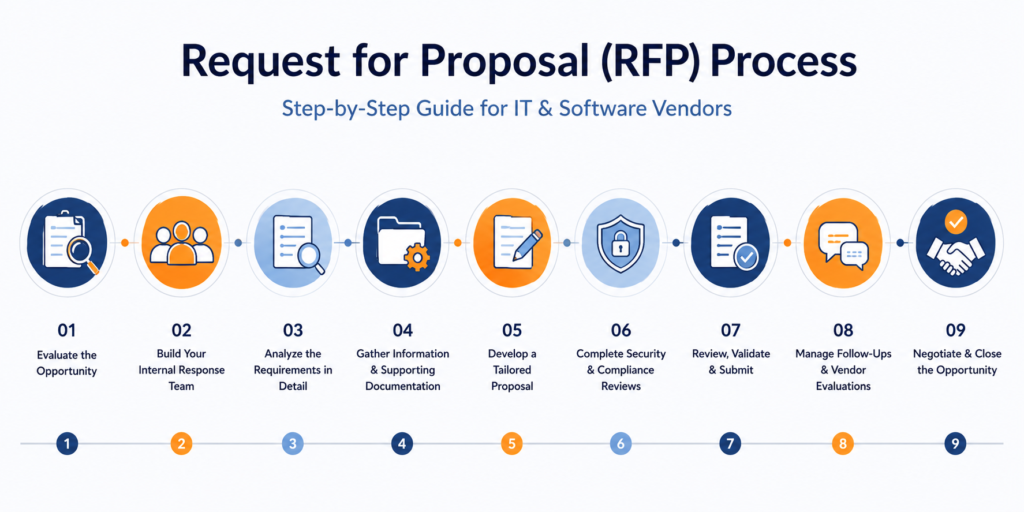
Step 1: Evaluate the Opportunity Before You Commit
One of the biggest mistakes software vendors make is responding to every RFP they receive.
Enterprise RFPs can consume significant time and resources. Depending on complexity, a single proposal may require dozens of hours from sales, engineering, product, security, compliance, and legal teams.
Before investing those resources, determine whether the opportunity is worth pursuing.
Review the RFP carefully and look for:
Alignment with your product capabilities
Industry fit
Budget indicators
Security and compliance requirements
Project timelines
Evaluation criteria
Competitive positioning
Ask yourself:
Can we realistically meet the customer’s requirements?
Do we have relevant experience?
Is the opportunity strategically valuable?
Can we differentiate ourselves from competitors?
Not every RFP deserves a response. Strong vendors focus their efforts on opportunities where they have a genuine chance of winning.
Step 2: Build Your Internal Response Team
Once you’ve decided to pursue the opportunity, assemble the right stakeholders.
Most enterprise RFPs require contributions from multiple departments, including:
Sales
Product Management
Engineering
Security
Compliance
Legal
Customer Success
Each team brings expertise that buyers expect to see reflected in the proposal.
Assign clear ownership from the beginning. Determine who will answer technical questions, who will manage security reviews, who will validate legal responses, and who will coordinate the overall submission.
Many organizations also designate a proposal manager or RFP owner responsible for tracking progress and ensuring deadlines are met.
Without clear ownership, response quality often suffers.
Step 3: Analyze the Requirements in Detail
Before answering a single question, take time to understand what the buyer is actually asking.
Many vendors rush directly into drafting responses and miss valuable insights hidden within the RFP document.
Review:
Business objectives
Technical requirements
Functional requirements
Security expectations
Compliance obligations
Evaluation criteria
Submission instructions
Pay particular attention to how proposals will be scored.
For example, some buyers prioritize technical capabilities while others place greater emphasis on implementation expertise, security maturity, customer references, or pricing.
Understanding these priorities allows your team to focus effort where it matters most.
The goal is not simply to answer questions. The goal is to demonstrate why your solution is the best fit.
Step 4: Gather Information and Supporting Documentation
Information gathering is often the most time-consuming phase of the request for proposal process.
A typical software RFP may require:
Product documentation
Architecture diagrams
Security policies
Compliance certifications
Customer case studies
Implementation methodologies
Service-level agreements
Business continuity plans
Unfortunately, this information is often scattered across multiple teams and systems.
Sales may have customer references.
Security may maintain compliance documentation.
Engineering may own technical architecture information.
The more centralized your knowledge repository is, the faster and more consistently your team can respond.
Organizations that maintain approved response libraries significantly reduce the effort required for future RFPs.
Step 5: Develop a Tailored Proposal
Many vendors make the mistake of treating RFPs as questionnaires.
Winning vendors treat them as opportunities to tell a compelling story.
While answering every requirement accurately is important, buyers are ultimately evaluating which vendor can help them achieve their business goals.
When drafting responses:
Focus on outcomes, not just features.
Use customer examples where possible.
Demonstrate understanding of the buyer’s challenges.
Highlight measurable results.
Explain implementation and support processes clearly.
Avoid generic marketing language.
The strongest proposals make it easy for evaluators to understand exactly how the solution addresses their requirements.
Step 6: Complete Security and Compliance Reviews
For modern software vendors, security reviews are often one of the most important parts of the request for proposal process.
Many enterprise buyers require vendors to complete:
Security questionnaires
Vendor risk assessments
Compliance reviews
Privacy assessments
Third-party risk evaluations
These reviews can significantly influence purchasing decisions.
In many cases, a technically strong proposal can still be delayed or rejected if security requirements are not addressed effectively.
To improve efficiency:
Maintain approved responses to common security questions.
Keep compliance documentation updated.
Centralize evidence and supporting materials.
Establish review workflows between security, compliance, and legal teams.
Organizations that streamline security reviews gain a significant competitive advantage because they can respond faster and with greater consistency.
Step 7: Review, Validate, and Submit
Before submission, conduct a comprehensive review of the proposal.
Verify:
Technical accuracy
Consistency across responses
Compliance with submission requirements
Formatting and completeness
Supporting documentation
This stage often uncovers inconsistencies that occur when multiple departments contribute to the same proposal.
A thorough review helps ensure that evaluators receive a professional, accurate, and complete response.
Once finalized, submit the proposal according to the customer’s instructions and confirm successful delivery.
Step 8: Manage Follow-Ups and Vendor Evaluations
Submitting the proposal is rarely the final step.
Buyers frequently request:
Clarification meetings
Product demonstrations
Technical workshops
Security review sessions
Additional documentation
Reference calls
The responsiveness of your team during this phase can influence the buyer’s perception as much as the proposal itself.
Respond quickly, provide accurate information, and maintain momentum throughout the evaluation process.
This is often where vendors separate themselves from competitors.
Step 9: Negotiate and Close the Opportunity
If shortlisted, the final phase typically involves commercial and contractual discussions.
Common negotiation topics include:
Pricing and commercial terms
Service-level agreements
Implementation timelines
Data security requirements
Intellectual property terms
Support obligations
Successful vendors enter negotiations with a clear understanding of both the customer’s priorities and their own non-negotiable requirements.
The objective is not simply to win the deal but to establish a partnership that sets both parties up for long-term success.
Once terms are finalized, the agreement is formalized through contracts such as a Master Service Agreement (MSA), Statement of Work (SOW), or subscription agreement.
At this stage, the request for proposal process is complete and the implementation journey begins.
Pro Tips for a Stronger Request for Proposal Process
A well-defined process can help your team respond to RFPs faster, improve proposal quality, and increase your chances of making the final shortlist. Here are a few practical tips that successful software vendors follow.
Be Selective About the Opportunities You Pursue
Not every RFP is worth the effort. Before committing resources, evaluate whether the opportunity aligns with your product capabilities, target market, budget expectations, and competitive strengths. A focused bid strategy often delivers better results than responding to every RFP that lands in your inbox.
Build and Maintain a Response Library
Many RFPs contain similar technical, product, security, and compliance questions. Maintaining a centralized repository of approved responses, supporting documents, case studies, and security evidence can dramatically reduce response times while improving consistency across submissions.
Tailor Responses Instead of Using Generic Content
Buyers can quickly identify copy-pasted responses. While reusable content is important, the strongest proposals are customized to address the customer’s specific requirements, business goals, and industry challenges. Demonstrating that you understand the buyer’s environment can significantly improve proposal quality.
Prepare Security and Compliance Documentation in Advance
For many software vendors, security reviews become the biggest bottleneck during the RFP process. Keep security questionnaires, compliance certifications, policies, audit reports, and supporting evidence organized and up to date. Being prepared can accelerate reviews and create a better experience for prospective customers.
Establish a Clear Internal Review Process
Before submitting any proposal, ensure technical, security, legal, and commercial stakeholders review the content. A structured review process helps identify inaccuracies, eliminate inconsistencies, and ensure the final submission accurately reflects your organization’s capabilities.
Continuously Improve Your Process
Every completed RFP provides valuable insights. Review what worked, identify recurring bottlenecks, and update your templates, response library, and workflows accordingly. Over time, these small improvements can significantly reduce effort while improving win rates.
How IT & SaaS Companies Are Automating the RFP Process
As RFP volumes continue to grow, many IT and SaaS companies are moving away from spreadsheets, email threads, and manual copy-paste workflows. Modern RFP automation platforms help teams centralize company knowledge, reuse approved responses, collaborate across departments, and respond to complex proposals significantly faster.
These platforms are particularly valuable when managing repetitive tasks such as completing security questionnaires, gathering compliance evidence, and coordinating responses from product, engineering, legal, and security teams. Instead of starting from scratch for every opportunity, teams can leverage existing knowledge and maintain consistency across submissions.
Many organisations are also extending beyond RFP automations; into areas such as security questionnaire automation and automated vendor risk assessment processes, helping reduce manual effort across the broader procurement and security review lifecycle.
Solutions such as Narad.io help software vendors streamline these workflows by organizing institutional knowledge, accelerating response generation, and reducing dependency on internal subject matter experts. As a result, many IT and SaaS companies have significantly reduced the time spent completing RFPs, security reviews, and vendor assessments while improving response quality and consistency.
Conclusion
A well-defined request for proposal process can be the difference between a rushed, inconsistent response and a proposal that stands out to enterprise buyers. As RFPs become more complex and security reviews become more demanding, software vendors need a repeatable process that helps teams collaborate efficiently, maintain response quality, and meet tight deadlines.
The most successful IT and SaaS companies don’t treat RFPs as one-off projects. They build systems, knowledge bases, and workflows that allow them to respond faster, reuse institutional knowledge, and reduce the burden on sales, security, engineering, and compliance teams.
If your team is spending too much time chasing answers, filling out repetitive questionnaires, or coordinating responses across departments, it may be time to rethink your approach.
At Narad, we’re helping software vendors streamline RFP responses, security questionnaires, and vendor assessments so teams can focus more on winning opportunities and less on administrative work.
Curious how other SaaS and IT companies are reducing response times? Schedule a quick conversation with our team and explore what’s possible.