
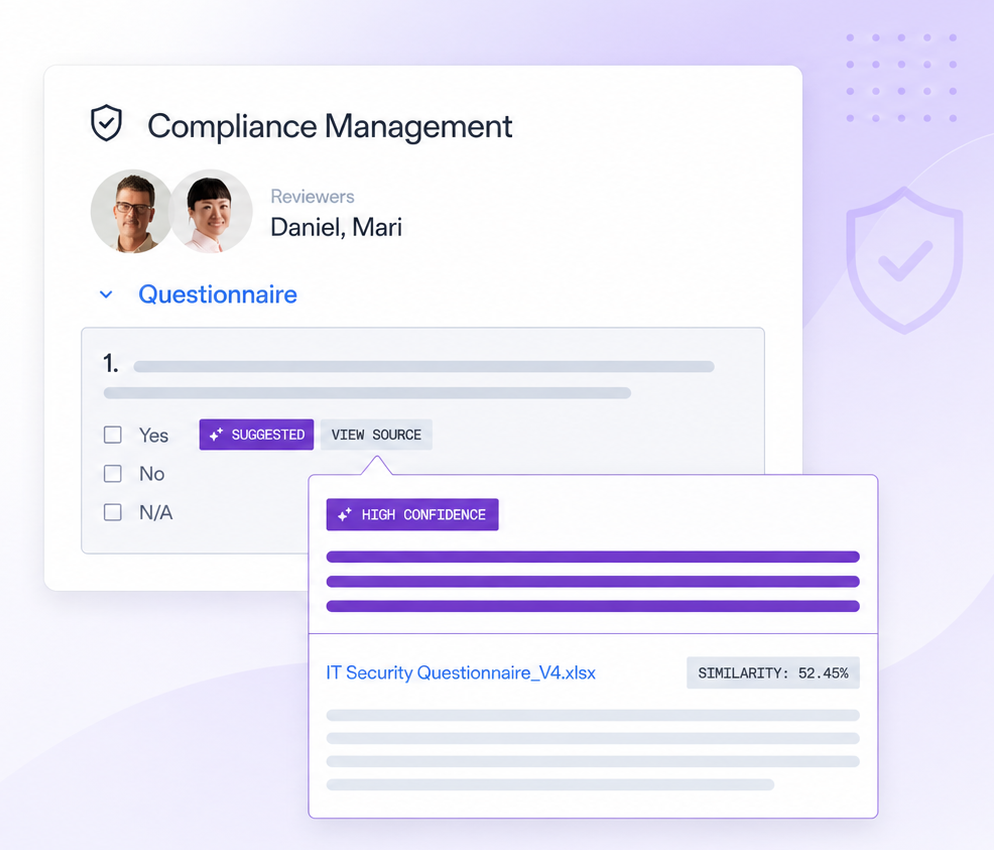
Banks, NBFCs, and insurers receive security questionnaires from regulators, enterprise clients, and auditors all at once. Security questionnaire automation software gives compliance teams a structured way to handle this volume without slowing down or losing consistency. This post breaks down what the software actually does and what to look for when evaluating it.
What Is a Security Questionnaire Automation Software?
Security questionnaire automation software is a platform that helps organisations respond to incoming vendor risk assessments, due diligence questionnaires, and compliance requests. It does this by combining a structured knowledge base with AI-assisted drafting and a workflow layer for review and approval.
In financial services, this term has a specific meaning. It refers to responding to questionnaires from different stakeholders. These may come from enterprise clients, auditors, or cloud and technology vendors. It also includes RBI-mandated third-party risk assessments. These checks are done before onboarding you as a customer.
The software does not write policy for you. It helps you use your existing policies to answer questions faster, more consistently, and with less manual effort.
Why Do Financial Services Teams Need Questionnaire Automation?
A compliance manager at a bank or NBFC is not just filling out one questionnaire at a time. In a given week, they might be responding to a client’s vendor due diligence form, a regulatory inspection checklist, an audit committee request, and an RFP security section.
Each of these comes in a different format. Each has its own deadline. And each one asks about the same underlying controls in completely different language.
Generic document management tools were not built for this. The trackers built on spreadsheets are not enough when the organisation has to answer thousands of questions. Shared drives with old response PDFs create version control problems and outdated answers.
The financial services context adds further pressure. The RBI’s guidelines on IT risk and cyber security, SEBI’s cybersecurity circular for regulated entities, and IRDAI’s IT framework for insurers all create a regulatory baseline that has to be reflected in every external response. A wrong or inconsistent answer is not just embarrassing; it can become an audit finding.
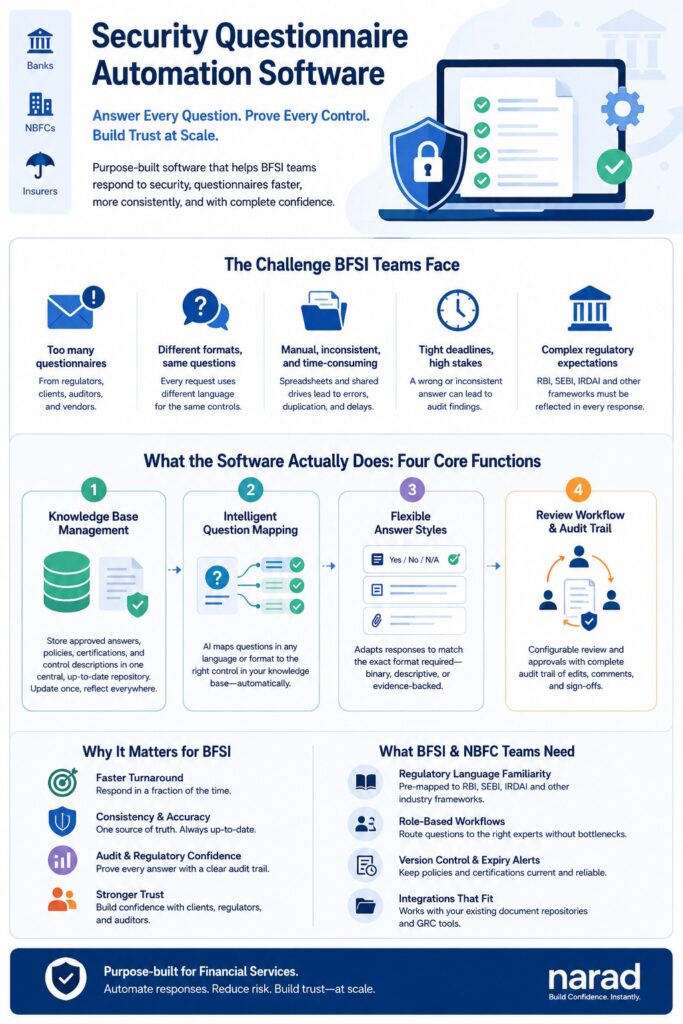
What the Software Actually Does: Four Core Functions
1. Knowledge Base Management
The platform stores your approved security answers, policy references, certifications, and control descriptions in one place. When your ISO 27001 certification renews or your BCP policy is updated, you change it once and every future response reflects it.
This centralisation is the foundation. Without it, automation produces inconsistent results because different team members pull from different versions of the same information.
2. Intelligent Question Mapping
Incoming questionnaires use different terminology for the same concepts. One client asks about “data retention policies.” Another asks “how long do you store customer records and who has access?”.
Good automation software maps these questions to the right control in your knowledge base regardless of how they are phrased. This semantic matching is what separates purpose-built tools from basic search-and-replace approaches.
Narad’s platform handles this mapping specifically for the financial services context, where questionnaires arrive in multiple formats from regulators and enterprise clients across BFSI.
3. Flexible Answers Styles
Security questionnaires do not follow a single format. Some require simple Yes, No, or Not Applicable responses. Others expect short explanations or detailed, evidence-backed answers.
Good automation software adapts responses to match the exact format each question demands. It ensures consistency while still meeting the expectations of different customers, auditors, and regulators.
Narad’s platform is designed to handle this variation seamlessly. Whether the question is binary, descriptive, or multi-layered, the response is structured in a way that aligns with the questionnaire format without requiring manual rework.
This flexibility is critical in financial services, where the same control may need to be presented differently across enterprise clients, regulators, and third-party assessments.
4. Review Workflow and Audit Trail
Every draft goes through a configurable review process before it leaves the organisation. Approvers are assigned by control area or question type. Every edit, comment, and approval is logged.
This audit trail matters in financial services. If a regulator or auditor asks how a particular answer was arrived at, you can show exactly who reviewed it, what was changed, and when it was approved.
What BFSI and NBFC Teams Actually Need From This Software
Banks, NBFCs, and insurers face questionnaires from regulators, enterprise clients, and auditors simultaneously. Generic automation tools treat all questionnaires the same. Financial services teams need software that accounts for a few specific realities.
Regulatory language familiarity. The software should recognise standard frameworks used in Indian financial services: the RBI IT Risk circular, SEBI’s cyber security framework, IRDAI IT guidelines. Mapping incoming questions to these frameworks saves significant manual effort.
Multi-user workflows with role-based access. A questionnaire response often touches the CISO, the IT risk team, the compliance officer, and sometimes legal. The platform needs to route the right questions to the right people without creating bottlenecks.
Version control for policies and certifications. Certifications expire. Policies get revised. The software should flag outdated knowledge base entries before they end up in an external response.
Integration with existing document repositories. Most BFSI teams already have policy documents, evidence artefacts, and past responses stored somewhere. The software should connect to these rather than requiring a full rebuild from scratch.
Related Reading
For the regulatory baseline, the RBI’s Master Direction on IT Governance, Risk, Controls and Assurance Practices provides the compliance reference most Indian banks and NBFCs are responding against.
FAQ
- Is security questionnaire automation software suitable for NBFCs, or is it only for large banks?
It is well-suited for NBFCs. The volume of incoming questionnaires is growing for NBFCs as enterprise clients tighten their vendor risk programmes. Smaller compliance teams benefit most because automation reduces the headcount required to keep up.
2. Can the software handle questionnaires in different formats, like Excel sheets and web forms?
Most purpose-built platforms support multiple input formats. You can import questionnaires from spreadsheets, PDFs, or web-based forms and the matching logic works the same way regardless of format.
3. How does the software stay current with regulatory changes?
The software itself does not track regulatory changes for you. Your team is responsible for updating the knowledge base when policies change. The platform makes this easier by centralising everything in one place with version history.
4. What is the difference between this and using a shared drive with past responses?
A shared drive stores documents. Automation software maps questions to specific controls, generates contextually appropriate drafts, tracks who approved what, and flags outdated entries. The shared drive approach relies on someone knowing where to look and which version to use.
5. How long before the software pays for itself in BFSI?
Teams that handle more than ten questionnaires per month typically recover the cost within one to two quarters through time saved on manual drafting and review cycles.