
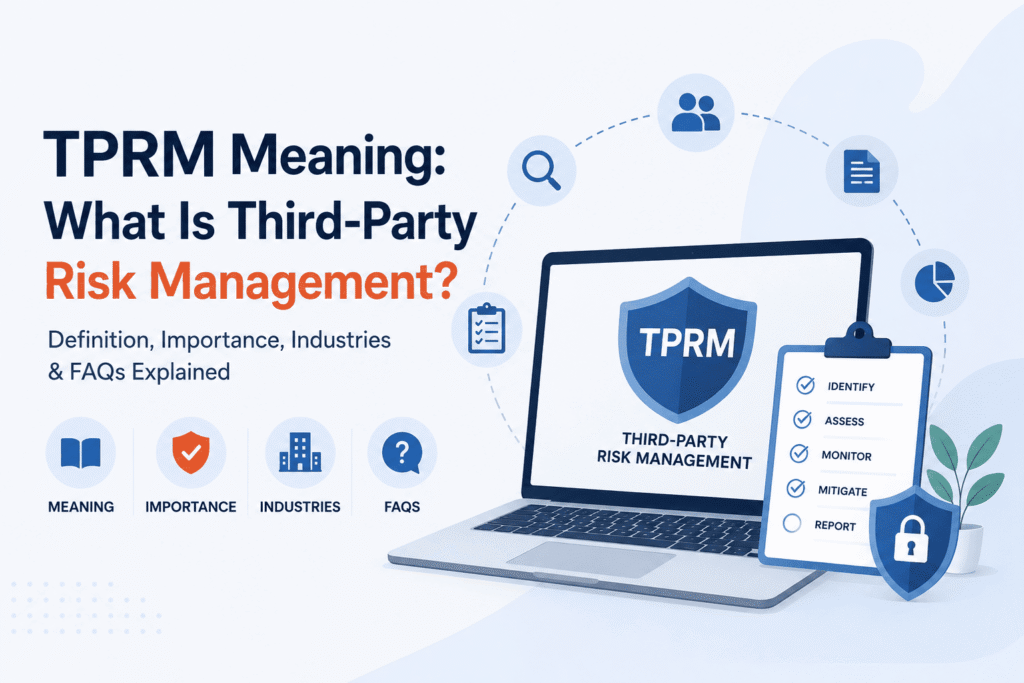
TPRM Meaning: What Is Third-Party Risk Management?
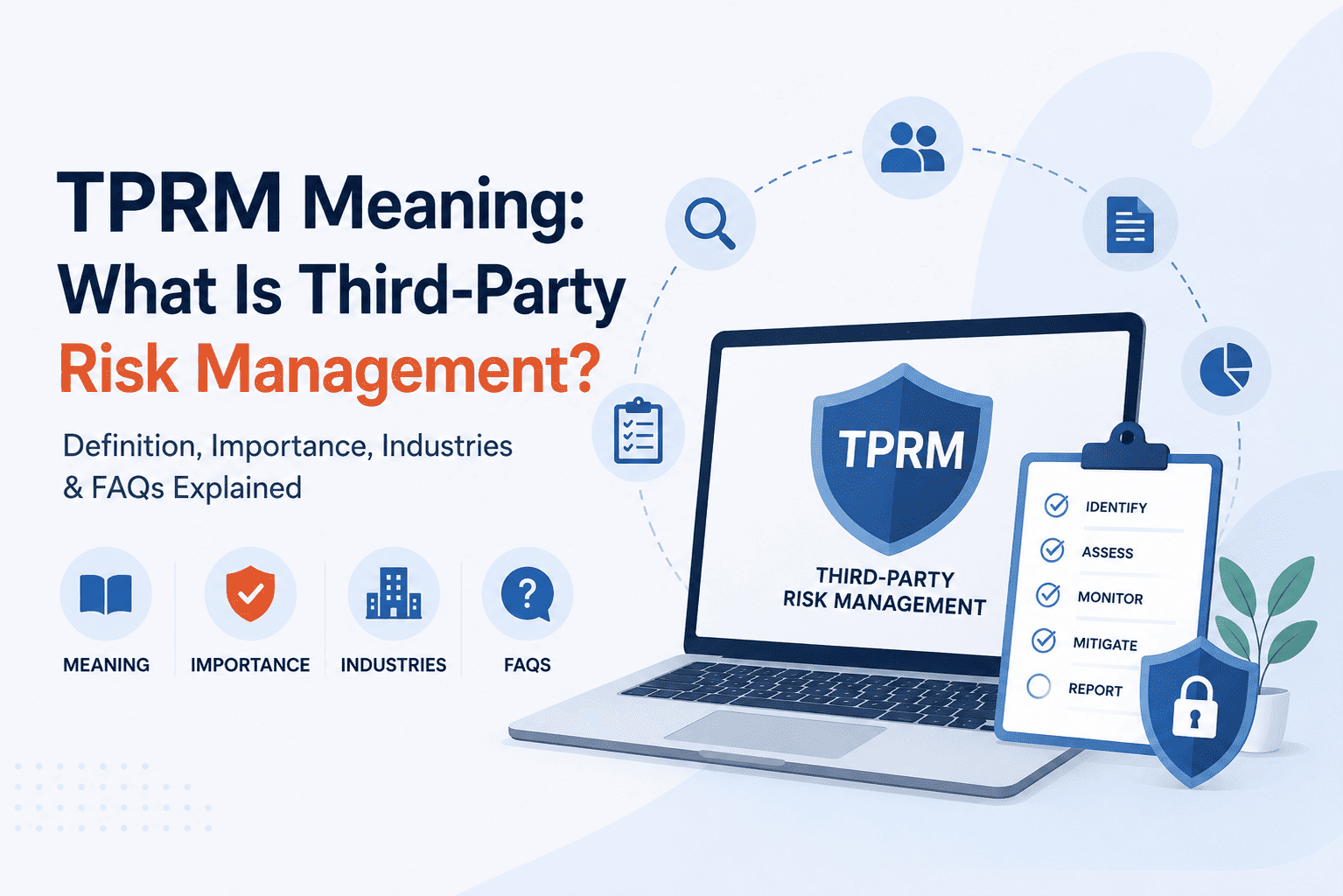
Key Takeaways
- TPRM meaning, in short, is the practice of identifying, assessing, and monitoring the risks introduced by vendors, suppliers, contractors, and other external partners.
- TPRM is different from vendor management. While vendor management focuses on contracts and performance, TPRM focuses on cybersecurity, compliance, financial, operational, and reputational risks.
- Every organisation that works with third parties needs TPRM. From SaaS providers and healthcare organisations to banks and retailers, vendor risks can impact business continuity and customer trust.
- TPRM is a continuous process, not a one-time assessment. Effective programs include vendor onboarding, risk assessments, ongoing monitoring, remediation, and periodic reassessments.
- A strong TPRM program helps reduce security incidents, meet regulatory requirements, and build trust with customers, partners, and auditors.
Introduction
Imagine this.
Your company has invested heavily in cybersecurity. Firewalls are up to date. Employees complete security training. Sensitive data is encrypted, and regular audits keep your compliance team happy.
Then one day, a vendor you rely on suffers a cyberattack.
Suddenly, your customer data is exposed, operations come to a halt, and your organisation is answering difficult questions from customers, regulators, and leadership, even though the breach didn’t happen inside your company.
This is the reality of modern business.
Today, organisations depend on dozens, sometimes hundreds, of third parties. Cloud providers, payroll companies, marketing agencies, payment processors, software vendors, and consultants all play an important role in keeping businesses running. But every external partner also introduces a level of risk that your organisation can’t afford to ignore.
In fact, SecurityScorecard’s 2025 Global Third-Party Breach Report, which analysed more than 1,000 real-world security incidents, found that vendor-driven attacks have become one of the fastest-growing sources of cyber breaches worldwide. This growing dependence on third parties has made vendor risk management a board-level priority rather than just a compliance exercise.
That’s where Third-Party Risk Management (TPRM) comes in.
While it sounds like another compliance buzzword, TPRM is actually a practical framework that helps businesses understand, assess, and continuously manage the risks that come with working with external vendors and partners.
In this guide, we’ll explain the TPRM meaning, how it differs from vendor management, why organisations invest in TPRM programs, and why it’s becoming an essential part of cybersecurity, compliance, and business resilience today.
What Does TPRM Stand For?
TPRM stands for Third-Party Risk Management. Each word carries specific weight. “Third-party” refers to any external entity (excluding your organisation and your customer) that plays a role in delivering your product or service. “Risk” covers the range of things that could go wrong: a breach, a compliance failure, a service outage. “Management” signals that this is not a one-time check. It is a continuous discipline with defined processes.
Some teams also use TPRM interchangeably with vendor risk management, or VRM. In practice, TPRM is the more encompassing term, since it can extend to non-vendor relationships like joint venture partners or outsourced business functions.
Understanding this precisely matters more than it might seem, since teams that conflate TPRM with a narrower concept like IT vendor management often end up excluding relationships that genuinely carry risk, such as a staffing agency with access to internal systems or a marketing partner handling customer contact data.
Read our complete Third-party risk management guide here.
Why Organizations Use TPRM
Companies rarely build every part of their operation in-house anymore. Cloud hosting, payment processing, identity verification, and customer support are commonly outsourced to specialised vendors. Each of these vendors becomes a link in the chain that delivers your service, and each link carries its own risk profile.
TPRM gives organisations a structured way to answer a deceptively hard question: if something goes wrong at one of our vendors, how exposed are we, and how would we know? Without a formal program, most companies only find out the answer after an incident has already occurred.
This is why TPRM has grown beyond regulated industries. Even organisations with no explicit regulatory mandate for vendor oversight increasingly build TPRM programs simply because the operational and reputational cost of a vendor-driven incident has grown too large to leave to chance.
For more details, read ‘Why is third-party risk management important?‘
Difference Between TPRM and Vendor Management
At first glance, Third-Party Risk Management (TPRM) and vendor management may seem like the same thing. After all, both involve working with external suppliers and service providers. However, they serve very different purposes within an organisation.
Vendor management focuses on building and maintaining successful business relationships. Its primary goal is to ensure vendors deliver the agreed products or services on time, within budget, and according to the contract. Vendor managers are responsible for tasks such as selecting suppliers, negotiating contracts, managing service-level agreements (SLAs), monitoring performance, and resolving day-to-day operational issues.
TPRM, on the other hand, focuses on understanding and reducing the risks that vendors introduce to the business. Rather than asking, “Is this vendor delivering what we paid for?” , TPRM asks questions like:
Is this vendor protecting our sensitive data?
Are they compliant with industry regulations?
Could their financial instability affect our operations?
How quickly would we know if they suffered a cyberattack?
What happens to our business if this vendor experiences an outage?
In other words, vendor management looks at business performance, while TPRM looks at business risk.
TPRM vs. Vendor Management: A Comparison
| Aspect | Vendor Management | Third-Party Risk Management (TPRM) |
|---|---|---|
| Primary Goal | Manage vendor relationships and performance | Identify, assess, and mitigate vendor risks |
| Focus | Cost, quality, delivery, contracts, and SLAs | Security, compliance, operational, financial, and reputational risk |
| Key Questions | Is the vendor meeting business expectations? | Does this vendor expose the organisation to unacceptable risk? |
| Typical Activities | Vendor selection, contract negotiation, performance reviews, invoice management | Risk assessments, security questionnaires, due diligence, continuous monitoring, remediation |
| Success Metrics | Vendor performance, cost savings, SLA compliance | Risk scores, assessment completion, remediation status, regulatory compliance |
| Ownership | Procurement, sourcing, or vendor management teams | Security, compliance, risk, legal, and governance teams |
Why Both Functions Are Important
An organisation can have an excellent vendor management program and still face significant third-party risks.
For example, imagine your company hires a cloud software provider. The procurement team negotiates an attractive contract, the pricing is competitive, and the vendor consistently meets every SLA. From a vendor management perspective, the relationship is a success.
However, a TPRM assessment might reveal that the same vendor:
Has outdated security controls
Doesn’t hold certifications like ISO 27001 or SOC 2
Stores customer data in non-compliant regions
Has experienced multiple security incidents in the past year
Although the vendor performs well commercially, it could still expose your organisation to serious cybersecurity, compliance, and operational risks.
The opposite can also happen. A highly secure vendor may repeatedly miss delivery deadlines or fail to meet contractual obligations, making them a poor business partner despite having a strong security posture.
TPRM and Vendor Management Work Best Together
Rather than operating independently, these two functions should complement one another.
Vendor managers often have valuable insights into contract renewals, supplier performance, and business priorities. Meanwhile, TPRM teams provide risk scores, assessment findings, compliance status, and security recommendations. Sharing this information enables better decision-making throughout the vendor lifecycle.
For example, before renewing a contract, procurement can review the vendor’s latest risk assessment. If significant security gaps remain unresolved, the organisation may choose to require remediation, negotiate stronger contractual controls, or even consider an alternative supplier.
The most mature organisations don’t treat vendor management and TPRM as competing functions. Rather, they integrate them into a single vendor governance process. This collaboration helps businesses not only get the best value from their vendors but also ensure those partnerships remain secure, compliant, and resilient over the long term.
Industries That Rely on Third-Party Risk Management (TPRM)
While Third-Party Risk Management (TPRM) first gained prominence in highly regulated industries, it has become an essential business practice across nearly every sector. As organisations increasingly rely on cloud services, outsourced operations, and digital vendors, managing third-party risk is a business necessity.
Here’s how different industries use TPRM.
Banking and Financial Services
Banks, credit unions, and financial institutions work with hundreds of third-party vendors for payment processing, cloud infrastructure, fraud detection, customer onboarding, and core banking systems.
Because they handle sensitive financial data, regulators expect these organisations to maintain rigorous vendor oversight. TPRM helps financial institutions:
Assess vendor security before onboarding
Meet regulatory requirements
Monitor critical service providers continuously
Reduce operational and cyber risks
Healthcare
Hospitals, clinics, insurers, and healthcare technology providers depend on external vendors for electronic health records (EHR), medical billing, telehealth platforms, cloud hosting, and laboratory services.
Since these vendors often have access to protected health information (PHI), healthcare organisations use TPRM to:
Protect patient data
Verify regulatory compliance
Evaluate vendor cybersecurity controls
Reduce the risk of healthcare data breaches
Insurance
Insurance companies rely on third parties for claims processing, underwriting platforms, customer support, document management, and data analytics.
A structured TPRM program helps insurers:
Protect confidential customer information
Assess outsourcing risks
Ensure business continuity
Meet industry compliance requirements
SaaS and Technology Companies
Software companies depend heavily on cloud providers, APIs, payment gateways, customer support tools, and development partners.
Enterprise customers increasingly ask SaaS vendors to demonstrate how they manage third-party risks before signing contracts. TPRM helps technology companies:
Strengthen their security posture
Support SOC 2 and ISO 27001 compliance
Build customer trust
Accelerate enterprise sales
Government and Public Sector
Government agencies regularly engage contractors and technology providers to deliver critical public services.
TPRM helps public sector organisations:
Protect sensitive government information
Evaluate contractor security practices
Reduce supply chain vulnerabilities
Meet cybersecurity and procurement requirements
Telecommunications
Telecom providers operate complex ecosystems of network infrastructure vendors, cloud providers, equipment manufacturers, and managed service providers.
A robust TPRM program helps them:
Secure critical infrastructure
Assess vendor resilience
Reduce service outages
Protect customer and network data
Why TPRM Is Becoming Universal
Although TPRM was once associated mainly with banking and healthcare, today’s organisations of all sizes depend on third parties to deliver products and services. A cybersecurity incident, compliance failure, or operational disruption at a single vendor can quickly impact customers, revenue, and brand reputation.
As a result, TPRM has become a competitive advantage as much as a compliance requirement. Enterprise customers increasingly expect vendors to demonstrate mature third-party risk management practices during procurement and security reviews. Organisations that can effectively identify, assess, and manage vendor risk are better positioned to win business, satisfy regulatory expectations, and build long-term trust with customers and partners.
FAQs
1. What is TPRM meaning?
TPRM stands for Third-Party Risk Management. It is the process of identifying, assessing, and continuously monitoring the risks introduced by vendors, suppliers, contractors, and other external partners.
2. What types of risks does TPRM cover?
TPRM covers cybersecurity, compliance, operational, financial, reputational, legal, and supply chain risks introduced by third-party relationships.
3. Who is responsible for TPRM in an organization?
TPRM is typically managed by security, risk, compliance, procurement, or governance teams, with collaboration across multiple departments.
4. Does TPRM help with regulatory compliance?
Yes. A mature TPRM program supports compliance with regulations and frameworks such as ISO 27001, SOC 2, PCI DSS, HIPAA, GDPR, and financial industry requirements.
5. Can TPRM be automated?
Yes. Modern TPRM platforms automate security questionnaires, evidence collection, vendor scoring, remediation tracking, and continuous monitoring, making vendor risk management faster and more scalable.
Conclusion
Understanding the TPRM meaning is the first step toward building a more resilient and secure business. As organisations become increasingly dependent on third-party vendors, managing vendor risk is a critical part of protecting your operations, customer data, and reputation. A structured TPRM program helps you identify risks early, make informed vendor decisions, and continuously monitor your third-party ecosystem. Platforms like narad simplify this process by automating vendor risk assessments, security questionnaires, evidence collection, remediation tracking, and continuous monitoring, enabling security and compliance teams to scale their TPRM programs with greater speed, consistency, and confidence. Explore narad’s third-party risk management tool here.
Book a demo now and see narad’s TPRM firsthand.