
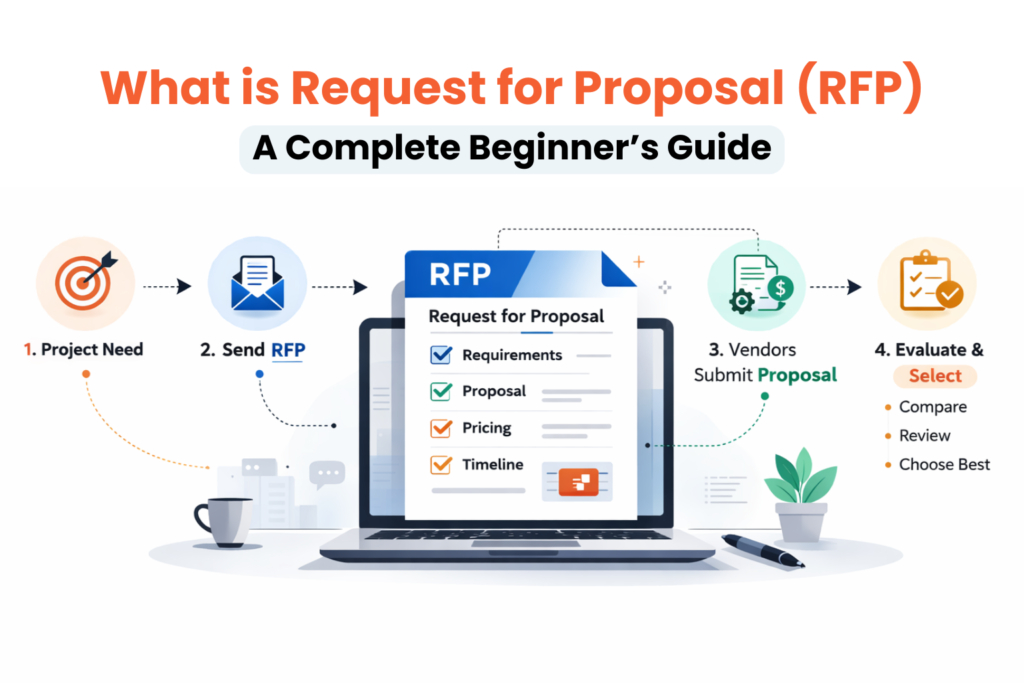

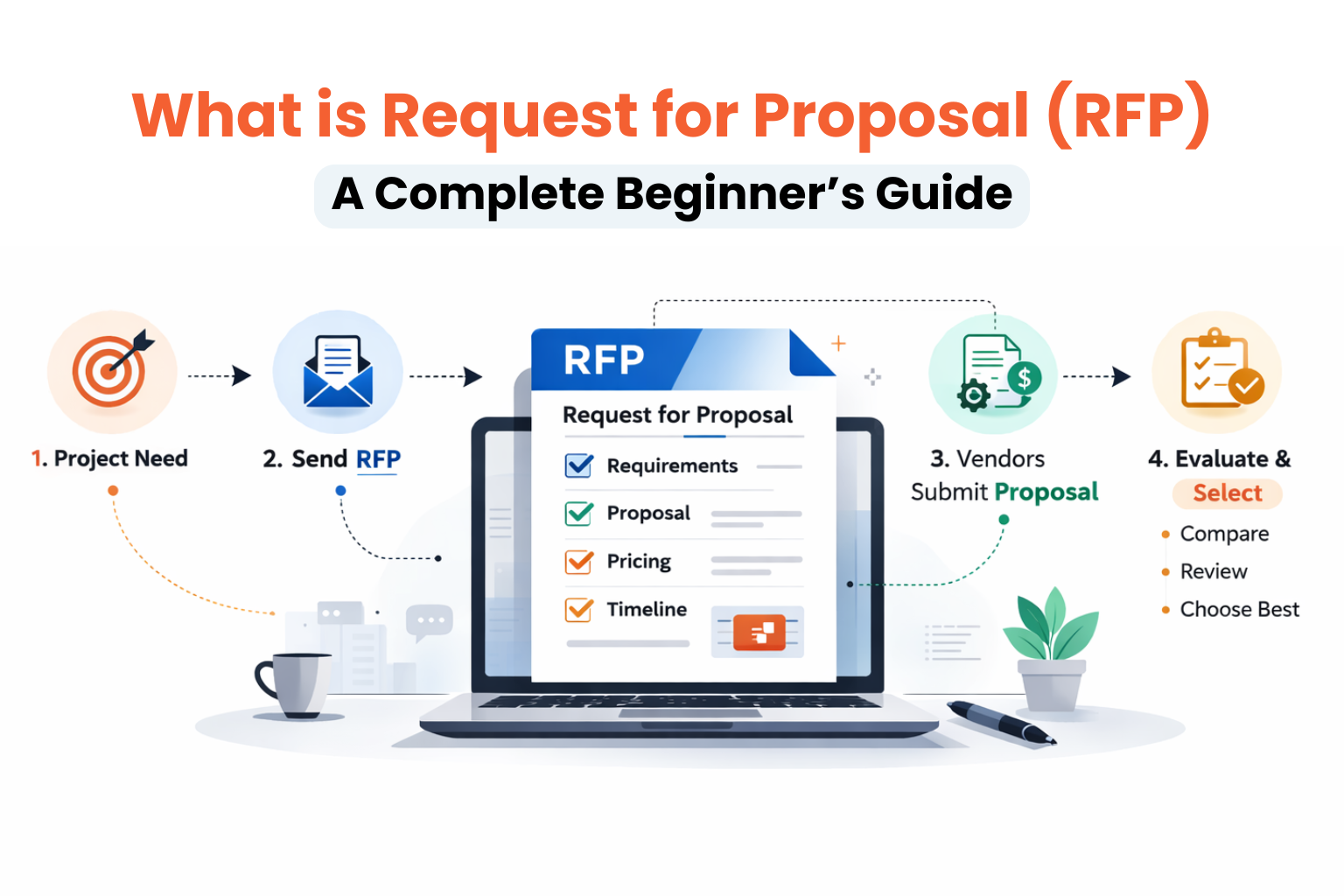
If you have ever seen a company say, ‘We are inviting vendors to submit proposals,’ they are usually talking about an RFP. An RFP stands for Request for Proposal. It is a formal document businesses use to invite vendors to propose a solution for a specific need. The company explains what they want to achieve, what requirements matter, and how they will evaluate responses. Vendors then submit a proposal with their approach, timeline, pricing, and proof they can deliver.
In this guide, you will learn:
What is Request for Proposal
Why it is used
What it includes
How the RFP process works
How to write one that gets strong vendor responses
What is Request for Proposal and why do companies use it?
A request for proposal, in simple terms, is a structured way for a company to compare vendors fairly when the decision is important.
Companies use an RFP when they want:
- Clear requirements instead of vague discussions
- Comparable proposals from multiple vendors
- Better control over budget and timelines
- Reduced risk around delivery, security, and compliance
- Alignment across internal stakeholders like procurement, finance, IT, and leadership
RFPs are common in software buying, IT services, consulting, marketing agencies, construction, and any project where the outcome matters more than just the lowest price.
When Should You Use an RFP?
An RFP is most useful when you’re making an important purchasing decision and need more than just a price comparison. It helps organisations evaluate not only what vendors charge but also how they plan to solve the problem, what experience they bring, and whether they’re the right long-term partner.
You should consider using an RFP when:
The Project Is Complex or High Value
Large software implementations, cybersecurity initiatives, cloud migrations, and digital transformation projects often involve significant investment and long-term commitments. An RFP helps you gather detailed information before making a decision that could impact the business for years.
Multiple Vendors Could Solve the Problem in Different Ways
Different vendors may propose different technologies, methodologies, timelines, or support models. An RFP allows you to compare approaches side by side and determine which solution best aligns with your business goals.
You Need to Evaluate More Than Just Cost
The cheapest proposal is not always the best option. An RFP gives vendors the opportunity to explain their technical expertise, implementation approach, customer support model, and overall value proposition so you can make a more informed decision.
Security, Legal, or Compliance Reviews Are Required
For software, SaaS, and technology purchases, organizations often need to review security controls, compliance certifications, data handling practices, and contractual terms before selecting a vendor. An RFP provides a structured way to collect and evaluate this information.
Multiple Stakeholders Need to Be Aligned
Purchasing decisions often involve IT, security, procurement, finance, legal, and business teams. An RFP creates a consistent framework that helps all stakeholders evaluate vendors against the same requirements and criteria.
If you already know exactly what solution you need and only want pricing information, a Request for Quotation (RFQ) may be more appropriate. If you’re still exploring the market and trying to understand what options are available, a Request for Information (RFI) is usually the better starting point.
RFP vs RFI vs RFQ: What’s the Difference?
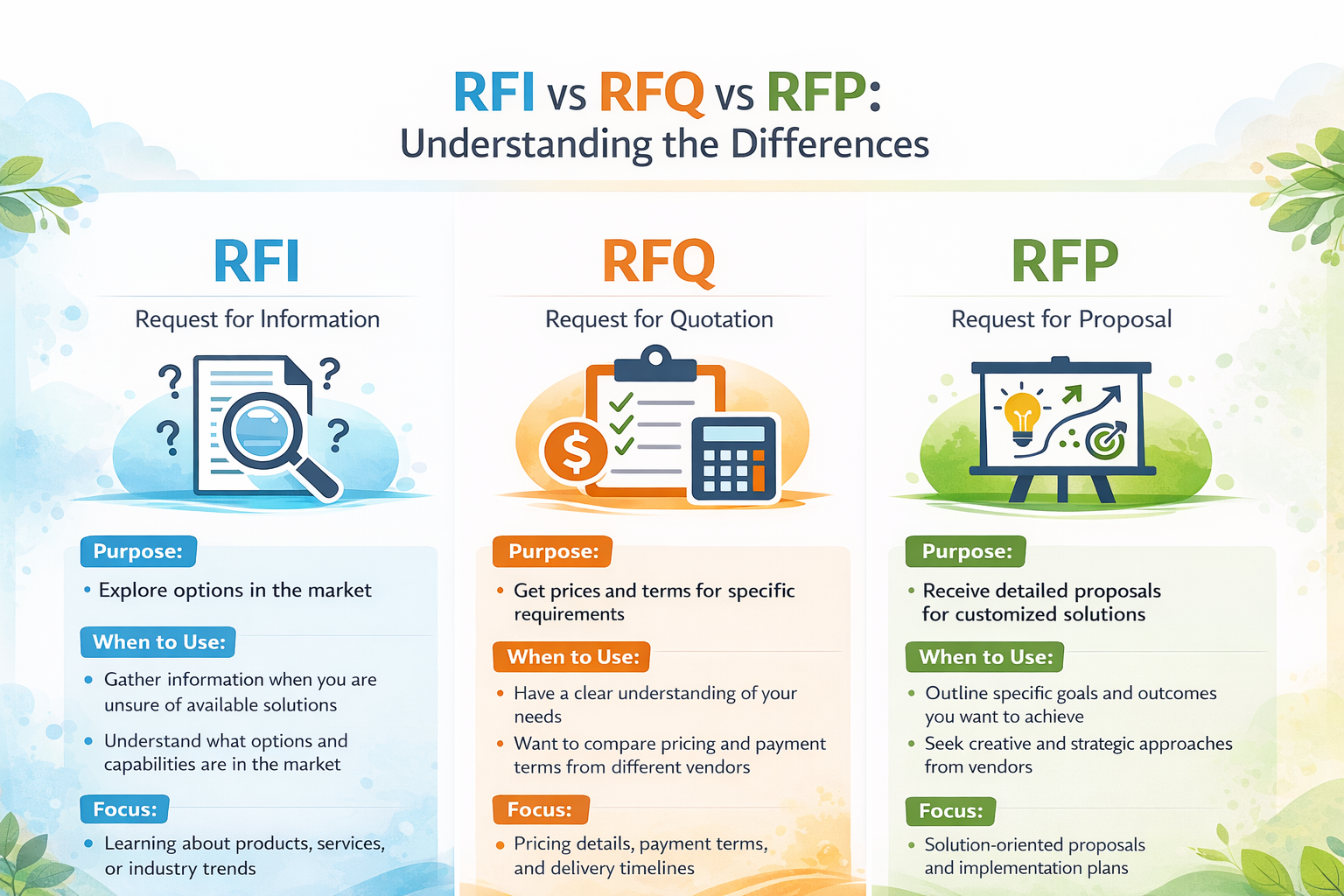
These procurement terms are often used interchangeably, but they serve very different purposes. Understanding the difference can help you choose the right approach and avoid unnecessary work for both buyers and vendors.
RFI (Request for Information)
An RFI is used when an organisation is still exploring the market and gathering information. At this stage, the buyer may not fully understand the available solutions or vendors and wants to learn what options exist before defining detailed requirements.
For example, a company considering a new cybersecurity platform may issue an RFI to understand available technologies, features, implementation approaches, and pricing models before creating a formal procurement plan.
RFQ (Request for Quotation)
An RFQ is used when the buyer already knows exactly what they need and simply wants pricing and commercial terms from vendors.
The requirements are usually well-defined, leaving little room for vendors to propose alternative approaches. The primary goal is to compare costs, delivery timelines, and contractual terms.
For example, if an organisation needs 500 laptops with specific hardware specifications, an RFQ would be more appropriate than an RFP.
RFP (Request for Proposal)
An RFP is used when the buyer knows the business outcome they want to achieve but wants vendors to propose how they would deliver it.
Unlike an RFQ, an RFP allows vendors to showcase their expertise, methodology, technology, implementation plan, support model, and overall approach. Buyers use RFPs when multiple vendors may solve the same problem in different ways and they need a structured framework to evaluate those options.
For software, cybersecurity, cloud, and digital transformation projects, the RFP process is often the preferred approach because technical expertise, implementation quality, security controls, and long-term support are just as important as pricing.
What is Request for Proposal Used For in Real Life
Here are common examples where companies use an RFP:
- Choosing a cybersecurity vendor for audits and monitoring
- Selecting a software platform like CRM, HRMS, or ERP
- Outsourcing application development or cloud migration
- Hiring a marketing agency for brand and performance campaigns
- Selecting a managed IT services provider
In all these cases, the buyer wants a clear plan, not just a price tag.
What a Request for Proposal Document Usually Includes
A strong RFP has enough detail to prevent confusion, but not so much that vendors cannot respond properly.
1. Company Background and Context
This section explains who you are and why you are issuing the RFP. Include:
- Short company overview
- Current situation and pain points
- What triggered the need
2. Goals and Success Criteria
State what success looks like. Examples:
- Reduce manual workload
- Improve response time
- Increase accuracy and consistency
- Meet compliance expectations
- Improve stakeholder visibility
3. Scope of Work
This defines what you want the vendor to deliver. Include:
- What is included
- What is not included
- Deliverables
- Required integrations
- Training, onboarding, and support expectations
A clear scope reduces misunderstandings and prevents disputes later.
4. Requirements
Organize requirements clearly.
Functional Requirements: What the solution must do.
Technical Requirements: Hosting, integrations, performance, data storage, scalability.
Security and Compliance Requirements: Encryption, access controls, audit logs, certifications, data handling.
Service Requirements: Support hours, response times, escalation process, account management.
If possible, label requirements as must have or nice to have.
5. Timeline and Key Dates
Include milestones such as:
- RFP release date
- Deadline for vendor questions
- Proposal submission deadline
- Demo or evaluation window
- Final selection date
- Expected start date
Realistic timelines improve proposal quality.
6. Proposal Submission Instructions
Tell vendors exactly how to respond. Include:
- Format, such as PDF
- Where to submit
- Contact person
- Required sections
- Response template, if any
7. Evaluation Criteria
Without clear evaluation criteria, decision making becomes slow. A simple framework may include:
- Fit to requirements
- Quality of approach and implementation plan
- Security posture and compliance readiness
- Relevant experience and case studies
- Pricing and total cost of ownership
- Support and reliability
- Timeline feasibility
8. Pricing Format
Ask vendors to present pricing clearly. Request:
- One time setup fees
- Subscription or licensing costs
- Usage based fees
- Support and maintenance costs
- Optional add ons
- Contract length and renewal terms
The RFP Process Step by Step
Here is how the process typically works:
- Step 1: Define the Need – Stakeholders align on the problem and outcome.
- Step 2: Build Requirements – Teams define scope, budget, security, and technical needs.
- Step 3: Write and Release the RFP – Send to shortlisted vendors or publish publicly.
- Step 4: Vendor Questions – Respond consistently to clarifications.
- Step 5: Proposal Submissions – Vendors submit full proposals.
- Step 6: Scoring and Shortlisting – Use evaluation criteria to compare.
- Step 7: Demos and Review – Validate claims and technical fit.
- Step 8: Final Selection and Negotiation – Finalize pricing and legal terms.
- Step 9: Onboarding and Implementation – Begin project execution.
Common RFP Mistakes Beginners Should Avoid
A poorly written RFP can lead to confusing proposals, longer evaluation cycles, and the wrong vendor selection. Here are some common mistakes to watch out for:
Vague Requirements
Unclear requirements lead to inconsistent proposals that are difficult to compare.
Asking for Everything
Including every possible requirement makes the RFP longer and often discourages quality vendors from responding.
No Clear Evaluation Criteria
Without predefined scoring criteria, vendor selection can become subjective and inconsistent.
Unrealistic Timelines
Giving vendors too little time often results in rushed, lower-quality proposals.
Ignoring Security and Compliance Early
Security, privacy, and compliance requirements should be evaluated from the beginning, not after a vendor is shortlisted.
Treating the RFP as a Formality
An RFP should help you evaluate vendors objectively, not simply validate a decision that’s already been made.
How to Write an RFP That Gets Better Vendor Proposals
The quality of proposals you receive is often a reflection of the quality of your RFP. A clear and well-structured document makes it easier for vendors to understand your requirements and submit meaningful responses.
Write for Clarity, Not Complexity
Use simple, direct language. The easier your requirements are to understand, the better the responses will be.
Focus on Outcomes
Instead of prescribing exactly how vendors should solve the problem, explain the business outcome you’re trying to achieve.
Give Vendors Enough Context
Share relevant background information, project goals, current challenges, and expectations so vendors can tailor their proposals accordingly.
Make Responses Easy to Compare
Provide a consistent response format and ask vendors to follow the same structure. This makes evaluation much easier.
Be Transparent About Priorities
Let vendors know what matters most—whether it’s cost, security, implementation experience, scalability, support, or timelines.
Include Real Constraints
Be upfront about budget ranges, compliance requirements, technical limitations, and project deadlines. This helps vendors propose realistic solutions and avoids wasted effort on both sides.
Final Takeaway
Now you understand What is Request for Proposal and how it helps businesses choose the right vendor with less risk and more clarity.
A well-written RFP is not just paperwork. It is a decision tool that saves time, prevents mistakes, and improves outcomes.
If you would like, tell me what category you are writing an RFP for, and I will create a ready-to-use RFP template tailored to your specific use case.
If you are looking for RFP automation, check out narad.io. Narad automates RFPs, security questionnaires and assessments , reduces response time; improves accuracy; and manages compliance workflows effortlessly.