


How to Find RFP Opportunities and Win Them?
How to find RFP opportunities is one of the most common questions asked by software vendors, SaaS companies, consulting firms, cybersecurity providers, and technology service companies looking to grow their enterprise business.
Many organizations invest heavily in building great products and services but struggle to create a predictable pipeline of enterprise opportunities. While referrals and outbound sales remain important, Requests for Proposals (RFPs) continue to be one of the most reliable ways to compete for large contracts and long-term customer relationships.
The challenge is that finding RFPs is only half the battle. Thousands of opportunities are published every day across government portals, procurement platforms, industry networks, and private marketplaces. Some are excellent fits for your business, while others can consume weeks of effort with little chance of success.
The most successful vendors don’t respond to every RFP they find. They build a repeatable system for discovering relevant opportunities, evaluating whether those opportunities are worth pursuing, and creating high-quality responses that stand out during vendor evaluations.
In this guide, we’ll explain how to find RFP opportunities, where to look for them, how to qualify them before investing resources, and what separates winning vendors from those that spend countless hours responding to proposals they never had a realistic chance of winning.
What Are RFP Opportunities?
RFP opportunities are business opportunities where an organization formally invites vendors to submit proposals for a product, service, project, or long-term partnership. Instead of purchasing directly from a vendor, the buyer creates a Request for Proposal (RFP) to evaluate multiple suppliers and determine which one best meets its requirements.
For software companies, SaaS providers, IT service firms, cybersecurity vendors, and consulting organizations, RFP opportunities often represent access to larger contracts and enterprise customers. Many organizations, especially large enterprises, government agencies, healthcare institutions, financial services firms, and educational organizations, use RFPs as a standard part of their procurement process to ensure transparency and make informed purchasing decisions.
A typical RFP opportunity contains detailed information about the buyer’s requirements, business objectives, budget expectations, evaluation criteria, project timelines, security requirements, and submission instructions. Vendors are then asked to submit a proposal explaining how their solution addresses the organization’s needs.
One important thing to understand is that not all RFP opportunities are the same. Some are highly competitive public opportunities open to dozens or even hundreds of vendors. Others are private invitations sent only to a small group of pre-qualified suppliers.
Common Types of RFP Opportunities
Government RFPs
Government agencies frequently publish RFPs for software, cybersecurity, cloud infrastructure, consulting services, and digital transformation initiatives. These opportunities are usually publicly available and follow strict procurement guidelines. While government contracts can be large and long-lasting, the sales cycles are often longer and the documentation requirements more extensive.
Enterprise RFPs
Large enterprises issue RFPs when evaluating vendors for software purchases, managed services, technology implementations, and strategic business initiatives. These opportunities often involve multiple stakeholders, detailed evaluation criteria, and extensive security and compliance reviews.
SaaS and Technology Procurement RFPs
As organizations adopt more cloud-based solutions, SaaS-focused RFPs have become increasingly common. Buyers may evaluate multiple software providers based on functionality, integrations, security posture, pricing, scalability, customer support, and implementation approach.
Consulting and Professional Services RFPs
Many organizations use RFPs when selecting consulting partners, managed service providers, system integrators, or software development firms. These opportunities often place greater emphasis on experience, expertise, project methodology, and past client success.
Why RFP Opportunities Matter
For vendors, RFP opportunities provide a structured path to winning new business. Unlike cold outreach or unsolicited proposals, the buyer has already identified a need and allocated resources to evaluate solutions.
However, finding RFP opportunities is only the first step. The most successful vendors don’t measure success by the number of RFPs they respond to. Instead, they focus on identifying opportunities that align with their expertise, target market, and competitive strengths. A carefully selected RFP with a strong fit often delivers better results than pursuing dozens of opportunities with little chance of success.
How to Find RFP Opportunities That Match Your Business
Finding RFP opportunities is not difficult. The real challenge is finding opportunities that align with your expertise, target market, and growth goals.
Many vendors make the mistake of chasing every available RFP. While this may increase the number of proposals submitted, it rarely improves win rates. Successful SaaS and IT companies focus on finding opportunities where they have a clear competitive advantage, relevant experience, and a strong chance of being shortlisted.
Fortunately, there are several ways to consistently discover high-quality RFP opportunities.
Use RFP Databases and Bid Platforms
One of the fastest ways to identify new opportunities is through dedicated RFP databases and bid marketplaces. These platforms aggregate opportunities from government agencies, enterprises, educational institutions, healthcare organizations, and private companies into a single searchable database.
Most platforms allow vendors to filter opportunities by industry, location, contract value, keywords, and submission deadlines. Many also provide email alerts whenever a relevant RFP is published.
Some popular options include:
For organizations that plan to pursue RFPs regularly, a subscription to one or more of these services can significantly reduce the time spent searching for opportunities.
Explore Government Procurement Portals
Government agencies publish thousands of RFPs every year covering software development, cybersecurity, cloud migration, managed services, consulting, and digital transformation projects.
Unlike private-sector opportunities, most government RFPs are publicly accessible. Vendors can browse procurement portals, review requirements, and submit proposals without needing an existing relationship with the buyer.
Depending on your target market, you may want to monitor:
- Federal procurement portals
- State government procurement websites
- Municipal procurement portals
- Public sector purchasing cooperatives
Government opportunities often involve longer sales cycles and stricter compliance requirements, but they can also result in large, long-term contracts.
Monitor Procurement and Supplier Networks
Many large enterprises use procurement platforms to manage vendor sourcing and purchasing activities. Buyers frequently publish opportunities directly through these systems and invite qualified suppliers to participate.
Examples include:
Creating supplier profiles and maintaining up-to-date company information can increase your visibility when buyers search for potential vendors.
Use LinkedIn and Industry Communities
While many people associate LinkedIn with networking and recruiting, it can also be a valuable source of procurement opportunities.
Organizations often announce upcoming projects, procurement initiatives, digital transformation programs, and vendor searches through LinkedIn posts and industry groups. Following procurement leaders, technology buyers, and industry-specific communities can help you identify opportunities before formal RFPs are released.
Industry associations, trade organizations, and technology communities can be equally valuable. These groups often share procurement announcements, partnership opportunities, and requests for vendor recommendations.
Build Relationships Before the RFP Is Published
Some of the best RFP opportunities never appear in a public search.
Many enterprise buyers create shortlists of vendors before issuing formal RFPs. Vendors that already have relationships with decision-makers, procurement teams, consultants, or industry influencers are more likely to be invited into these opportunities.
This is why sales, marketing, and business development efforts play an important role in RFP generation.
Consider:
- Engaging target accounts through account-based marketing campaigns
- Building relationships with procurement teams
- Attending industry conferences and events
- Participating in webinars and roundtables
- Connecting with consultants and implementation partners
Being known before the RFP is released often provides a significant advantage during the evaluation process.
Register as a Preferred Vendor
Many organizations maintain supplier databases that allow vendors to register their services, capabilities, certifications, and contact information.
Depending on the company, this may be called:
- Supplier Registration
- Vendor Registration
- Supplier Portal
- Vendor Application
- Preferred Supplier Program
Completing these profiles can increase your chances of being included in future procurement opportunities, particularly when buyers are building initial vendor shortlists.
Leverage Existing Customers and Partners
One of the most overlooked sources of RFP opportunities is your existing customer base.
Current customers often launch new initiatives, expand into new business units, or evaluate additional services through formal procurement processes. Strong customer relationships can provide early visibility into upcoming opportunities.
Similarly, technology partners, channel partners, and implementation partners frequently become aware of projects before they reach the public market.
Companies that consistently win RFPs rarely rely on a single source. Instead, they build a diversified opportunity pipeline that combines public databases, procurement platforms, strategic relationships, industry networks, and customer referrals. The broader your visibility into the market, the more selective you can be when deciding which opportunities deserve your time and resources.
Should You Respond to Every RFP Opportunity?
The short answer is no.
One of the biggest mistakes software vendors make is assuming that every RFP is a potential revenue opportunity worth pursuing. While it may seem logical to maximize the number of proposals submitted, the reality is that responding to RFPs requires a significant investment of time, expertise, and internal resources.
A single enterprise RFP may require input from sales, product, engineering, security, compliance, legal, and customer success teams. Between gathering documentation, answering technical questions, completing security assessments, and reviewing final submissions, even a moderately complex RFP can consume dozens of hours.
That’s why successful vendors don’t measure performance by the number of RFPs they respond to. Instead, they focus on identifying opportunities where they have the highest probability of winning.
Before committing resources, evaluate the opportunity across four key areas.
1. Strategic Fit
Start by asking whether the opportunity aligns with your ideal customer profile (ICP).
Consider factors such as:
- Industry alignment
- Company size
- Geographic location
- Use case requirements
- Budget expectations
For example, if your company specializes in serving mid-market SaaS businesses, pursuing an RFP from a government agency with highly specialized procurement requirements may not be the best use of your team’s time.
The strongest opportunities are often those that closely resemble customers you’ve successfully served before.
2. Technical Fit
Even if an opportunity looks attractive from a revenue perspective, you need to determine whether your solution can realistically meet the buyer’s requirements.
Review the RFP carefully and assess:
- Functional requirements
- Integration requirements
- Security requirements
- Compliance expectations
- Implementation timelines
Be particularly cautious when the project requires extensive customization or features that don’t currently exist in your product roadmap.
Winning an RFP only to discover that the project cannot be delivered profitably creates challenges for both the vendor and the customer.
3. Competitive Position
Not every RFP is a truly open competition.
In some cases, organizations already have a preferred vendor in mind and use the RFP process primarily to satisfy procurement requirements. While it’s not always possible to identify these situations, there are often clues.
Questions worth asking include:
- Do we already have a relationship with this organization?
- Have we participated in previous discussions or product evaluations?
- Does the RFP strongly favor a specific technology or approach?
- Do we have relevant references in this industry?
If you have no prior engagement and the requirements appear unusually specific, your chances of winning may be lower than they initially seem.
4. Commercial Value
Finally, evaluate whether the opportunity justifies the effort required to pursue it.
Consider:
- Contract value
- Revenue potential
- Expansion opportunities
- Strategic importance
- Internal resource requirements
A large contract may appear attractive on paper, but if the response process requires weeks of effort and the probability of success is low, the opportunity cost can be substantial.
A Simple Bid/No-Bid Rule
Before responding to any RFP, ask yourself a simple question:
If we win this opportunity, will it be a customer we’re excited to serve for the next three to five years?
If the answer is yes, the opportunity may be worth pursuing. If the answer is uncertain, it’s often better to focus your resources elsewhere.
The most successful vendors don’t win because they respond to more RFPs. They win because they respond to the right RFPs.
How Winning Vendors Prepare Before the RFP Arrives
Many vendors start preparing for an RFP only after it lands in their inbox. Unfortunately, by that point, the clock is already ticking.
The most successful software and SaaS companies treat RFP readiness as an ongoing process rather than a last-minute activity. They maintain up-to-date product documentation, customer case studies, security policies, compliance certifications, architecture diagrams, and approved responses to frequently asked questions. This preparation allows them to respond quickly without sacrificing quality or accuracy.
Winning vendors also establish clear internal workflows before opportunities arise. They know who owns product-related questions, who handles security reviews, and who is responsible for final proposal approvals. As a result, they spend less time chasing information and more time crafting compelling responses.
If you’re looking for a detailed breakdown of how software vendors manage the entire RFP response lifecycle, from qualification to submission, read our guide on the Request for Proposal Process for IT Software Vendors.
The reality is simple: companies that prepare before the RFP arrives consistently respond faster, produce better proposals, and improve their chances of making the final shortlist.
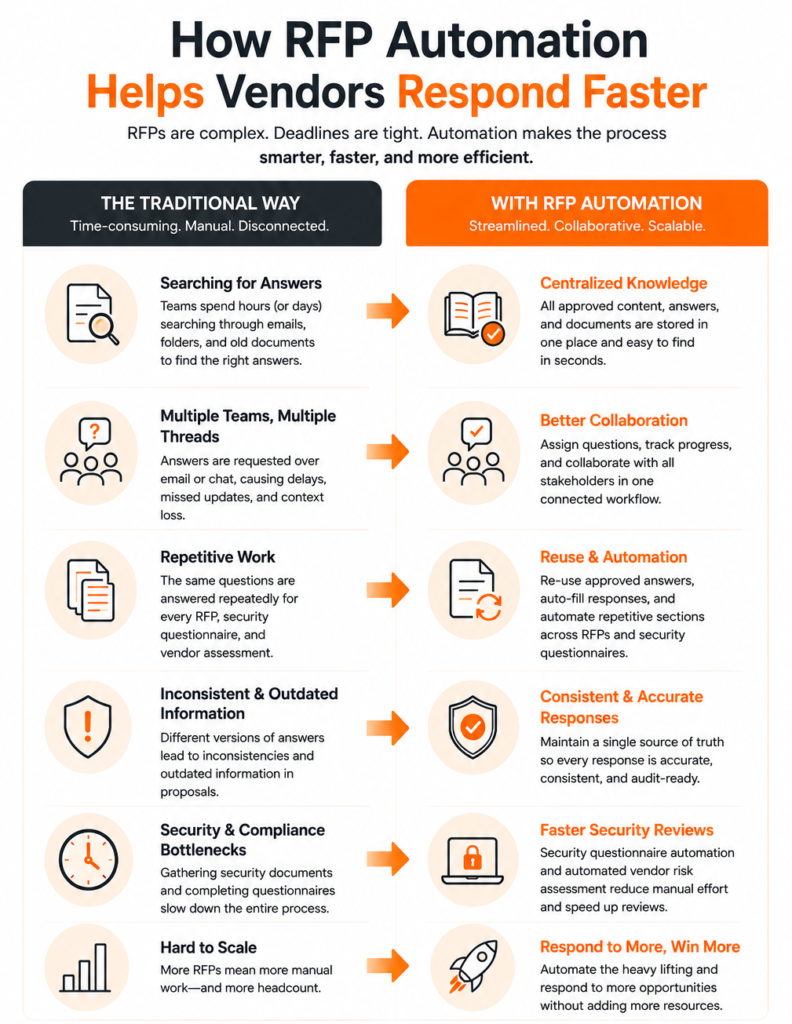
How RFP Automation Helps Vendors Respond Faster
As organizations pursue more enterprise opportunities, the traditional approach to managing RFPs becomes increasingly difficult to scale.
Many vendors still rely on spreadsheets, shared folders, email threads, and copy-pasting answers from previous proposals. While this may work for a handful of opportunities, it quickly becomes inefficient as RFP volume grows.
The challenge isn’t just completing the proposal itself. Most RFPs require information from multiple departments, including sales, product, engineering, security, compliance, legal, and customer success teams. Every new opportunity triggers the same cycle of searching for answers, requesting reviews, gathering supporting documents, and validating information before submission.
This is where RFP automation becomes valuable.
Instead of starting from scratch for every opportunity, modern RFP automation platforms help organizations centralize institutional knowledge and streamline the response process.
Reduce Repetitive Work
One of the biggest frustrations for vendors is answering the same questions repeatedly.
Buyers often ask similar questions about:
- Product capabilities
- Security controls
- Compliance certifications
- Data privacy practices
- Service-level agreements
- Implementation methodologies
An RFP automation platform can maintain a centralized knowledge base of approved responses, allowing teams to quickly reuse existing content instead of recreating answers for every proposal.
Improve Response Quality and Consistency
When multiple teams contribute to proposals, inconsistencies can easily appear.
For example, a sales team may describe a feature differently than a product manager. Security teams may provide updated information while older responses continue circulating in previous documents.
Automation helps maintain a single source of truth, ensuring that responses remain accurate, consistent, and aligned across proposals.
Accelerate Security and Compliance Reviews
For many software vendors, security reviews take longer than the actual RFP.
Enterprise buyers increasingly require:
- Security questionnaires
- Vendor assessments
- Compliance documentation
- Privacy reviews
- Third-party risk assessments
Gathering this information manually often creates bottlenecks between sales, security, and compliance teams.
Companies using RFP automation tools can focus more on searching for the right opportunities and not filling out the form. The tool takes care of responding to the questions, saving hours of time.
Organizations that use security questionnaire automation can significantly reduce the time spent completing repetitive security reviews while improving response accuracy.
Similarly, teams managing customer due diligence processes can benefit from automated vendor risk assessment workflows that centralize evidence, documentation, and approved responses.
Improve Cross-Functional Collaboration
RFPs rarely belong to a single department.
- Sales teams need product expertise.
- Product teams need engineering input.
- Security teams need compliance validation.
- Legal teams need to review contractual language.
Automation platforms help coordinate these stakeholders through structured workflows, task assignments, approval processes, and centralized content management.
Respond to More Opportunities Without Adding Headcount
Perhaps the biggest benefit of automation is scalability.
Without automation, increasing RFP volume often requires additional operational resources.
With the right systems in place, vendors can respond to more opportunities, reduce turnaround times, and improve proposal quality without significantly increasing workload.
Many IT and SaaS companies use platforms like Narad to centralize company knowledge, automate repetitive responses, streamline security reviews, and reduce the time spent completing RFPs, security questionnaires, and vendor assessments. The result is a faster, more efficient response process that allows teams to focus on winning business instead of managing administrative work.
Frequently Asked Questions
1. How to find RFP opportunities online?
RFP opportunities can be found through government procurement portals, RFP databases, procurement platforms, industry associations, LinkedIn, partner networks, and existing customer relationships. Most successful vendors use multiple channels rather than relying on a single source.
2. What is the best website for finding RFP opportunities?
The best platform depends on your target market. Government contractors often use government procurement portals and bid databases, while SaaS and technology vendors frequently monitor procurement platforms, industry communities, and enterprise supplier networks.
3. How do SaaS companies get invited to private RFPs?
Private RFP invitations are often relationship-driven. Building relationships with buyers, procurement teams, consultants, channel partners, and existing customers can significantly increase your chances of being included in future vendor evaluations.
4. How long does it typically take to complete an RFP?
The timeline varies depending on complexity. Simple RFPs may take a few days, while enterprise opportunities involving security reviews, compliance assessments, and multiple stakeholders can take several weeks to complete.
5. Can AI help automate the RFP response process?
Yes. Modern RFP automation platforms use AI to help vendors find approved responses, generate draft answers, centralize knowledge, complete security questionnaires, and reduce manual effort throughout the proposal process. This allows teams to respond faster while maintaining consistency and accuracy.
6. Which RFP automation software should I use?
Several RFP automation tools are available today, but for IT and SaaS companies looking to automate RFPs, security questionnaires, and vendor assessments, Narad is a strong option. It helps teams centralize company knowledge, reuse approved responses, and reduce the time spent completing repetitive proposal and security review tasks. Schedule a 15-min no-obligation demo to see narad.
Conclusion
Finding RFP opportunities is only the first step. The real challenge lies in identifying the right opportunities, qualifying them effectively, and responding with speed and accuracy.
The most successful IT and SaaS companies don’t chase every RFP they find. Instead, they build a repeatable system for discovering high-fit opportunities, evaluating whether they’re worth pursuing, and preparing winning responses without overwhelming internal teams.
As competition increases and procurement processes become more complex, having the right processes, documentation, and automation in place can create a significant advantage. Whether you’re responding to a handful of proposals each year or managing dozens every month, improving your RFP strategy can help you increase win rates while reducing the time and effort required from sales, product, security, and compliance teams.
If your team is looking for a faster way to manage RFPs, security questionnaires, and vendor assessments, explore how Narad can help streamline the entire response process and free up your experts to focus on what they do best.