
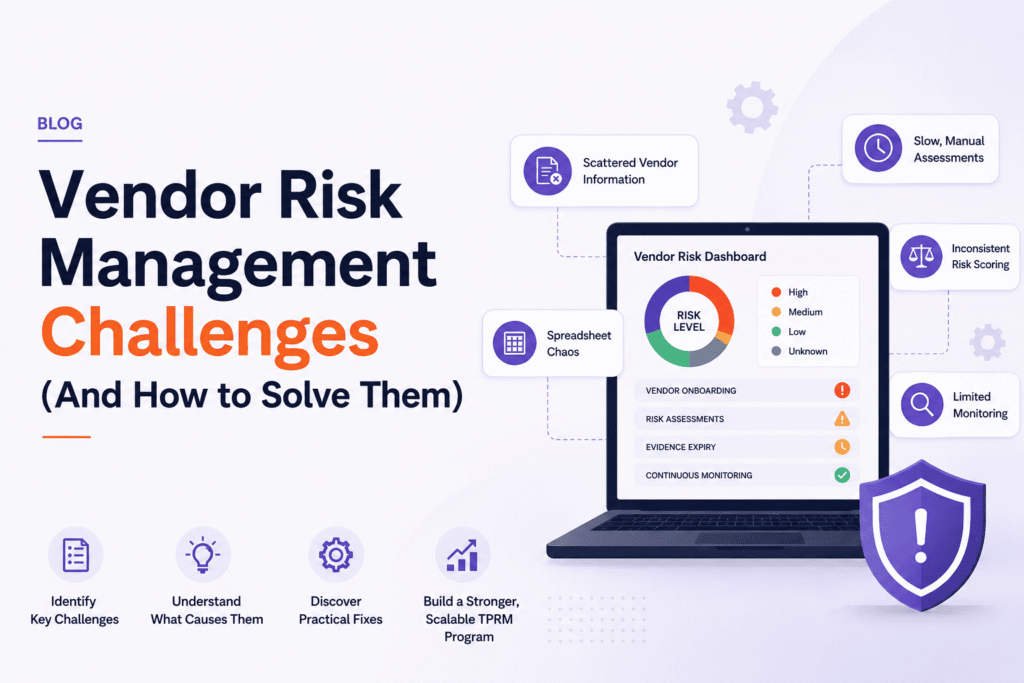
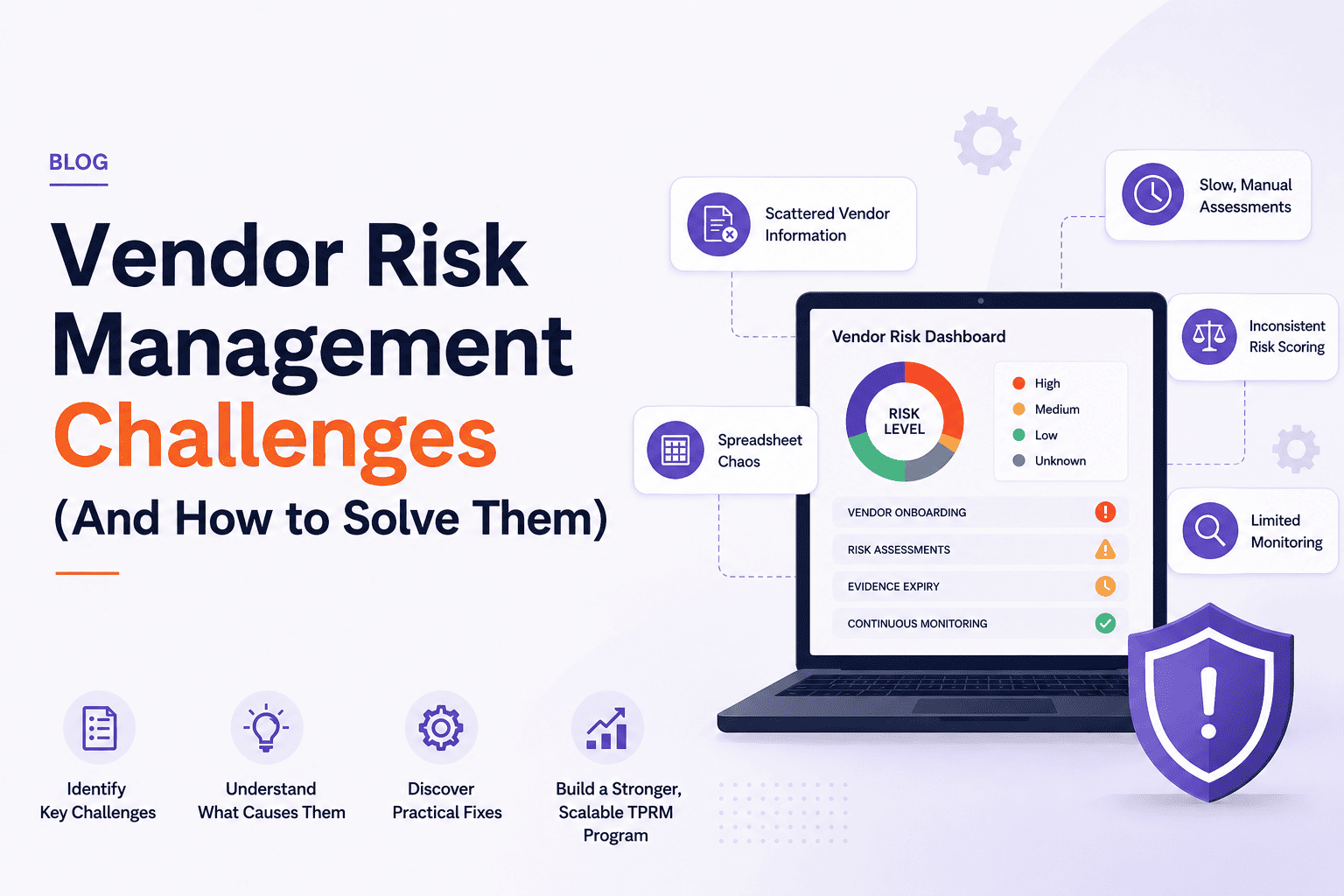
Vendor Risk Management Challenges (And How to Solve Them)
Key Takeaways
- Vendor risk management challenges usually stem from manual processes that become difficult to manage as the number of vendors grows.
- Keeping all vendor information in one place makes it easier to assess and monitor risks.
- Manual reviews, spreadsheets, and inconsistent processes slow down vendor assessments and increase the chance of mistakes.
- Regularly reviewing vendors helps you identify new risks before they become bigger problems.
- Automating repetitive tasks saves time and helps security and compliance teams manage more vendors without adding extra workload.
Introduction
Vendor risk management has become one of the biggest priorities for security and compliance teams. As organisations rely on more cloud providers, software vendors, consultants, and outsourcing partners, the number of third parties that need to be assessed and monitored continues to grow.
According to the Verizon Data Breach Investigations Report (DBIR), 48% of confirmed data breaches now involve a third party, making vendor oversight more important than ever.
The challenge is that most vendor risk programs don’t fail because of a lack of policies. They fail because the process doesn’t scale. Vendor information is scattered across spreadsheets, assessments take weeks to complete, evidence is difficult to track, and risk scoring often varies depending on who performs the review. As the vendor ecosystem expands, these small inefficiencies quickly become major operational and compliance risks.
In this guide, we’ll explore the most common vendor risk management challenges organisations face, why they occur, and practical ways to solve them as your third-party risk management (TPRM) program matures.
Key Vendor Risk Management Challenges most Businesses Face
1. No Central Vendor Inventory
One of the biggest vendor risk management challenges is simply not knowing every third party your organisation works with. Vendors are often managed by different teams, including procurement, finance, IT, HR, and marketing. Over time, each department builds its own records, making it difficult to maintain a complete and up-to-date vendor inventory.
This lack of visibility creates significant risk. If the security or compliance team doesn’t know a vendor exists, they can’t assess its security controls, review compliance documents, or monitor potential risks. Shadow IT makes the problem even worse. For example, a marketing team might subscribe to a new analytics platform using a company credit card without informing procurement or IT. Although the tool now has access to business data, it never enters the formal vendor risk management process.
A central vendor inventory acts as the foundation of any TPRM program. It gives teams a single source of truth for every vendor, what services they provide, the data they access, their risk level, and when they need to be reassessed.
How to solve it: Create a centralised vendor register that automatically pulls vendor information from procurement, finance, and IT systems. This ensures new vendors are captured early and remain visible throughout their lifecycle.
2. Manual Vendor Assessments
Many organisations still rely on email, spreadsheets, and document sharing to complete vendor assessments. A questionnaire is sent to the vendor, responses are chased for weeks, evidence is reviewed manually, and missing information often requires several rounds of follow-up.
While this process may work for a small number of vendors, it quickly becomes unsustainable as the business grows. Security and compliance teams spend more time managing administrative tasks than evaluating actual risks. As a result, important vendor reviews are delayed, while urgent procurement requests often receive priority simply because they have tighter deadlines.
Manual assessments also increase the likelihood of human error. Questions may be overlooked, supporting evidence may not be reviewed thoroughly, and different reviewers may interpret responses differently.
How to solve it: Automate repetitive assessment tasks wherever possible. AI-assisted questionnaires, reusable evidence libraries, and structured review workflows can significantly reduce assessment time while allowing reviewers to focus on genuine risk instead of administrative work.
3. Inconsistent Risk Scoring
Risk scoring helps organisations prioritise which vendors need immediate attention. However, if every analyst applies their own judgement, similar vendors may receive completely different risk ratings.
For example, one reviewer might classify an expired SOC 2 report as a high-risk issue, while another considers it acceptable because the vendor has promised an updated report within a few weeks. These inconsistencies make it difficult to compare vendors fairly or justify remediation decisions during audits.
Inconsistent scoring also reduces confidence in the overall TPRM program. Business leaders cannot prioritise remediation effectively if risk scores are subjective rather than based on clearly defined criteria.
How to solve it: Develop a standard risk scoring methodology that applies the same criteria across every assessment. Using software to automate scoring based on predefined rules further improves consistency and reduces individual bias.
If you are looking to understand and implement your TPRM program, read our complete third-party risk management guide.
4. Missing or Outdated Evidence
Security questionnaires are only one part of a vendor assessment. Organisations also need supporting evidence, such as SOC 2 reports, ISO 27001 certificates, penetration test reports, privacy policies, and other compliance documents.
The problem is that vendors sometimes submit expired certifications, incomplete documentation, or evidence that doesn’t apply to the services your organisation actually uses. Manually reviewing every document takes considerable time, especially when hundreds of vendors are involved.
If outdated evidence goes unnoticed, organisations may believe a vendor meets their security requirements when that is no longer the case.
How to solve it: Maintain a structured evidence repository with automated reminders for expiring documents. Modern TPRM platforms can also flag missing, outdated, or incomplete evidence before it affects compliance reviews or audits.
5. Spreadsheet Chaos
Spreadsheets are often the starting point for vendor tracking because they’re familiar and inexpensive. However, they rarely remain effective as the number of vendors increases.
Multiple versions of the same spreadsheet begin circulating across teams, formulas are accidentally modified, important notes are stored in email threads, and reassessment dates are easily missed. It also becomes difficult to understand the current status of each vendor or generate accurate reports for auditors and management.
What worked well with twenty vendors often becomes overwhelming when an organisation is managing hundreds of third-party relationships.
How to solve it: Replace spreadsheets with a dedicated TPRM platform that stores vendor information, assessment history, risk scores, evidence, and remediation activities in a single, searchable system.
6. Gaps in Continuous Monitoring
Completing a vendor assessment during onboarding doesn’t guarantee the vendor will remain secure throughout the relationship. Security incidents, compliance failures, ownership changes, and newly discovered vulnerabilities can all occur after the initial assessment.
Unfortunately, many organisations only review vendors once a year. This means a vendor’s risk profile could change significantly between assessments without anyone noticing.
Continuous monitoring provides ongoing visibility into vendor risk instead of relying on information collected months earlier. It allows security teams to respond more quickly when new risks emerge.
How to solve it: Supplement periodic assessments with continuous monitoring that tracks security events, compliance status, certification renewals, and other risk indicators throughout the vendor lifecycle.
7. Scaling the Program as the Business Grows
As organisations expand, the number of vendors typically grows much faster than the size of the security or compliance team. Processes that worked well with 30 vendors often become impossible to manage with 300.
Without automation, teams spend more time chasing questionnaires, updating spreadsheets, and preparing reports than performing meaningful risk analysis. Eventually, assessments become backlogged, vendor onboarding slows down, and compliance deadlines become harder to meet.
Many organisations only recognise this problem after an audit finding or a security incident exposes weaknesses in their TPRM process.
How to solve it: Build scalability into the program from the beginning. Automating vendor onboarding, questionnaires, evidence management, risk scoring, and reporting allows organisations to manage a growing vendor ecosystem without proportionally increasing headcount.
Conclusion
Vendor risk management becomes more challenging as your organisation grows. More vendors mean more security questionnaires, more compliance documents, more risk assessments, and more opportunities for something to slip through the cracks. While spreadsheets and manual processes may work for a small vendor base, they quickly become difficult to manage at scale.
The good news is that these challenges are solvable. Building a central vendor inventory, standardising assessments, implementing consistent risk scoring, and continuously monitoring vendors can significantly improve the effectiveness of your TPRM program. As your vendor ecosystem expands, automation becomes essential to maintain accuracy, consistency, and audit readiness.
Platforms like narad help organisations automate these repetitive tasks, enabling security and compliance teams to focus on identifying and reducing risk rather than managing administrative work. Check out narad’s automated third-party risk management tool.
If you are looking for a beginner-friendly explanation. Read our detailed guide on TPRM meaning.
Frequently Asked Questions
1. How can organisations improve vendor risk management?
Organisations can improve vendor risk management by maintaining a central vendor inventory, using standardised assessment processes, implementing consistent risk scoring, continuously monitoring vendors, and automating repetitive tasks such as questionnaires, evidence collection, and reporting.
2. When should a vendor risk assessment be performed?
A vendor risk assessment should be conducted before onboarding a new vendor and repeated periodically based on the vendor’s level of risk. High-risk vendors are typically reassessed annually or whenever there is a significant change to their services, security posture, or compliance status.
3. What is the role of automation in vendor risk management?
Automation reduces the manual effort involved in vendor assessments by streamlining questionnaire management, evidence collection, risk scoring, workflow approvals, and reporting. This allows security and compliance teams to manage more vendors while maintaining consistency and reducing the likelihood of human error.
4. What’s the difference between vendor risk management and third-party risk management?
The terms are often used interchangeably, but third-party risk management (TPRM) is broader. It covers risks associated with all external parties, including vendors, suppliers, contractors, consultants, and service providers. Vendor risk management focuses specifically on organisations that provide products or services to your business.
5. How can tools like Narad help overcome vendor risk management challenges?
Tools like Narad simplify vendor risk management by automating many of the repetitive tasks that slow down security and compliance teams. Instead of relying on spreadsheets and manual follow-ups, Narad centralises vendor information, automates security questionnaires, standardises risk assessments, tracks evidence, and supports continuous monitoring. This helps organisations assess vendors more efficiently, maintain consistency across reviews, and scale their TPRM program as the number of third parties grows, all while improving visibility and audit readiness.