
Automation Tools vs Claude: Which Is Better for Security Questionnaires?
When comparing automation tools vs Claude for security questionnaires, vendor risk assessments (VRAs), due diligence questionnaires (DDQs), and RFPs, you’ve probably had the same thought:
“Why can’t I just upload this to Claude and let it answer everything?”
It’s a reasonable question.
Claude can read hundreds of pages of documentation, summarise policies, and draft answers in seconds. In fact, Claude has become one of the most widely adopted AI assistants for knowledge work, content generation, and document analysis across enterprises. Claude AI statistics and adoption trends
So when organisations start looking at security questionnaire automation tools, many wonder whether they actually need dedicated software at all.
It is a fair question. Anthropic’s Claude is an exceptional AI assistant. It can process massive volumes of text, summarise lengthy PDFs, and draft natural-sounding responses in seconds.
However, in the high-stakes world of enterprise compliance, generating an answer is only 10% of the battle. The other 90% is proving that the answer is accurate, verified, legally defensible, and audit-ready.
When you’re dealing with customer security reviews, regulatory requirements, audits, and enterprise procurement processes, accuracy is only one part of the equation. You also need consistency, approvals, accountability, evidence, and audit trails.
That’s where specialized automation platforms like Narad come in.
In this article, we’ll compare automation tools vs Claude. We’ll explain when a general-purpose AI assistant is enough and when a dedicated compliance automation platform becomes essential.
Why Are Compliance Teams Comparing Automation Tools with Claude?
Over the last few years, enterprise security reviews have become significantly more detailed.
Before signing a contract, customers often send the following:
- Security questionnaires
- Vendor risk assessments (VRAs)
- Due diligence questionnaires (DDQs)
- Compliance reviews
- RFPs and RFIs
Many of these documents contain hundreds of questions covering:
- Data security
- Access management
- Encryption
- Incident response
- Business continuity
- Regulatory compliance
- Third-party risk management
Because many questions are repeated across customers, organisations look for ways to automate the process. This is where AI tools like Claude enter the conversation. Instead of manually answering every question, teams can upload policies and documentation and ask Claude to draft responses.
The approach works well for creating initial drafts. The challenge begins after the answers are generated.
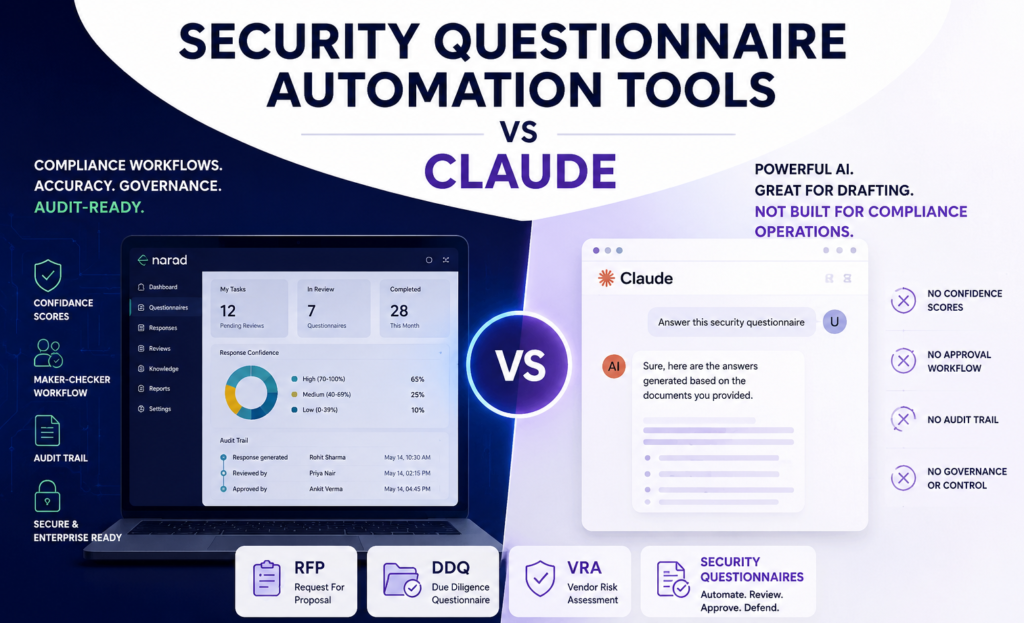
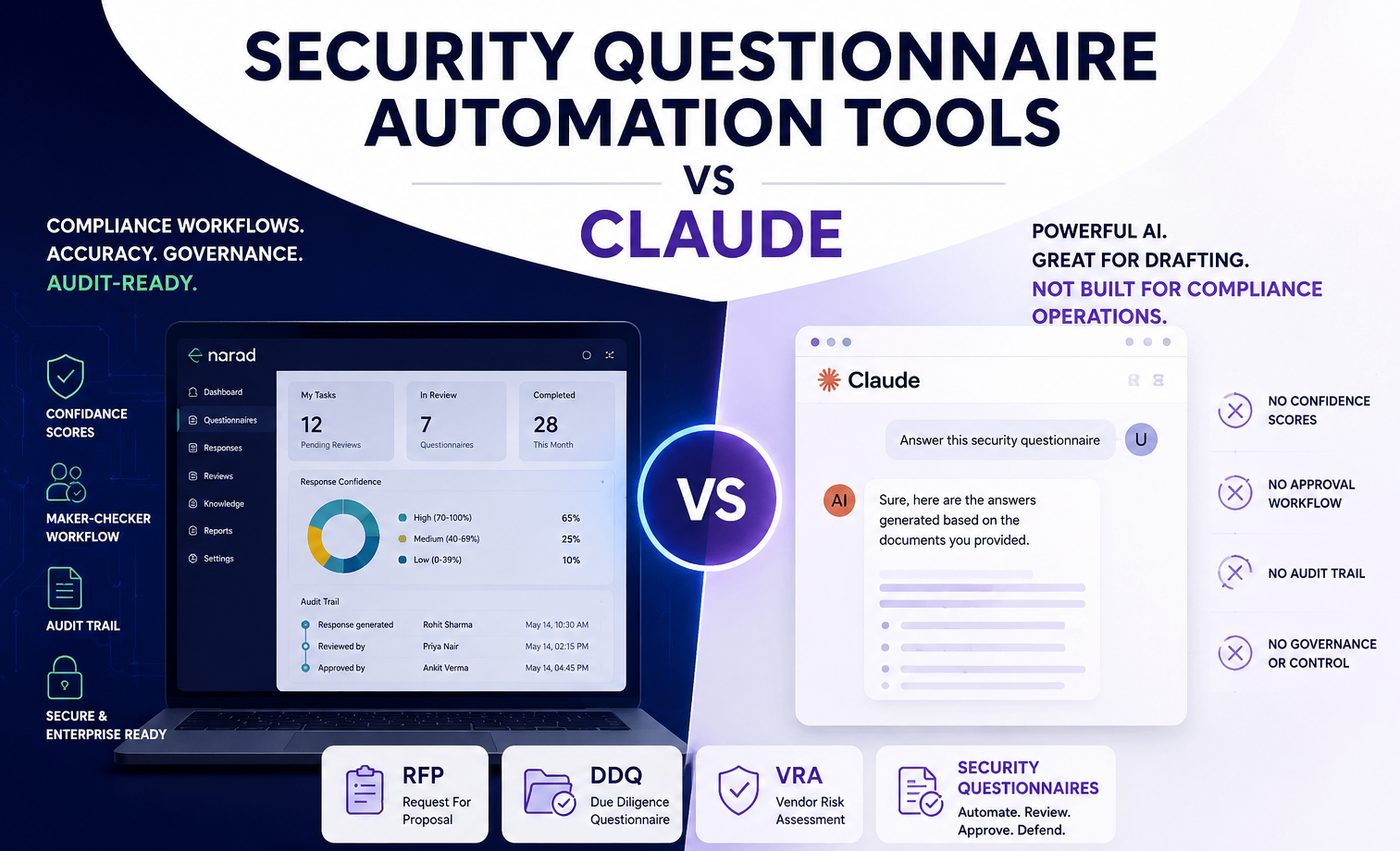
How Are Security Questionnaire Automation Tools Different From Claude?
Let’s look at how a general AI chatbot and a purpose-built compliance platform handle specific workflows. This will help us understand their operational gap.
Capability | Claude | Narad.io |
Primary Purpose | General AI assistant | Purpose-built compliance and questionnaire automation platform |
Security Questionnaires | Can draft responses | Automates end-to-end questionnaire workflows |
Knowledge Management | Manual document uploads | Centralized compliance knowledge repository |
Answer Consistency | Depends on prompts and users | Standardized responses across assessments |
Confidence Scoring | Not available | Confidence score for every generated response |
Source Validation | The user must verify manually | Responses linked to approved organizational knowledge |
Maker-Checker Workflow | Not available | Built-in review and approval process |
Audit Trail | No structured audit history | Complete audit logs and approval records |
Team Collaboration | Chat-based interaction | Multi-user compliance workflow |
Evidence Management | Manual process | Reference-backed responses |
Compliance Governance | Limited | Built specifically for governance and compliance operations |
Review Assignments | Manual | Automated routing and review workflows |
Institutional Knowledge Retention | Stored across chats and files | Centralized and reusable knowledge base |
Audit Readiness | Requires additional processes | Designed for audit-ready submissions |
What’s the Problem with Using Claude Alone?
The biggest misconception is that answering questionnaires is primarily a writing task.
Responding to questionnaires is not simply generating responses. But it’s about following the compliance processes. The real challenge is making sure those answers are:
- Accurate
- Consistent
- Approved
- Traceable
- Audit-ready
To understand the difference in practice, let’s look at a realistic enterprise scenario.
Your sales team is on the verge of closing a landmark seven-figure deal. The prospect sends over a 250-question risk assessment. Eager to clear the hurdle, a compliance analyst copies and pastes your company’s internal information security policy into Claude, uploads the spreadsheet, and prompts. “Answer these questions based on our policy.”
Ten minutes later, Claude spits out a beautifully formatted, highly articulate set of answers. The text looks perfect. The analyst copies it into the client’s portal and hits submit.
Six months later, during a routine SOC 2 renewal audit or a customer security review, an inspector zeroes in on Question 142: “Do you perform continuous automated vulnerability scanning on all production microservices, and how are remediation SLAs enforced?”
Claude answered: “Yes, we perform continuous automated scanning across all production environments using industry-standard tools, and critical vulnerabilities are remediated within 24 hours.”
The auditor asks for the receipts.
Suddenly, your team is scrambling. You discover that while your draft policy mentioned a 24-hour SLA goal, your engineering team’s actual operational SLA is 72 hours, and continuous scanning was only partially rolled out to a legacy cluster.
Now, you face a series of cascading risks:
- Contractual Breach: You have legally attested to a security control you do not actually maintain.
- Audit Scrutiny: The auditor expands their sample size, delaying your SOC 2 report.
- Customer Churn Risk: The enterprise customer loses faith in your security assertions, putting the renewal in jeopardy.
How do tools like narad.io make a difference?
If that same 250-question document had been processed through Narad.io, the workflow would have looked fundamentally different:
- Step 1: Ingestion & Parsing: Narad breaks the questionnaire down, mapping questions against your centralised knowledge repository.
- Step 2: Confidence Evaluation: For the vulnerability scanning question, Narad analyses past questionnaires and current policies. It notices a discrepancy between a newly uploaded policy draft and an older answered questionnaire. Instead of guessing, it flags the response with a medium confidence score.
- Step 3: Source Verification: The platform clearly displays the exact source of its drafted answer alongside a warning note: “Matches Draft Policy v2, but conflicts with past submission to Client X.”
- Step 4: Automated Routing: Because the answer is flagged as medium confidence, Narad automatically routes it to the Head of SecOps for review, skipping the high-confidence answers that require no human intervention.
- Step 5: The Maker-Checker Sign-off: The SecOps engineer corrects the SLA to 72 hours, uploads the actual configuration file as evidence, and approves it. Narad logs this edit, locks it as the new truth, and saves the audit trail.
Why Does True Compliance Require “Maker-Checker” Governance?
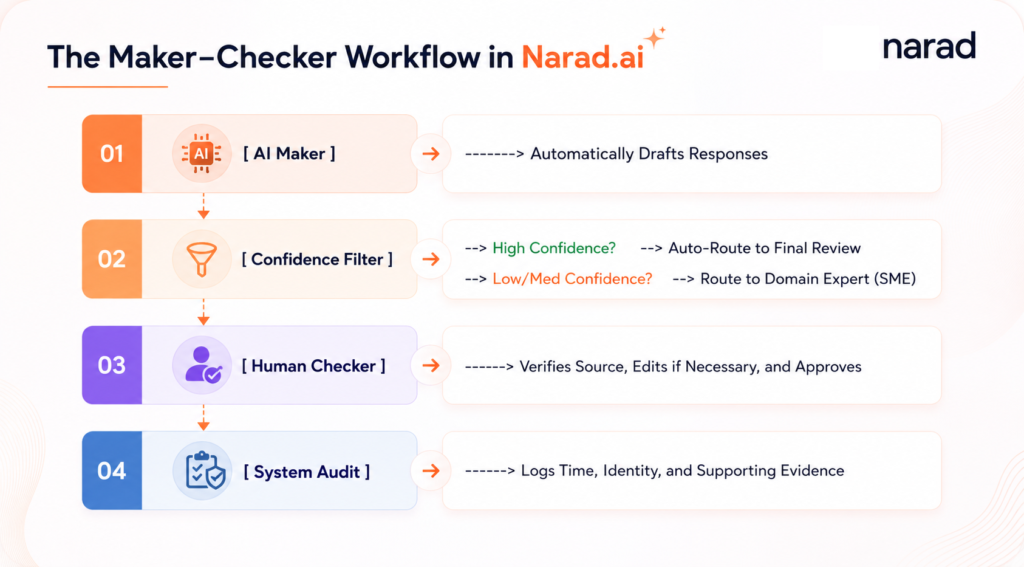
In financial services and cybersecurity, the Maker-Checker principle (also known as the Four-Eyes principle) is a fundamental control mechanism. It dictates that every high-risk transaction or data point must be created by one person (the Maker) and reviewed and authorised by another (the Checker).
Claude is an isolated “Maker.” It creates content but cannot act as its own checker, nor does it provide an environment where a human checker can systematically sign off on its work.
Narad doesn’t simply copy-paste the responses. It creates a structured compliance operation by enforcing this workflow:
- Accountability: You know exactly which analyst ran the automation and which executive authorised the final submission.
- Continuous Improvement: When a human “Checker” modifies an AI-drafted response to make it more accurate, Narad automatically feeds that correction back into your centralised knowledge base. The system gets smarter with every single questionnaire you complete.
- Auditor Delight: When a third-party auditor asks why a certain response was given, you don’t show them a chaotic Slack thread or an untraceable AI chat log. You export a clean, system-generated audit report showing the exact lifecycle of that answer.
Automation Tools vs Claude: When to Choose What?
To help your team make an objective decision, use this operational checklist to determine which approach aligns with your current risk profile and business goals.
Choose Claude if your organisation fits this profile:
- You receive fewer than 5 security questionnaires or RFPs per year.
- You do not sell to highly regulated industries (e.g., healthcare, fintech, government, enterprise banking).
- Your security review process is managed entirely by a single person who has total context of every policy and system change.
- You do not maintain formal compliance frameworks like SOC 2, ISO 27001, or FedRAMP, and you are not subject to regular external audits.
Choose a specialised platform like Narad.io if your organisation fits this profile:
- You are scaling your B2B enterprise sales pipeline and handling dozens (or hundreds) of questionnaires annually.
- Multiple internal stakeholders (sales, security, legal, and product) must collaborate and sign off on responses.
- You require a central, immutable source of truth for your compliance data that updates automatically as your company grows.
- You need to dramatically reduce the time your engineering teams spend answering questionnaires so they can focus on core product development.
- You view security and compliance transparency as a competitive differentiator that can be used to win deals faster.
Conclusion: In Compliance, Governance is the Ultimate Feature
Artificial intelligence has fundamentally changed how businesses manage data, and tools like Claude are undeniably brilliant at processing language. But language generation is merely a feature; governance is a business strategy.
Using Claude alone to fill out security questionnaires is like hiring a fast typist to run your legal department. They can produce pages of text in record time, but they lack the context, the guardrails, and the systemic accountability required to protect your organisation from risk.
When a customer or an auditor reviews your security posture, they aren’t evaluating your ability to generate clean prose. They are evaluating whether they can trust you with their data.
Ready to transform your security questionnaire workflow from a risky manual chore into an efficient, audit-ready compliance operation? Book a demo with Narad.io today.
Check out Narad’s