
Key Takeaways
- narad.io and AutoRFP both use AI to automate security questionnaires, but they are designed for different teams and workflows.
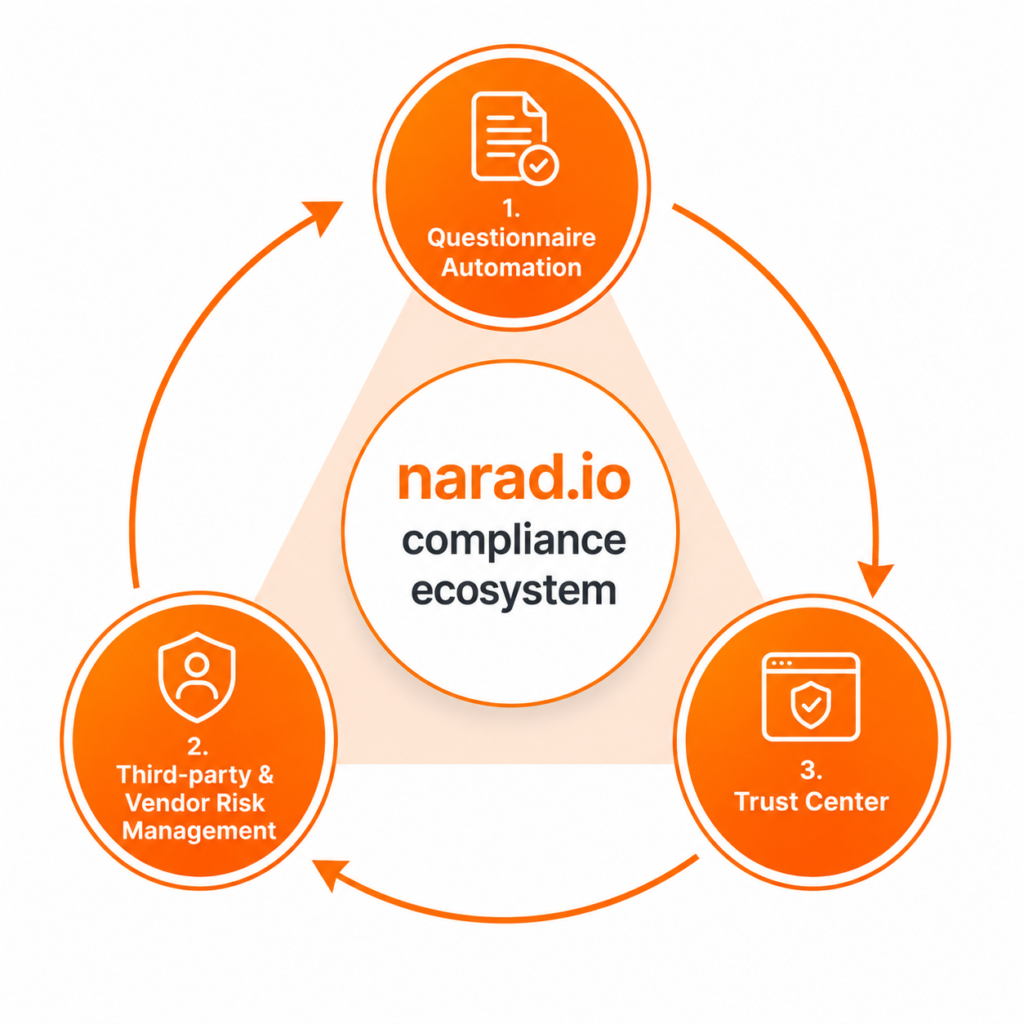
- AutoRFP focuses on one part of the compliance workflow – responding to questionnaires. narad.io provides a broader compliance ecosystem. Teams can create and send security questionnaires, respond to customer assessments, manage vendor risk, perform TPRM, maintain a Trust Center, and centralise compliance activities from a single platform.
- narad.io is purpose-built for security, compliance, and GRC teams handling security questionnaires, vendor risk assessments, and third-party risk management (TPRM).
- AutoRFP is best suited for sales, bid, and proposal teams managing RFPs, RFIs, and tenders at scale.
- If your biggest challenge is winning more bids, AutoRFP is a strong choice. If your focus is reducing compliance effort and managing vendor risk, narad.io offers a more comprehensive solution.
Introduction
Choosing the right security questionnaire automation platform isn’t always straightforward. Search for AI-powered questionnaire tools and you’ll quickly come across names like narad.io and AutoRFP. Both use artificial intelligence to reduce manual work, improve response quality, and help teams complete long questionnaires faster.
The challenge is that while these platforms appear similar at first glance, they’re designed for different users. One focuses on helping sales and proposal teams respond to RFPs and tenders more efficiently, while the other is built specifically for security, compliance, and vendor risk management teams.
This reflects a broader trend in enterprise software. According to Gartner, organisations are increasingly adopting specialised AI tools designed for specific business functions rather than relying on a single platform to solve every workflow. As AI becomes more embedded across the enterprise, choosing software that aligns with your team’s day-to-day responsibilities is often more important than choosing the platform with the longest feature list.
In this comparison, we’ll look at Narad vs AutoRFP across features, use cases, compliance capabilities, pricing, and ideal customers. The goal isn’t to declare one platform universally better than the other but to help you understand which solution is the right fit for your organisation.
What Does narad.io Do?
Rather than focusing on a single workflow, narad.io is an AI-powered Governance, Risk, and Compliance (GRC) platform that brings together multiple security and compliance processes into one system. Instead of using separate tools for security questionnaires, vendor assessments, third-party risk management, and compliance documentation, teams can manage everything from a single platform.
1. Security Questionnaire Automation
Security questionnaires are repetitive by nature. Customers ask many of the same questions about security controls, certifications, data handling, access management, and compliance.
narad.io uses AI to generate accurate, reference-backed responses using your approved policies, certifications, previous questionnaire responses, and internal documentation. Every answer is grounded in your own knowledge base rather than generic AI responses, helping maintain consistency while reducing manual effort.
Check out the security questionnaire automation here.
2. Third-Party Risk Management (TPRM)
Managing vendor risk doesn’t stop after collecting a questionnaire.
narad.io includes a complete Third-Party Risk Management (TPRM) module that helps organisations
- Onboard vendors through structured assessments
- Classify vendors based on risk
- Review security controls and supporting evidence
- Identify control gaps
- Track remediation activities
- Reassess vendors periodically
- Monitor ongoing vendor risk
This gives security and compliance teams continuous visibility across their vendor ecosystem instead of relying on spreadsheets or disconnected processes.
Check out third-party risk management tool here.
3. Vendor Risk Assessments
Vendor risk assessments (VRA) often involve multiple stakeholders, supporting documents, approval workflows, and risk scoring.
narad.io standardises this entire process, making assessments more consistent and easier to manage. Teams can evaluate vendors against internal security requirements while maintaining a complete audit trail of every review and approval.
Automate vendor risk assessment here.
4. Trust Center & Compliance Evidence
Enterprise customers increasingly expect vendors to share security documentation before doing business.
narad.io includes a Trust Center where organisations can securely publish policies, certifications, penetration test summaries, audit reports, and other compliance evidence. This reduces repetitive document requests while giving customers faster access to the information they need.
Check out narad.io’s interactive trust centre.
5. Centralised Knowledge Base
Instead of searching across folders, emails, and previous questionnaires, narad.io stores approved responses, policies, security documentation, certifications, and compliance evidence in one central location.
As more assessments are completed, the knowledge base continues to grow, making future questionnaires faster and more consistent.
6. Built for Security & Compliance Teams
Unlike general AI writing tools, narad.io is designed specifically for security and compliance workflows.
The platform includes structured review and approval processes, complete audit trails, and evidence-backed AI responses to support the governance requirements expected in regulated industries.
narad.io is also SOC 2 compliant and regularly undergoes Vulnerability Assessment and Penetration Testing (VAPT), reflecting the same security-first approach it helps customers implement.
Whether you’re responding to customer security reviews or managing hundreds of third-party vendors, narad.io provides a single platform to simplify security questionnaires, vendor risk management, and broader compliance operations.
What Does AutoRFP Do?
AutoRFP is an AI-powered platform designed to help organisations respond to RFPs, RFIs, security questionnaires, and other procurement documents more efficiently.
Its primary focus is helping proposal, bid, sales, and revenue teams reduce the time spent answering repetitive questions while improving collaboration across subject matter experts.
The platform uses an AI-powered knowledge base to reuse previously approved responses, generate draft answers, and maintain consistency across proposals. Teams can collaborate on responses, assign questions to subject matter experts, and track progress throughout the proposal process.
For organisations that respond to a high volume of RFPs, AutoRFP helps reduce manual effort and accelerate response times, allowing proposal teams to focus on higher-value work instead of repeatedly writing similar answers.
While AutoRFP also supports security questionnaires, its primary focus remains proposal management and questionnaire response automation. Organisations looking for a solution to improve bid efficiency and streamline proposal workflows will find it well suited to those use cases.
narad.io vs AutoRFP
1. Feature Comparison
| Capability | AutoRFP | narad.io |
|---|---|---|
| AI-powered Security Questionnaire Automation |  | |
| AI Knowledge Base | | |
| RFP & Proposal Automation | | |
| Vendor Risk Assessments | Limited | |
| Third-Party Risk Management (TPRM) |  | |
| Vendor Onboarding Workflows | | |
| Risk Scoring & Remediation Tracking | | |
| Continuous Vendor Monitoring | | |
| Trust Center | | |
| SOC 2 Compliant Platform | | |
| Regular VAPT Assessments | — | |
2. Pricing Comparison
Pricing is an important factor when choosing any software platform, but it’s equally important to understand what you’re paying for. While both platforms use AI to automate questionnaires, they follow different pricing models because they’re built for different use cases.
| Pricing Factor | AutoRFP.ai | narad.io |
|---|---|---|
| Pricing Model | Project-based pricing | Usage-based, customised pricing |
| Starting Price | USD 899/month (billed annually) | Starts from USD 999/year (approx. USD 83/month) |
| Enterprise Plan | Custom | Custom |
| Best Suited For | Sales, proposal, and bid teams | Security, compliance, and TPRM teams |
| Pricing Scales With | Number of projects | Usage, questionnaire volume, vendor count, and compliance requirements |
AutoRFP.ai follows a transparent project-based pricing model. Its Scale plan starts at USD 899 per month and includes 24 projects per year, while the Accelerate plan supports 50 projects per year for USD 1,299 per month. Both plans include unlimited users, AI usage, integrations, SSO, and enterprise security features. This makes it easy for proposal teams to estimate costs if they handle a predictable number of RFPs annually.
narad.io uses a more flexible pricing model. Plans start from just USD 999 per year (approximately USD 83 per month), with pricing based on factors such as questionnaire volume, platform usage, vendor count, and the scope of your compliance programme. This allows organisations to start small and scale the platform as their security and compliance requirements grow.
Which Offers Better Value?
The better value depends on your team’s objectives. If your primary goal is responding to a high volume of RFPs, RFIs, and proposal documents, AutoRFP.ai offers a straightforward pricing model that’s easy to budget for.
If your organisation needs more than questionnaire automation, such as security questionnaire automation, third-party risk management (TPRM), vendor risk assessments, a trust centre, compliance workflows, and continuous vendor monitoring, narad.io provides a broader compliance platform with an entry price that is accessible even for growing SaaS companies. Rather than paying only for project volume, organisations can adopt a solution that grows alongside their security and compliance program.
3. Use Case Comparison: Which Platform Is Right for Your Team?
Although narad.io and AutoRFP.ai both use AI to automate questionnaires, they’re designed for different business challenges. The best choice depends on who will use the platform and what you’re trying to accomplish.
| Use Case | AutoRFP.ai | narad.io |
|---|---|---|
| Responding to RFPs and RFIs | Best Fit |  Supports security questionnaires Supports security questionnaires |
| Proposal & Bid Management | Best Fit | |
| Security Questionnaire Automation | | |
| Responding to Enterprise Security Reviews | | Best Fit |
| Vendor Risk Assessments (VRA) | Limited | |
| Third-Party Risk Management (TPRM) | | |
| Vendor Onboarding & Risk Reviews | | |
| Continuous Vendor Monitoring | | |
| Trust Center & Compliance Evidence Sharing | | |
| Security & Compliance Teams | Good | Best Fit |
| Sales & Proposal Teams | Best Fit | Good |
Choose AutoRFP.ai if:
AutoRFP.ai is a strong choice if your organisation’s biggest challenge is responding to a large number of RFPs, RFIs, DDQs, and proposal documents. It is designed for sales, proposal, and bid teams that want to improve response speed, collaborate more effectively, and increase their chances of winning new business.
Choose narad.io if:
Choose narad.io if your security or compliance team spends significant time managing security questionnaires, vendor risk assessments, third-party risk management (TPRM), compliance evidence, and customer security reviews. Rather than solving a single workflow, narad.io brings these activities together into one platform, helping organisations reduce manual effort while maintaining a consistent, audit-ready compliance process.
FAQ
1. Is Narad.io a replacement for AutoRFP?
Not exactly. Narad focuses on Infosec questionnaires, vendor risk, and compliance frameworks, while AutoRFP.ai focuses on the broader RFP and tender process. Many companies use both, assigned to different teams.
2. Which platform is better for a security or compliance manager?
narad.io is purpose-built for security and compliance teams. It helps automate security questionnaires, manage vendor risk assessments, support Third-Party Risk Management (TPRM), identify compliance gaps, and maintain a Trust Center for securely sharing approved security documentation. While AutoRFP.ai supports security questionnaires, they are one of several document types it automates rather than its primary focus.
3. Does Narad support Indian regulatory frameworks like RBI or SEBI guidelines?
Narad’s framework-mapping approach is built to extend to regional and sector-specific regulations as part of its compliance automation, which matters for BFSI and NBFC vendors operating under Indian regulatory oversight.
4. How is Narad’s pricing structured compared to AutoRFP.ai?
AutoRFP.ai uses a fixed, project-based model published on its site. Narad’s pricing scales with vendor count and questionnaire volume, reflecting the ongoing nature of vendor risk management rather than a per-project count.
5. Can a growing SaaS company start with just one platform?
Yes. If your Infosec questionnaire volume is still low, AutoRFP.ai can likely cover it as part of your broader RFP process. Once questionnaires become a recurring, standalone workload, a dedicated tool like Narad becomes worth the switch.
Conclusion
Every organisation reaches a point where spreadsheets, shared folders, and manual questionnaires are no longer enough. As customer expectations increase and vendor ecosystems become more complex, security and compliance teams need tools that help them work more efficiently without sacrificing governance.
Whichever platform you choose, the goal should be the same: reduce repetitive work, improve consistency, and give your team more time to focus on managing risk rather than administrative tasks.