
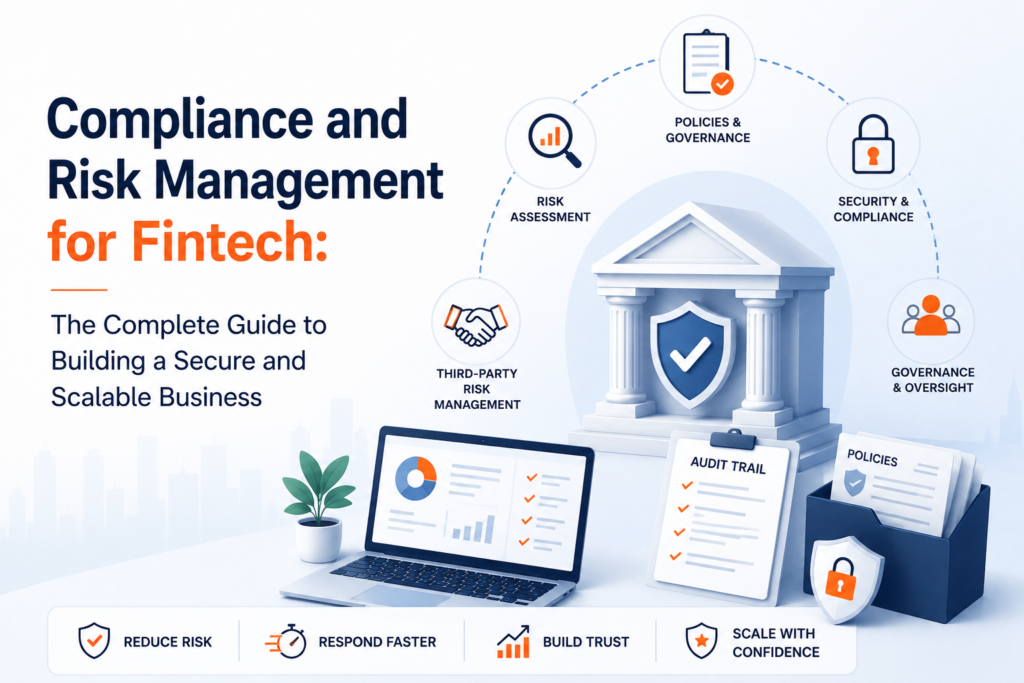
Compliance and Risk Management for Fintech: Complete Guide (2026)
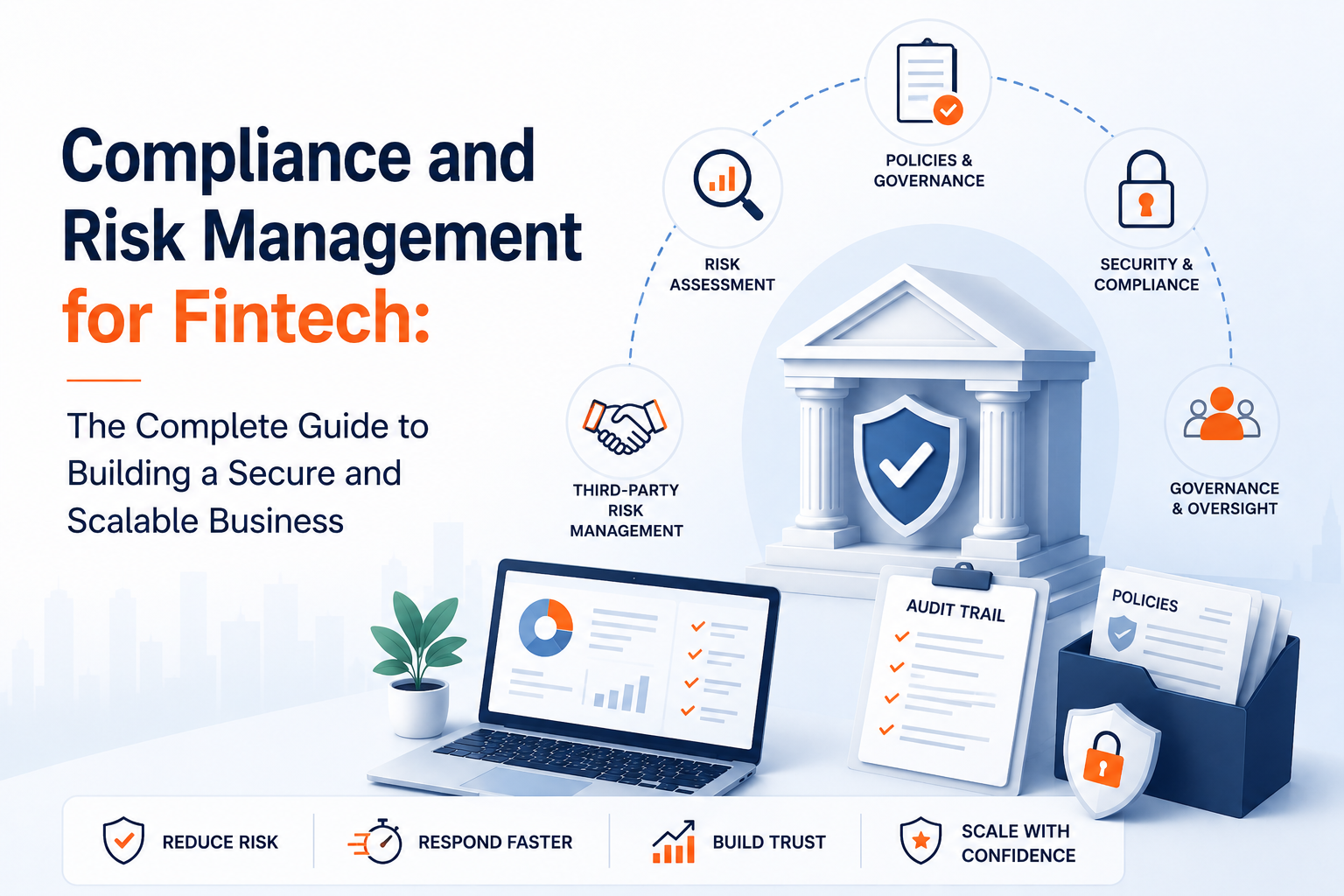
Key Takeaways
- Compliance and risk management for fintech go beyond regulatory compliance. They are essential for building customer trust, winning enterprise deals, and scaling the business.
- A strong compliance programme combines governance, risk assessments, vendor risk management, security questionnaires, incident response, and audit-ready documentation.
- As fintech companies grow, manual compliance processes become difficult to manage, making automation essential for maintaining accuracy and efficiency.
- Third-party vendors, cybersecurity threats, and changing regulations are among the biggest risks fintech companies must actively monitor and manage.
- AI-powered GRC platforms like Narad help security and compliance teams automate repetitive work, strengthen governance, and stay audit-ready.
Introduction
Compliance and risk management for fintech is no longer just about passing audits or meeting regulatory requirements. As fintech companies grow, they handle more sensitive financial data, work with more third-party vendors, and face increasing scrutiny from regulators, enterprise customers, and investors. Strong compliance has become essential for building trust and supporting long-term growth.
At the same time, managing compliance is becoming more complex. Organisations must keep up with evolving regulations, assess vendor risks, respond to security questionnaires, prepare for due diligence, and maintain evidence that can withstand audits. A single compliance failure or unmanaged security risk can lead to financial penalties, lost business opportunities, and reputational damage.
The good news is that compliance doesn’t have to slow your business down. With the right governance, processes, and technology, it can become a competitive advantage that helps you close enterprise deals faster, strengthen customer confidence, and reduce operational risk.
In this guide, we’ll explore the key components of a modern fintech compliance programme, the biggest risks organisations face, best practices for managing compliance at scale, and how automation can help security and compliance teams work more efficiently.
What Is Compliance and Risk Management for Fintech?
These three terms get used interchangeably in fintech conversations, but they describe distinct functions that work together.
- Compliance is the practice of meeting the legal, regulatory, and contractual obligations that apply to your business. For a fintech company, this could include complying with financial regulations in the markets where you operate, adhering to the Payment Card Industry Data Security Standard if you process payment card data, maintaining certifications such as ISO/IEC 27001, or meeting General Data Protection Regulation requirements when handling the personal data of European customers. Compliance is about following the rules that govern your business. It answers the question, “Are we doing what we’re required to do?”
- Risk management is broader. It’s the ongoing practice of identifying, assessing, and mitigating the things that could harm your business, such as, financial loss, operational disruption, reputational damage, regulatory penalties, etc. Risk management answers a different question: “What could go wrong, and how exposed are we?”
- Governance is the structure that makes both of these functions actually work. It’s the policies, roles, decision rights, and oversight mechanisms that determine who is accountable for compliance and risk decisions, how those decisions get made, and how they’re documented. Without governance, compliance becomes a checklist nobody owns, and risk management becomes a conversation that happens after something has already gone wrong.
The relationship between the three is sequential and reinforcing. Governance defines who is responsible and how decisions get made. Risk management identifies what needs attention. Compliance ensures the organisation meets its specific obligations in response to those risks. A fintech company with strong compliance but weak risk management will pass audits while remaining exposed to risks nobody is actively tracking. A company with strong risk management but weak governance will identify problems without a clear path to fixing them. You need all three working together.
For more details, read our guide on understanding GRC.
Why Compliance and Risk Management Matter for Fintech Companies
The case for investing in compliance and risk management isn’t purely defensive anymore. It touches nearly every part of how a fintech company grows.
1. Regulatory obligations
Fintech companies operate in one of the world’s most heavily regulated industries. Depending on where they do business, they may need to comply with financial regulations, data privacy laws, cybersecurity requirements, and industry standards. This could include frameworks such as the General Data Protection Regulation for organisations serving customers in Europe, the Payment Card Industry Data Security Standard for businesses that process payment card data, or regulations issued by financial authorities in the markets where they operate. Non-compliance isn’t just a legal risk. It can lead to financial penalties, operational restrictions, increased regulatory scrutiny, and damage to customer confidence.
2. Customer trust
Fintech companies handle customers’ money, financial transactions, and sensitive personal information. That makes trust as important as the product itself. A single security incident or compliance failure can damage a company’s reputation and take years to recover from. On the other hand, organisations that demonstrate a strong security and compliance posture through a Trust Center, independent certifications such as SOC 2 or ISO 27001, and transparent security practices build confidence with customers and differentiate themselves from competitors.
3. Enterprise sales
Winning enterprise customers often means passing a rigorous vendor security review before a contract is signed. Banks, insurers, payment providers, and large enterprises increasingly require vendors to complete detailed security questionnaires, vendor risk assessments, and due diligence reviews before sharing sensitive data or integrating critical systems. Fintech companies that can respond quickly with accurate, well-documented answers move through procurement faster, while those relying on manual processes often experience unnecessary sales delays.
4. Investor due diligence
Compliance and risk management have become an important part of fundraising, particularly as fintech companies grow beyond the early stages. Investors want evidence that the business has documented policies, clear governance, effective internal controls, and a structured approach to managing regulatory and operational risk. Companies that can produce this information quickly demonstrate operational maturity, while those that cannot may face additional questions that slow investment decisions.
5. Operational resilience
Risk management isn’t only about preventing incidents. It’s about ensuring the business can continue operating when disruption occurs. Cyberattacks, third-party outages, regulatory changes, fraud attempts, and operational failures are inevitable as organisations scale. Companies with mature risk management practices detect issues earlier, respond more effectively, and recover with less disruption to customers and business operations.
6. Avoiding penalties
Regulatory fines are often the most visible consequence of poor compliance, but they’re rarely the largest cost. Investigations, legal expenses, customer notifications, remediation efforts, business disruption, and reputational damage can have a far greater financial impact. Investing in strong compliance and risk management helps organisations reduce both the likelihood and the long-term cost of these events.
7. Competitive advantage
Strong compliance is no longer just about satisfying regulators. It has become a competitive differentiator. Enterprise customers increasingly prefer vendors that can demonstrate mature security controls, transparent governance, and efficient compliance processes. Fintech companies that can provide evidence quickly, respond confidently to security reviews, and maintain audit-ready documentation are more likely to win enterprise deals and build long-term customer trust.
The Biggest Risks Facing Modern Fintech Companies
A working risk management programme starts with a clear-eyed view of where the exposure actually sits. For most fintech companies, the exposure clusters around six categories.
1. Operational Risk
Operational risk covers the everyday failures that can disrupt your business: process breakdowns, system outages, human error, and inadequate internal controls. For fintech companies, this often shows up as failed transaction processing, reconciliation errors, or gaps in segregation of duties that allow mistakes, or fraud, to go undetected. Operational risk tends to be underestimated because it rarely makes headlines the way a security breach does, but it’s frequently the source of regulatory findings during routine audits.
2. Cybersecurity Risk
Fintech companies are high-value targets. They sit on financial data, personal information, and payment credentials, all of which carry resale value to attackers. Cybersecurity risk spans everything from phishing and credential compromise to vulnerabilities in customer-facing applications and inadequate access controls on internal systems. Regulatory frameworks globally have increasingly explicit cybersecurity requirements, which means cybersecurity risk and regulatory risk are now tightly linked for fintech companies.
Also Read: How to do a Cybersecurity Incident Reporting
3. Third-Party Risk
Almost no fintech company operates without vendors such as payment processors, cloud infrastructure providers, KYC verification services, and customer support tools. Each of these relationships introduces risk that originates outside your own walls but lands squarely on your shoulders if something goes wrong. A vendor breach, an unpatched vulnerability in a third-party API, or a subprocessor that doesn’t meet your data-handling standards can all create regulatory and reputational exposure for you. This is why a structured vendor risk assessment process has become a baseline expectation rather than a nice-to-have for fintech companies of any size.
4. Regulatory Risk
Regulatory risk is the exposure that comes from operating in a constantly shifting rulebook. Frameworks get updated, new reporting obligations get introduced, and enforcement priorities shift. Fintech companies operating across multiple jurisdictions face compounding regulatory risk as they need to track and satisfy multiple regimes simultaneously.
5. Fraud Risk
Fraud risk includes account takeover, payment fraud, synthetic identity fraud, and internal fraud by employees or contractors with privileged access. Fintech companies face fraud risk both as a direct financial threat and as a compliance obligation, since most AML and KYC frameworks exist specifically to detect and prevent it. Weak fraud controls don’t just cost money directly, but they also generate the kind of suspicious activity reports and regulatory findings that erode trust with both regulators and enterprise customers.
6. Data Privacy Risk
Data privacy risk covers the handling, storage, and processing of personal and financial data in ways that meet regulatory requirements and customer expectations. This spans consent management, data minimisation, cross-border data transfer rules, and the right of individuals to access or delete their data. As more jurisdictions adopt GDPR-style privacy frameworks, data privacy risk has become one of the fastest-moving categories fintech compliance teams need to track.
The Core Components of a Fintech Compliance Program
A successful compliance programme is made up of several moving parts. Each plays an important role in helping fintech companies manage risk, meet regulatory requirements, and prepare for audits. Let’s look at the key components.
Governance & Policies
Every compliance programme starts with good governance. This means having clear policies that define how your organisation protects data, manages security risks, responds to incidents, and works with third-party vendors.
However, writing policies is only the first step. They should be reviewed regularly, aligned with regulatory requirements, and reflected in how your teams actually work. A policy that exists only for an audit won’t help you reduce risk or demonstrate compliance.
Risk Assessment
Risk assessment is the process of identifying, evaluating, and prioritising the risks your organisation faces. These could be cybersecurity risks, operational risks, regulatory risks, or risks introduced by third-party vendors.
Risk assessments shouldn’t be treated as an annual compliance exercise. Every new product, customer, vendor, or regulatory change can introduce new risks. A mature compliance programme continuously reviews these changes so teams know which risks need immediate attention and where to focus their resources.
Vendor Risk Management
Today’s organisations rely on dozens, sometimes hundreds, of third-party vendors. Each one can introduce security, operational, or compliance risks.
Vendor risk management helps you assess vendors before onboarding, classify them based on the level of risk they introduce, collect supporting evidence, and reassess them periodically. This ensures vendors continue meeting your security and compliance requirements as your business grows.
For a detailed breakdown, read our guide to vendor risk assessments (VRA).
Security Questionnaires
Security questionnaires have become a standard part of enterprise sales and vendor due diligence. Before doing business with you, customers want to understand how you protect their data and whether your security controls meet their requirements.
The challenge is that many questionnaires ask similar questions, making the process repetitive and time-consuming. As companies scale, manually completing every questionnaire can slow down both security teams and sales cycles. That’s why many organisations are adopting security questionnaire automation to improve speed while maintaining accuracy.
Also read: The Best Tools to Automate Security Questionnaires.
Due Diligence
Due diligence is a more detailed review of your business that typically takes place during fundraising, mergers and acquisitions, strategic partnerships, or large enterprise deals.
Unlike a standard security questionnaire, due diligence covers multiple areas, including security, legal, financial, operational, and compliance practices. Being prepared with the right documentation can significantly speed up these reviews and build confidence with potential investors and customers.
Learn more in our guide to due diligence questionnaires’ meaning.
Incident Management
No matter how strong your security programme is, incidents can still happen. What matters is how quickly and effectively your organisation responds.
Incident management covers the entire response process from detecting and containing an incident to investigating what happened, notifying the right stakeholders, and meeting any regulatory reporting requirements. A documented and well-tested incident response process is an essential part of every compliance programme.
We’ve covered this in detail in our guide to security incident reporting.
Evidence & Documentation
Compliance isn’t just about saying you have security controls in place—it’s about proving it.
Your organisation should maintain policies, certifications, audit reports, penetration test results, and other supporting documents in a structured way. Having this evidence readily available makes customer reviews, audits, and compliance assessments much faster. Many organisations also use a Trust Center to securely share this information without repeatedly responding to individual requests.
Approvals & Audit Trails
Every important compliance decision should have a clear approval process and a record of who approved it.
Whether you’re reviewing a security questionnaire, approving a vendor, or accepting a risk, it’s important to capture who made the decision, what changed, and when it happened. Many organisations use a maker-checker workflow, where one person prepares the response and another reviews and approves it. This improves accuracy, strengthens governance, and creates the audit trail that customers, auditors, and regulators expect.
How Narad Helps Fintech Teams Strengthen Compliance
Narad is built by a compliance professional who spent more than two decades helping global organisations, including Barclays, manage security, risk, and regulatory requirements.
That experience shapes every part of the platform. Instead of replacing compliance professionals, Narad removes the repetitive work that slows them down. Whether that’s responding to security questionnaires, reviewing vendors, managing evidence, or preparing for audits, Narad takes care of all sorts of compliance processes. The goal is simple: help compliance teams spend less time on paperwork and more time reducing risk and supporting business growth.
Narad is SOC 2 compliant and trusted by security and compliance teams at organisations including Exotel, Cockroach Labs, VideoSDK, and other fast-growing technology companies. Built with enterprise security in mind, it combines AI with structured review workflows, audit trails, and evidence-backed responses, giving teams the confidence to automate without compromising accuracy.
Frequently Asked Questions
1. What is fintech compliance?
‘Fintech compliance’ refers to the practice of meeting the legal, regulatory, and contractual obligations specific to financial technology companies. It includes data protection, cybersecurity, anti-money laundering, and sector-specific regulatory frameworks like those set by the RBI, SEBI, or international bodies depending on where the company operates.
2. How often should risk assessments be performed?
Risk assessments should be continuous rather than a once-a-year exercise. At minimum, conduct a full assessment annually, but trigger additional assessments whenever you onboard a new vendor, launch a new product, expand into a new market, or experience a significant incident.
3. Who owns compliance in a fintech company?
Compliance ownership typically sits with a Chief Compliance Officer, Head of Risk, or, at smaller companies, a founder or operations lead. But effective compliance requires distributed accountability across engineering, sales, legal, and leadership, each responsible for their own contribution to the organisation’s overall posture.
4. How do fintech companies manage vendor risk?
Fintech companies manage vendor risk by classifying vendors into risk tiers based on the sensitivity of data or systems they touch, running structured assessments before onboarding, and reassessing periodically. This process is increasingly supported by automation tools that speed up both the assessment and the response side of vendor risk management.
5. What are security questionnaires?
Security questionnaires are structured sets of questions that enterprise customers, partners, or regulators use to evaluate a company’s security and compliance posture before entering into a business relationship. They typically cover data handling, access controls, incident response, and certifications and are a standard part of enterprise vendor onboarding. Read our guide on ‘What are security questionnaires, and why do you need them?’
6. What should a Trust Center include?
A Trust Center should include your approved security policies, relevant certifications (such as SOC 2 or ISO 27001), data handling practices, sub-processor information, and answers to commonly asked security questions, giving customers self-serve access to the evidence they need without a one-off request to your team.
Conclusion
Compliance is no longer just about passing audits or meeting regulatory requirements. It’s about building trust. Customers want to know their data is secure. Investors want confidence that risks are being managed. Regulators expect organisations to have clear processes and evidence to support them. A strong compliance programme helps you meet all three.
The good news is that you don’t need a large compliance team to build an effective programme. What you need is the right foundation of clear policies, regular risk assessments, strong vendor management, and well-defined processes for handling security reviews and incidents.
As your business grows, managing all of this manually becomes difficult. The right technology can help you automate repetitive work, stay audit-ready, and give your team more time to focus on managing risk instead of paperwork.
In the end, the goal isn’t just to stay compliant. It’s to build a business that customers, partners, and regulators can trust.