
Key Takeaways
- Security incident reporting is the formal process of notifying internal teams, regulators, and affected parties when a cybersecurity event crosses a defined threshold.
- Regulatory timelines in India and Southeast Asia are strict, where some frameworks require notification within two hours of detection.
- Most reporting failures happen not because teams lack intent, but because they lack a clear escalation path and pre-approved documentation templates.
- A structured incident report serves as both a regulatory deliverable and a post-incident learning tool for your security programme.
Your security team detects unusual activity at 11 PM. They deep-dive and confirm that a third-party application accessed internal records it shouldn’t have. Now what?
Most compliance teams know what a security incident is. Fewer have a clear, rehearsed answer to what happens in the next sixty minutes. Who gets called first? What goes in the initial notification? When does the regulator need to know?
In regulated industries, reporting an incident is only half the job. Following the right process, within the required timelines, is what keeps organisations compliant. In this guide, we try to cover all knowledge around security incident reporting.
What Is Security Incident Reporting?
Security incident reporting is the structured process of documenting a confirmed or suspected security incident and notifying the relevant internal and external stakeholders within defined timeframes. It includes the initial detection log, escalation to internal leadership, regulatory notification where required, and a formal post-incident report once the event is resolved.
Reporting is not the same as incident response. Response is about containment and recovery. Reporting is about documentation, accountability, and transparency. Both run in parallel, and each has its own requirements.
A well-run incident report tells regulators three things: what happened, when you knew, and what you did about it. Teams that struggle to answer those three questions clearly are the ones that face extended scrutiny.
When Does the Reporting Obligation Begin?
The obligation to report doesn’t start when the incident is fully understood. It starts when you have reasonable grounds to believe an incident has occurred.
This is a common source of confusion. Many teams delay notification while they try to gather more information. They want to be certain before they commit to a report. But most regulatory frameworks in India and the Asia-Pacific region require notification from the point of awareness, not the point of confirmed impact.
The Reserve Bank of India’s cybersecurity framework requires banks and NBFCs to report cybersecurity incidents to the RBI CSITE cell within two to six hours of detection, depending on severity classification. The RBI’s IT Framework for NBFCs is explicit that delays in notification are treated as a separate compliance failure.
SEBI’s 2023 Cybersecurity and Cyber Resilience Framework (CSCRF) requires reporting of cybersecurity incidents within six hours. CERT-In’s directions, updated in April 2022, require organisations to report sixty-three categories of incidents within six hours of noticing them.
The practical takeaway: your team needs a defined “detection-to-decision” process. The moment a threshold event is confirmed, the reporting clock starts.
Who Needs to Be Notified, and in What Order?
Effective security incident reporting follows a sequence. Internal notification comes first. External notification follows once leadership has been informed.
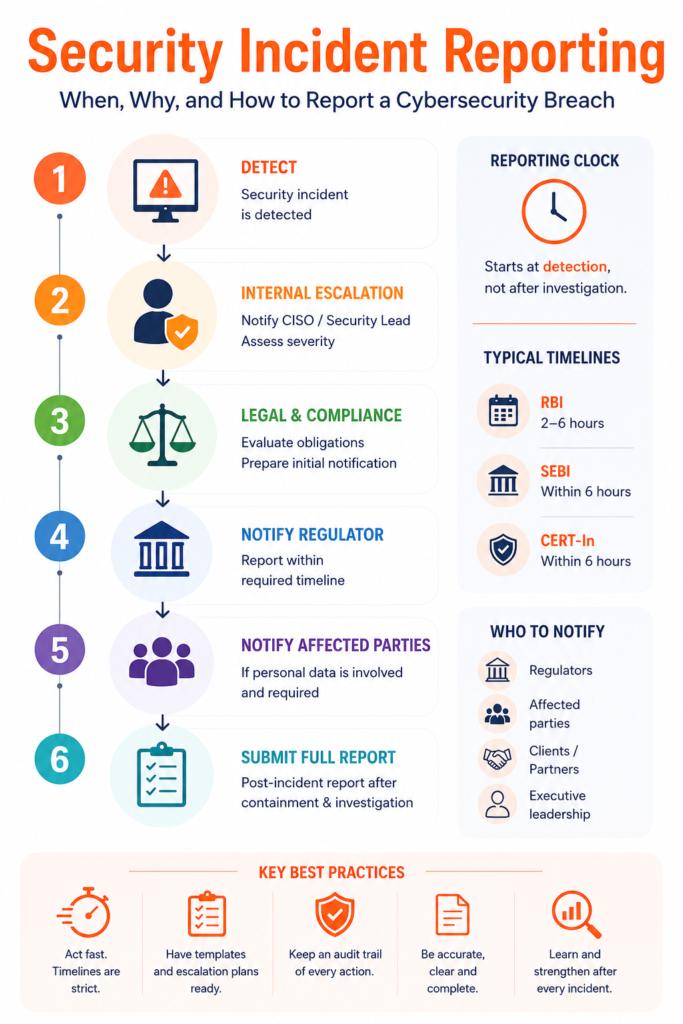
A standard escalation chain for a regulated financial institution looks like this:
Step 1: A security analyst confirms the incident and logs the initial detection record with a timestamp, systems affected, and preliminary impact assessment.
Step 2: CISO or security lead is notified within the first thirty minutes. They make the call on severity classification, which determines the external reporting timeline.
Step 3: Legal and compliance are looped in simultaneously. They assess regulatory notification obligations and draft the initial regulatory communication.
Step 4: Regulator notification is submitted within the framework’s required window. This is typically a brief initial notification, not a full incident report.
Step 5: Affected parties are notified if personal data was involved. GDPR requires notification to affected individuals without undue delay if the breach poses a high risk to their rights and freedoms.
Step 6: A full post-incident report is submitted once the incident is contained and investigated. Most frameworks expect this within thirty to ninety days.
Missing any step in this chain, or doing them out of order, can turn a manageable incident into a multi-quarter regulatory engagement.
Internal escalation that bypasses legal and compliance is one of the most common mistakes security teams make. The instinct to contain first and report later creates more problems than it solves.
What Should a Security Incident Report Contain?
A well-structured security incident report covers six core sections. These apply whether you’re submitting to the RBI, SEBI, or an enterprise client following a vendor risk assessment.
Incident summary
A two-to-three paragraph description of what happened, when it was detected, and which systems or data were involved. Write this for a non-technical reader. Regulators and senior leadership need to understand it at a glance.Detection timeline
A chronological log of key events from first alert to confirmed detection to notification. Timestamps matter here. Regulators check whether your notification was filed within the required window.Scope and impact assessment
What was accessed, modified, or exfiltrated? How many records were affected? Were third-party systems involved? Avoid estimates without supporting evidence.Containment and remediation steps
What did you do, and when? This section demonstrates your organisation’s ability to respond. It’s also where you document any evidence of the incident being stopped or contained.Root cause analysis
What allowed the incident to happen? Was it a misconfiguration, a phishing compromise, or a third-party access failure? Root cause analysis is expected in post-incident reports and often reviewed during subsequent audits.Corrective actions and forward controls
What has changed since the incident? What controls are being added or updated? This section shows regulators and clients that your organisation learns from incidents rather than just containing them.
Security questionnaires often ask vendors to describe their most recent security incident and the corrective actions taken. If your security questionnaire automation workflow includes incident history questions, this structure is exactly what you should expect vendors to provide.
The Most Common Security Incident Reporting Failures
Organisations with mature security programmes still get reporting wrong. These are the most frequent failure points.
Delayed internal escalation
Teams spend too long trying to characterise the incident before looping in legal and leadership. By the time the CISO is briefed, the regulatory window has already narrowed.No pre-approved notification template
Drafting regulatory communications from scratch during an active incident is slow and error-prone. Organisations without pre-approved templates consistently file late or incomplete notifications.Inconsistent severity classifications
The same event gets classified differently by the security team and the compliance team. Without a shared severity matrix, the escalation path varies every time.Incomplete post-incident reports
Initial notifications are filed on time, but follow-up reports are vague, lack root cause analysis, or omit corrective actions. Regulators treat this as evidence of an immature incident management programme.No audit trail
Documentation of who was notified, when, and via what channel is often missing. During a regulatory review, the absence of an audit trail is treated the same as a failure to notify.
If you’re running a third-party risk management programme, these are also the gaps you should be probing when you assess vendor incident management processes.
Is Your Organisation Ready to Report a Breach?
Most organisations can detect an incident. Fewer can report one cleanly.
A team that’s ready to report a breach has four things in place before an incident occurs: a defined severity classification matrix, a pre-approved internal escalation chain, draft regulatory notification templates, and a post-incident report structure. These aren’t complex documents. They take a few weeks to build and save enormous time during an active incident.
If your team doesn’t have these in place, that’s the gap to close first. The regulatory frameworks aren’t waiting for you to be ready, and neither are the incidents.
Frequently Asked Questions
What is the difference between incident response and security incident reporting?
Incident response covers the technical actions taken to contain, investigate, and recover from a security incident. Security incident reporting is the documentation and notification process that runs alongside response. Both start at the same time. Response focuses on stopping the incident; reporting focuses on informing the right people and regulators within required timeframes.
How quickly must a security incident be reported in India?
Timelines vary by framework. CERT-In requires reporting within six hours for most incident categories. The RBI requires banks and NBFCs to notify the CSITE cell within two to six hours, depending on severity. SEBI’s CSCRF also sets a six-hour window. These clocks start from the point of detection, not the point of full investigation.
What happens if we miss the regulatory reporting window?
Late notification is treated as a separate compliance failure by most regulators. It typically results in a regulatory query, which may escalate into a formal audit. The RBI and SEBI have both issued penalties for delayed incident reporting. Courts and regulators also consider late notification as evidence of inadequate incident management controls.
Does security incident reporting apply to incidents caused by third-party vendors?
Yes. If a vendor incident results in unauthorised access to your organisation’s data or systems, your organisation typically carries the reporting obligation to regulators and affected individuals. Your contract with the vendor should require them to notify you immediately so you can meet your own timelines.
What should we include in an initial regulatory notification?
Initial notifications are brief. Include the date and time of detection, a high-level description of the incident, the systems or data affected, the initial containment steps taken, and the point of contact for follow-up. A full post-incident report with root cause analysis and corrective actions is submitted after the incident is resolved.
Conclusion
Knowing what a security incident is only takes you so far. The test of your incident management programme is what happens in the first sixty minutes after detection. Teams that have documented their escalation chain, pre-built their templates, and aligned on severity classifications consistently outperform those that improvise under pressure. That preparation is rarely visible until it’s needed. Build it before the clock starts.