
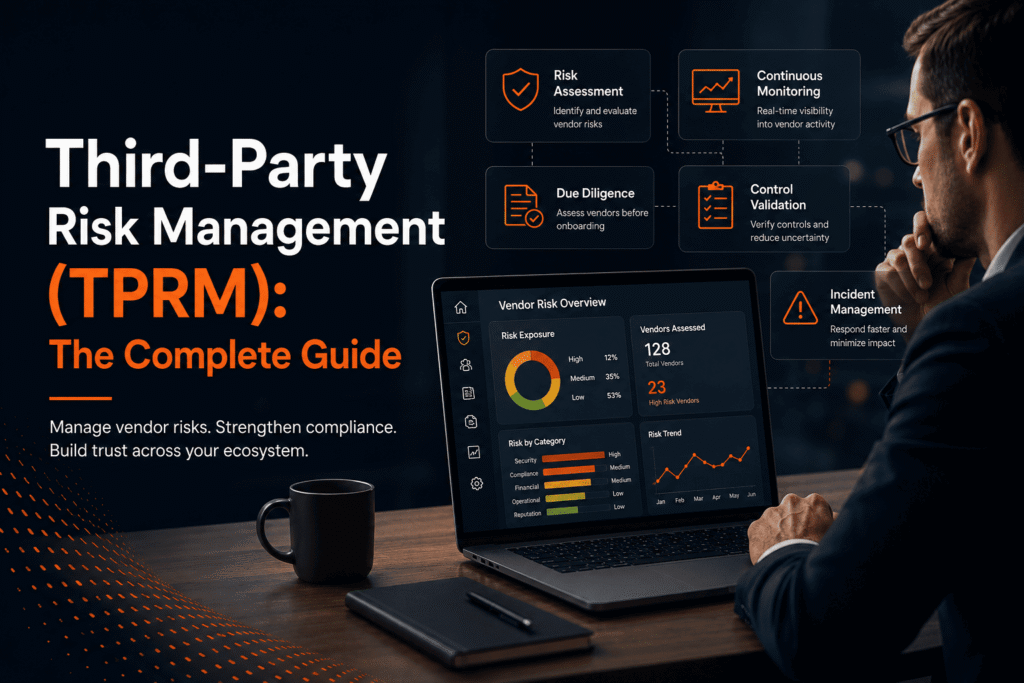
Third-Party Risk Management (TPRM): The Complete Guide
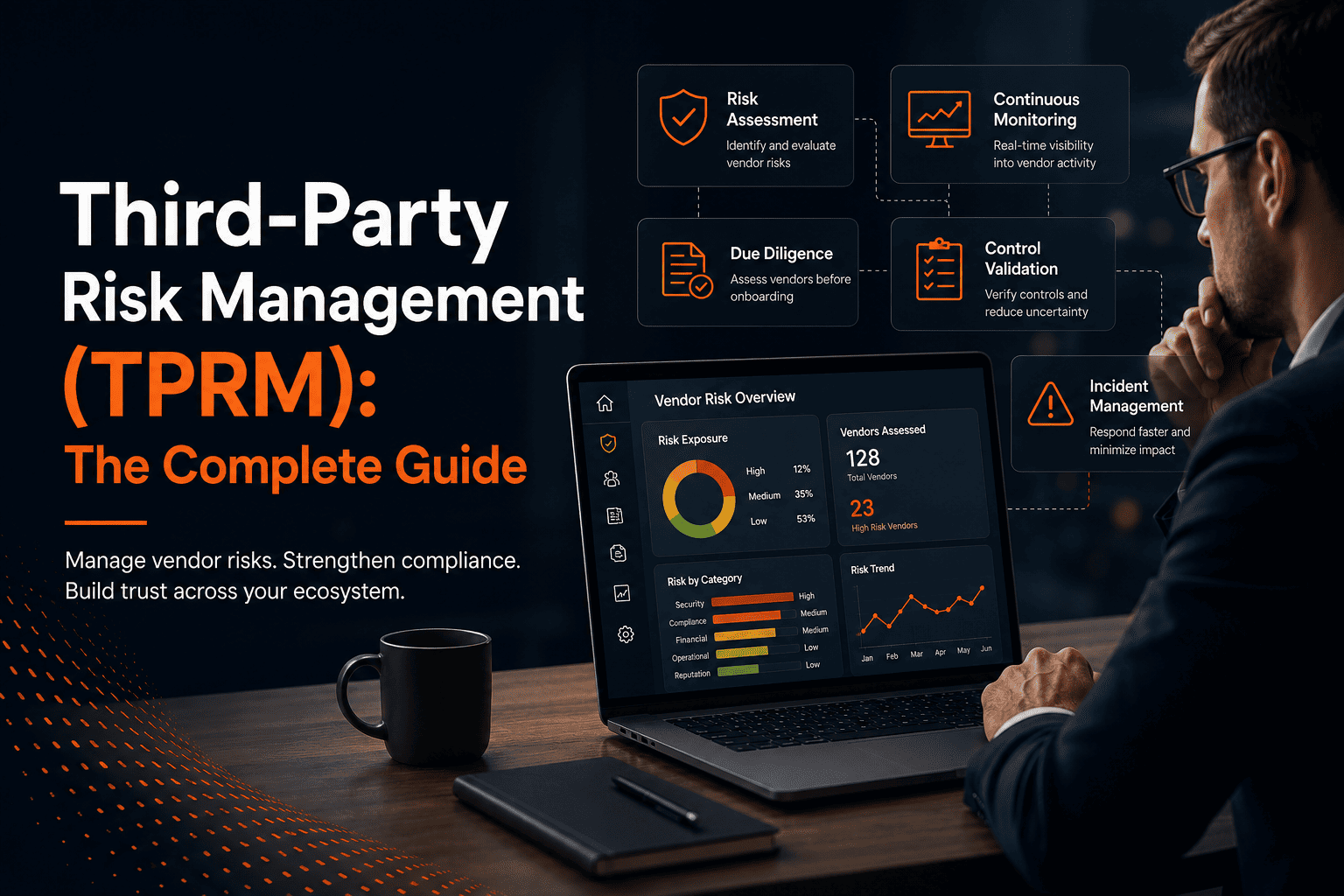
Key Takeaways
- Third-party risk management covers every vendor, supplier, contractor, and partner with access to your data or systems.
- Cybersecurity, compliance, financial, operational, and reputational risk all fall under the TPRM umbrella.
- Manual, spreadsheet-based vendor tracking breaks down once a vendor list crosses roughly 50 to 100 entries.
- A mature TPRM program runs on a repeatable lifecycle: onboarding, classification, assessment, scoring, remediation, and continuous monitoring.
- Regulators in banking, insurance, and healthcare now treat vendor oversight as a direct extension of the regulated entity’s own compliance obligations.
Introduction
Businesses today rely on dozens, sometimes hundreds, of third-party vendors. From cloud providers and payment processors to payroll systems and marketing platforms, these vendors help organisations operate efficiently. But they also introduce risk. According to the NIST Cybersecurity Framework (CSF) 2.0, organisations should manage cybersecurity risks arising from suppliers, customers, and partners as part of their overall governance strategy.
A security incident at one vendor can quickly affect every business that depends on it. That’s why Third-Party Risk Management (TPRM) has become a critical part of modern cybersecurity and compliance.
TPRM is the process of identifying, assessing, and continuously monitoring the risks that vendors, suppliers, and other external partners bring to your organisation. Instead of treating vendor reviews as a one-time procurement task, effective TPRM makes risk management an ongoing process throughout the vendor relationship.
In this guide, you’ll learn:
- What Third-Party Risk Management (TPRM) is
- Why it’s more important than ever
- The different types of third-party risks
- The complete TPRM lifecycle
- Best practices for building a mature TPRM program
- How automation can simplify vendor risk management at scale
Whether you’re a compliance manager, procurement professional, security leader, or risk officer, this guide will help you understand how to build a TPRM program that protects your business as your vendor ecosystem continues to grow.
What Is Third-Party Risk Management?
Third-party risk management is the structured process of identifying, evaluating, and monitoring the risks that arise when an organisation works with an outside entity. That entity could be a software vendor, a payment processor, a logistics partner, a marketing agency, or a subcontractor. If they touch your data, your systems, or a process your customers depend on, they fall inside the scope of TPRM.
At its core, TPRM answers three questions on a continuous basis:
- Who are our third parties, and what do they have access to?
- What could go wrong with each relationship, and how likely is it?
- Are the controls we agreed on actually in place today, not just at signing?
Why Every Organization Needs TPRM
Modern businesses are built on outsourced infrastructure. A fintech company might rely on a cloud provider for hosting, a KYC vendor for identity verification, a payment gateway for transactions, and a customer support platform for service. Each of these relationships is a door into the organisation’s environment. TPRM is how a company keeps track of every door and checks that each one is still locked the way it was supposed to be.
Without a formal program, organisations tend to discover vendor risk reactively, usually during an audit, a breach, or a regulatory examination. By then the exposure has often already existed for months or years.
Difference Between Vendor Management and TPRM
Vendor management and third-party risk management are related but not identical. Vendor management is broader and covers the full commercial relationship: contracts, pricing, service levels, and performance. Third-party risk management is a subset that focuses specifically on the risk dimension of that relationship, security posture, compliance status, financial stability, and operational resilience.
A vendor manager might track whether a supplier delivered on time. A TPRM analyst tracks whether that same supplier still holds a valid SOC 2 report and hasn’t had an unpatched vulnerability sitting open for six months.
The two functions frequently sit in different departments entirely. Vendor management often reports through procurement or operations, while TPRM typically reports through compliance, risk, or information security. In mature organisations, these two functions coordinate closely, since a vendor’s commercial terms and its risk profile both need to be evaluated together before a contract is finalised. A vendor offering an attractive price but a weak security posture is not actually a good deal once the potential cost of a breach is factored in.
Learn more in our dedicated guide: TPRM Meaning: What Is Third-Party Risk Management?
Why Third-Party Risk Management Matters
TPRM has moved from a nice-to-have to a board-level expectation over the past several years, driven by five converging pressures. Each of these pressures existed to some degree before, but their combined weight is what has pushed vendor oversight out of the compliance back office and into regular conversations at the executive and board level. Here are some reasons why third-party risk management is becoming extremely important in today’s time:
Regulatory Expectations
Financial regulators, including the RBI in India and equivalent bodies globally, have issued explicit guidance stating that outsourcing an activity does not outsource accountability. If a regulated entity’s vendor mishandles customer data, the regulated entity is still held responsible. This shift means TPRM is no longer optional documentation; it is an examinable control.
Examiners now routinely request evidence that a regulated entity’s TPRM program is operating in practice, not just described in a policy document. This typically means producing records of vendor risk assessments, remediation tracking for identified gaps, and proof of ongoing monitoring for critical vendors. An organisation that can only show a policy document, with no evidence of the actual process running, faces the same scrutiny as one with no program at all.
Cybersecurity
Attackers have learnt that the easiest way into a well-defended target is through a poorly defended vendor. Supply chain attacks, where a trusted vendor’s software or credentials are used to reach the real target, have grown sharply in frequency because they bypass an organisation’s own perimeter entirely. A well-funded internal security team offers limited protection if the attacker simply walks in through a vendor’s weaker access controls instead.
Vendor Breaches
High-profile incidents involving IT management software, payment processors, and cloud storage providers have shown that a single compromised vendor can cascade across thousands of downstream companies simultaneously. The blast radius of a vendor breach is rarely contained to one customer.
These incidents also tend to surface a second, quieter problem: many affected organisations did not know they were exposed until well after the initial disclosure, simply because they had never mapped which of their vendors relied on the compromised software or service. A functioning TPRM program shortens that discovery window significantly since it maintains an accurate picture of vendor dependencies before an incident forces the question.
Business Continuity
If a critical vendor goes down, whether from a cyber incident, a natural disaster, or simple insolvency, the services that depend on that vendor go down too. TPRM programs increasingly assess a vendor’s resilience and continuity planning, not just their security controls, including whether the vendor has a tested disaster recovery plan and realistic recovery time objectives.
Enterprise Trust
Large enterprise customers now routinely ask their vendors to prove they manage their own third-party risk. A company that cannot answer basic questions about its vendor oversight program risks losing deals before the sales conversation even gets serious.
This dynamic has created a chain effect across entire industries. As large enterprises demand proof of vendor oversight from their direct suppliers, those suppliers in turn demand the same proof from their own vendors. The result is that a strong TPRM program has become a genuine sales asset in procurement conversations, not just a defensive control.
Read the full breakdown: Why Is Third-Party Risk Management Important?
Types of Third-Party Risks
A mature TPRM program does not treat all vendors as the same risk. It categorises risk across several distinct dimensions, since a vendor that scores well on one dimension can still be a serious liability on another. It’s very important to assess each of these risks:
Cybersecurity Risk
This covers the vendor’s exposure to breaches, weak access controls, unpatched systems, and poor data handling practices. It is usually the most heavily assessed category because it has the most direct and immediate impact. Assessment here typically looks at how the vendor manages access controls, encrypts data in transit and at rest, patches known vulnerabilities, and responds to incidents when they occur.
Compliance Risk
A vendor that fails to meet regulatory or contractual obligations, such as data localisation rules or industry-specific standards, exposes your organisation to fines and enforcement action even if your own systems were never touched. This category matters most for vendors handling regulated data, such as customer financial records or health information, where the compliance obligations attached to that data follow it wherever it goes.
Financial Risk
A vendor in financial distress may cut corners on security investment, delay critical patches, or fail outright, leaving your organisation scrambling for a replacement mid-contract. Financial risk assessment typically involves reviewing a vendor’s financial statements or credit reports for critical relationships, particularly ones where switching vendors quickly would be operationally difficult.
Operational Risk
This covers a vendor’s ability to consistently deliver the service you depend on, including their own subcontractors, staffing, and infrastructure resilience. A vendor with a single point of failure in their own operations, such as one data centre with no failover, carries higher operational risk than one with redundant infrastructure.
Reputational Risk
If a vendor is involved in a public incident, whether a breach, a labour dispute, or a compliance violation, that association can damage your organisation’s reputation even when you were not directly at fault. Customers and media rarely draw a fine distinction between a company’s own failure and a vendor’s failure when the impact reaches the end user.
Fourth-Party Risk
Your vendors have their own vendors. A cloud provider your SaaS tool relies on, or a subcontractor your logistics partner uses, sits one level removed from your direct oversight but can still expose you to risk. This is one of the most commonly overlooked categories in TPRM programs, largely because most organisations lack any visibility into their vendors’ own vendor relationships, and few contracts require that visibility to be disclosed.
Go deeper here: Fourth-Party Risk Management Explained
Third-Party Risk Management Lifecycle
A repeatable TPRM program moves through the same stages for every vendor relationship, whether it is a small marketing tool or a critical payment processor. Understanding this lifecycle in detail is what allows a risk team to build a program that scales, rather than one that collapses under its own manual weight once vendor count grows.
1. Vendor Onboarding
Before a contract is signed, the vendor should go through an initial risk screening. This determines what tier of due diligence the relationship requires and sets the baseline for everything that follows. Onboarding is deliberately positioned before signing, since it is far cheaper to walk away from or renegotiate a risky vendor relationship at this stage than to remediate it after systems are already connected.
2. Vendor Classification
Not every vendor deserves the same scrutiny. Classification tiers vendors by criticality and data access, so a payroll processor gets a deeper assessment than a stationery supplier. A common approach uses three or four tiers, ranging from critical vendors with access to sensitive systems or regulated data down to low-risk vendors with no meaningful access at all. This tiering directly determines both the depth of the initial assessment and how frequently the vendor is reassessed going forward.
3. Risk Assessments
This is where the organisation gathers evidence: security questionnaires, SOC 2 or ISO 27001 reports, penetration test summaries, and policy documentation. The goal is to verify that the vendor’s actual controls match what they claim. A well-designed assessment is proportional to the vendor’s tier, since sending a two-hundred-question security assessment to a low-risk vendor wastes time on both sides without materially improving the risk picture.
4. Control Validation
Evidence collection alone is not enough. Control validation checks that the certificates and attestations submitted are current, scoped correctly, and actually cover the systems relevant to your relationship. It is common for a vendor to submit a SOC 2 report that covers an entirely different product line than the one your organisation actually uses, and catching this mismatch requires deliberate review rather than a quick glance at the document’s cover page.
5. Risk Scoring
Once assessments are complete, the vendor is assigned a risk score that reflects the combined likelihood and impact of the risks identified. This score drives prioritisation and determines reassessment frequency. A standardised scoring methodology, applied the same way across every vendor, is what makes the resulting score genuinely useful for comparing risk across a portfolio rather than reflecting the mood of whichever analyst happened to review it.
6. Remediation
Where gaps are found, the vendor is given a remediation plan with clear deadlines. Tracking these plans to closure is one of the most consistently under-resourced parts of manual TPRM programs, since it requires ongoing follow-up rather than a single point-in-time review. A remediation item that is opened but never closed provides no real risk reduction, regardless of how well the initial assessment identified it.
7. Continuous Monitoring
A vendor’s risk posture does not stay static after the initial assessment. Continuous monitoring tracks changes, new vulnerabilities, expired certifications, and breach disclosures, so risk teams are not relying on a snapshot that is a year out of date. This is increasingly viewed as the difference between a genuinely effective TPRM program and one that only looks effective on paper during an annual review.
Narad automates the assessment, scoring, and continuous monitoring stages of this lifecycle, replacing manual questionnaire cycles with AI-driven evidence review that updates in near real time. See how Narad’s TPRM platform works.
Common Vendor Risk Management Challenges
Most organisations run into the same set of obstacles as their vendor list grows: no single source of truth for who their vendors even are, assessments that take weeks to complete manually, inconsistent scoring between analysts, and monitoring that happens once a year instead of continuously. These challenges compound as vendor counts scale, and they are the primary reason organisations eventually move away from spreadsheet-based tracking. Recognising which of these challenges is currently holding a program back is usually the fastest way to identify where to invest first.
Full breakdown here: Vendor Risk Management Challenges (And How to Solve Them)
Manual vs Automated TPRM
Why Spreadsheets Fail
Spreadsheets work fine for five vendors. They start to fail around the 30 to 50 vendor mark, when questionnaire responses live in scattered email threads, evidence documents get lost in shared drives, and nobody can say with confidence which vendors are actually overdue for reassessment.
The core problem is not the spreadsheet itself; it is that spreadsheets have no memory. They cannot flag an expiring certificate, cannot cross-reference a vendor’s claimed controls against submitted evidence, and cannot alert a risk owner when a vendor’s public breach disclosure appears. Every one of these gaps has to be filled by a human remembering to check manually, and that approach reliably breaks down as the vendor list grows past what one or two analysts can track in their heads.
Benefits of Automation
Automated TPRM platforms remove the manual bottleneck at every stage of the lifecycle. Questionnaires are pre-filled using AI trained on prior responses and evidence libraries. Evidence documents are parsed automatically to flag gaps or expired certifications. Risk scores update as new information arrives instead of sitting frozen until the next annual review.
For teams managing hundreds of vendors, automation is not a convenience; it is the only way the program stays accurate.
Check out narad’s security questionnaire automation here.
How to Choose a TPRM Platform
The right platform should reduce assessment cycle time, centralise vendor evidence in one place, and support continuous monitoring rather than point-in-time reviews. Look for AI-assisted questionnaire completion, integration with existing GRC and procurement tools, and clear audit trails that hold up under regulatory scrutiny. It is worth evaluating platforms on how they validate evidence, not just how they collect it, since collection without validation simply digitises the same trust-but-don’t-verify problem spreadsheets already had.
Full buying guide: How to Choose the Best Third-Party Risk Management Software
Metrics That Matter in a TPRM Program
A successful TPRM program isn’t just about completing vendor assessments—it’s about measuring how well your program is reducing risk over time.
Tracking the right Key Performance Indicators (KPIs) helps security, compliance, procurement, and executive teams understand the health of the vendor ecosystem. These metrics also provide the evidence auditors and regulators often ask for during compliance reviews.
Here are the key metrics every TPRM program should monitor.
1. Percentage of Critical Vendors That Are Compliant
Not every vendor carries the same level of risk. Critical vendors, those with access to sensitive data or business-critical systems, should always meet your organisation’s security and compliance requirements.
This metric shows:
- How many critical vendors have completed their required assessments
- Whether they have submitted the necessary documentation
- Whether they currently meet your security standards
A high compliance percentage indicates that your highest-risk vendors are being actively managed rather than overlooked.
2. Average Vendor Assessment Cycle Time
This measures how long it takes to complete a vendor risk assessment, from sending the questionnaire to approving the vendor.
Long assessment cycles can:
- Delay vendor onboarding
- Slow down business operations
- Create frustration for procurement teams
- Increase administrative workload
Organisations using spreadsheets and email often take weeks or even months to complete assessments. Automated TPRM platforms can significantly reduce this time by automating questionnaires, evidence collection, reminders, and workflows.
3. Number of Open Remediation Actions
Finding risks is only the first step. What matters is whether those risks are actually being fixed.
Track:
- Total open remediation items
- High and critical severity issues
- Average time taken to resolve findings
- Percentage of overdue remediation tasks
If remediation items continue to grow, your organisation may be identifying risks faster than it can address them.
4. Vendors Overdue for Reassessment
Vendor risk changes over time. A vendor that was secure last year may no longer meet your security requirements after changes to its infrastructure, ownership, or threat landscape.
This metric identifies vendors whose periodic reviews are overdue.
Monitoring overdue reassessments helps ensure:
- Risk assessments remain current
- Internal policies are being followed
- Compliance requirements are met
- Auditors can verify ongoing vendor oversight
Many regulators expect organisations to reassess high-risk vendors annually or whenever significant changes occur.
5. High-Risk Vendors Without Active Mitigation Plans
Some vendors will inevitably be classified as high risk. The important question is whether those risks are being actively managed.
Track:
- Number of high-risk vendors
- Vendors with approved mitigation plans
- Vendors awaiting remediation
- Vendors that should be escalated for executive review
This metric helps leadership understand where the greatest exposure exists.
6. Vendor Inventory Coverage
You can’t manage risks you don’t know about.
Measure:
- Total active vendors
- Vendors that have completed assessments
- Vendors awaiting onboarding reviews
- Vendors missing ownership or risk classification
Maintaining a complete vendor inventory ensures every third party is included in your TPRM program.
7. Continuous Monitoring Alerts
Modern TPRM doesn’t stop after onboarding.
Track the number of:
- Security rating changes
- Data breach notifications
- Expired certifications
- Compliance status changes
- Critical vulnerabilities affecting vendors
Continuous monitoring allows organisations to detect emerging risks before they become business incidents.
8. Third-Party Incidents
Ultimately, one of the most important indicators of TPRM effectiveness is the number of security incidents involving vendors.
Examples include:
- Data breaches
- Service outages
- Compliance violations
- Supply chain attacks
- Unauthorized access through third parties
Reviewing these incidents helps identify trends and improve future vendor assessments.
Why These Metrics Matter
Tracking these metrics consistently transforms TPRM from a one-time compliance exercise into an ongoing risk management program.
They enable organizations to:
- Measure the effectiveness of their TPRM program
- Identify bottlenecks and improve efficiency
- Prioritize remediation efforts
- Demonstrate compliance during audits
- Provide executives with meaningful risk insights
- Make informed decisions about vendor relationships
Rather than relying on intuition, these KPIs give leadership a clear, data-driven view of third-party risk across the organization. Mature organizations review these metrics regularly through dashboards, enabling them to respond proactively as vendor risks evolve.
Also Read: Third-Party Risk Management Best Practices
How Narad Helps
Narad is an AI-powered platform built to remove the manual burden from third-party risk management. It automates security questionnaire completion using a continuously updated evidence library, validates vendor-submitted certifications against their actual scope, and monitors vendor risk posture continuously instead of once a year.
For compliance and security teams in banking, NBFCs, fintech, and other regulated industries, Narad turns a process that used to take weeks per vendor into one that takes hours without sacrificing the audit trail regulators expect. See Narad’s TPRM platform in action.
The platform is designed around the same lifecycle described throughout this guide, from initial vendor classification through continuous monitoring, so teams do not need to rebuild their process from scratch to adopt it. Instead, the manual steps that consume the most time, chasing questionnaire responses, cross-checking evidence, and tracking remediation deadlines, are handled automatically, while risk owners retain full control over final decisions and exceptions.
FAQ
1. What is the difference between TPRM and vendor risk management?
They are largely used interchangeably in practice, though TPRM is the broader umbrella term that includes vendor risk management alongside supplier, contractor, and partner risk.
2. How often should third-party risk assessments happen?
Critical vendors should be reassessed at least annually, with continuous monitoring in between. Lower-risk vendors can follow a lighter, less frequent cycle based on their classification tier.
3. Who owns TPRM inside an organisation?
Ownership typically sits with the compliance, risk, or security team, but execution requires input from procurement, legal, and IT since vendor relationships touch all of these functions.
4. Can small companies skip formal TPRM?
Even small companies benefit from a lightweight version of TPRM, since a single critical vendor failure can be disproportionately damaging to a smaller organisation with less redundancy.
5. What tools do companies use to run TPRM programs?
Programs range from basic spreadsheets at the smallest scale to dedicated TPRM platforms like Narad that automate assessment, evidence validation, and continuous monitoring for organisations managing larger or higher-risk vendor portfolios.
Conclusion
Third-party risk management is no longer a back-office compliance exercise; it is a frontline defence against the breaches, regulatory penalties, and business disruptions that increasingly originate outside an organisation’s own walls. Building a repeatable lifecycle, from onboarding through continuous monitoring, is what separates organisations that catch vendor risk early from those that find out about it in an incident report.
The guides linked throughout this article go deeper into each stage of that lifecycle. Start wherever your program has the biggest gap today.